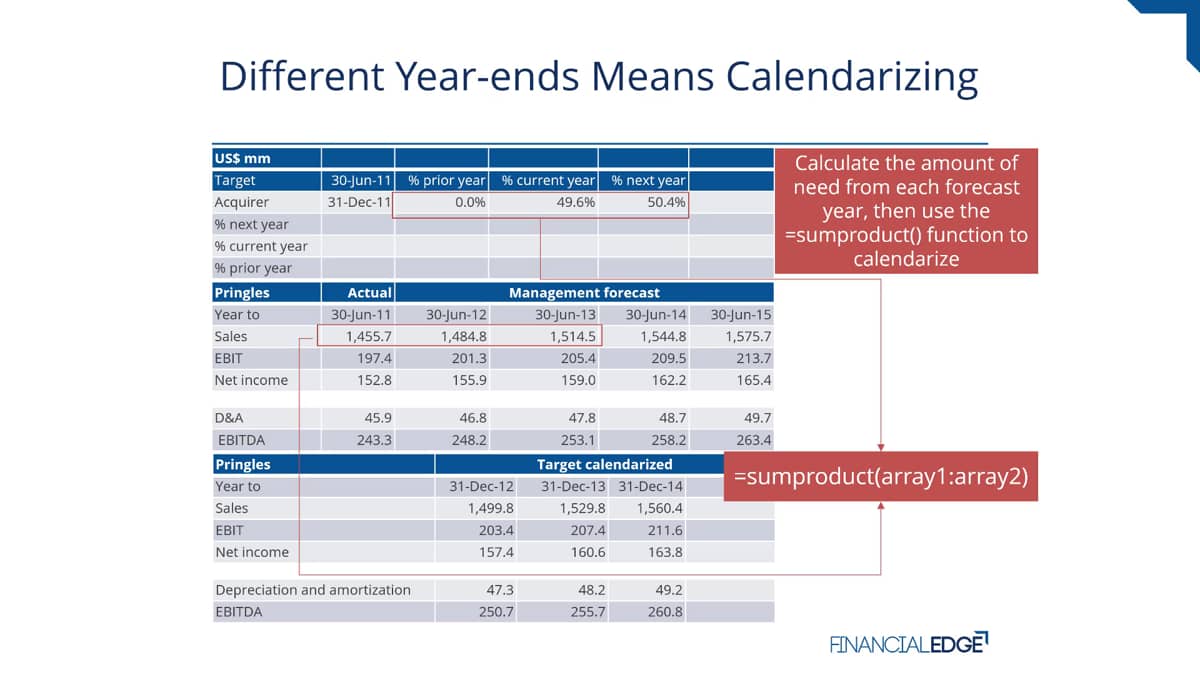
When an acquirer company and a target company have different year ends, if we want to consolidate those companies, we're gonna need to calendarize their figures.
So here at the bottom we've got Pringles, and we've got their figures calendarized to the 31st of December each year.
The problem is that their actual figures and management forecasts at the moment only run to the 30th of June each year.
So we need to somehow take them from the 30th of June and create figures that go to the 31st of December.
In order to do this, what we're gonna do is we're gonna take three years.
We're gonna take a percentage from the prior year, current year, and next year.
Let's take the calendarized year end of 31st, December 12 as our example.
If I want the 12 months up to the 31st December 12, I don't need any figures at all from the 30th of June 11.
So if we look at the very top inside, that red box, the prior year has a 0% underneath it because I don't need any of the figures from 30th of June 11.
If I'm trying to calculate figures to the 31st, December 12, then 2012 is going to be my current year.
How much of Pringle's, 2012 figures do we want? Well, I look at their 30th of June, 12 figures, and I want about 50% the actual figures, 49.6 we can see at the top.
And then I ask, what percentage do I need of their next year figures, the 12 months to the 30th of June 13? Well, I need the January to June from that, and that is 50.4%.
If I take those three percentages at the top and the three sales figures to the 30th of June 11, 12, and 13, and we multiply them together using the sum product function, and that will get us the Calendarized figures.
If we look at the year to 31st, December 12, look at the sales of 1499.8.
That is just about halfway between their sales at the 30th of June 12th, 1000 484.8, and the 30th of June 13, 1,514.
The Calendarized figure looks like it's in the middle of those two figures.