Traditional life insurance workout.
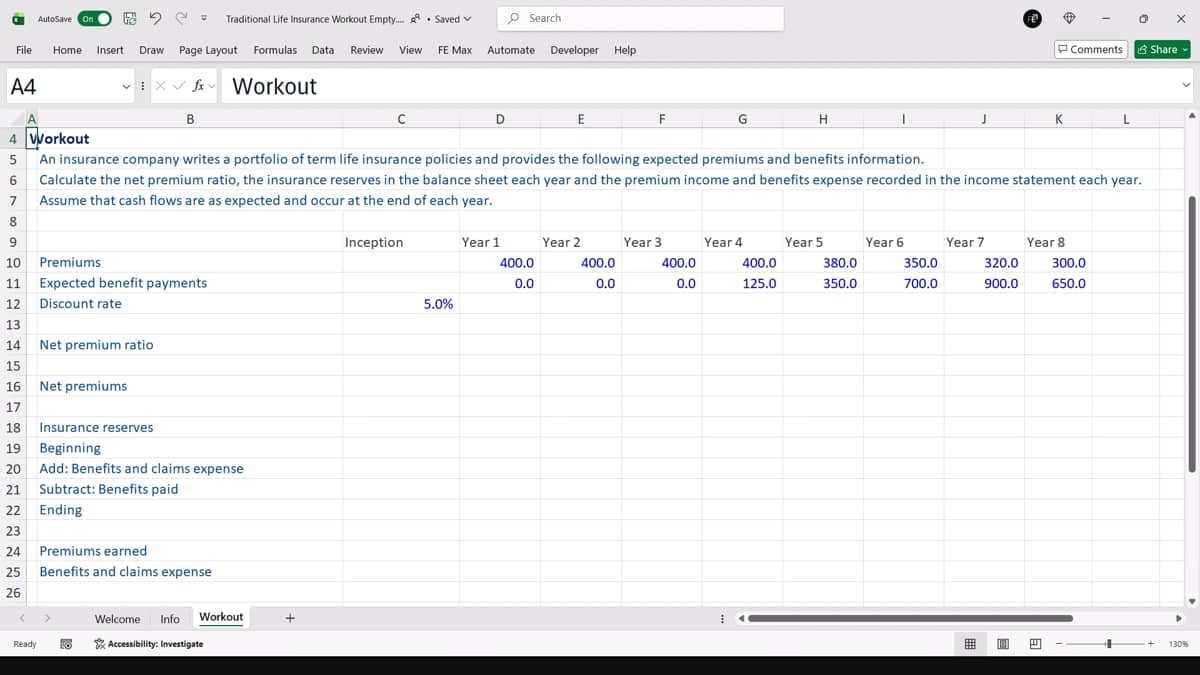
In this workout, we're told that an insurance company writes a portfolio of term life insurance policies and provides the following expected premiums and benefit information.
We're asked to calculate the net premium ratio, the insurance reserves in the balance sheet each year, and the premium income and benefits expense recorded in the income statement each year.
Now, we'll assume that cash flows are as expected and that they occur at the end of each year, and we're going to use the discount rate provided of 5%.
Let's start with calculating the net premium ratio.
That's the ratio of the present value of expected benefits and claims to the present value of premiums. So we can think of this as the expected loss ratio. And we're going to use the NPV function for this.
Grab the discount rate and then select all of the benefit payments and divide that by the PV of the premiums.
And that gives a net premium ratio of 82.2%.
The next step is to apply this net premium ratio to the gross premiums.
This effectively tells us how much the premium received each year is needed to cover the expected future benefits and claims.
So we're going to multiply the net premium ratio, and I'll lock my reference to that so I can reuse the formula, by the gross premiums each year.
And that gives me net premiums of 328.8 in the first year.
Now roll forward that calculation.
The next step is to calculate the insurance reserves each year.
We calculate these as the present value of the expected benefits and claims, less the present value of the net premiums. And again, we'll use the NPV function for this calculation.
Now, first of all, I've locked quite a few of the cell references there.
That's just to help me roll forward the formulas.
I also selected cash flows beyond the end of the policy.
That just means when I roll forward my formulas, they still work even in the final year.
The final thing to notice is that at inception, the reserves are zero, which is what we should expect, because reserves show us the extent to which future claims and benefits exceed the future net premiums, those premiums that are needed to cover the benefits.
And at inception, well, the present value of the future claims are equal to the present value of the net premiums.
Now, if we roll forward that calculation by one year, we get a reserves balance at the end of the first year of 328.8, and that's because we received 400 of gross premium, of which 328.8 is needed for future claims. So effectively, we had to reserve that amount of premium to cover those claims. The next step is to fill in the rest of the reserve movements, and the ending balance from the previous year becomes the beginning balance in the next year.
We then subtract the benefits actually paid each year.
And finally, the benefits and claims expense, which is a plug.
The increase in reserves, less the benefits paid each year is the expense.
So unsurprisingly, in year one, the benefits and claims expense is 328.8. That's the increase in the reserves of that year, as no benefits are actually paid in year one.
Now let's roll forward our calculations.
And when we do, we can see that the reserves build as premiums are received and then fall as benefits are paid out, until they reach zero at the end.
Now let's identify the premium income and claims expense.
The premium income is the gross premium that's received each year.
And the claims expense is taken from our reserves calculation.
Now, note that I can actually disaggregate this claims expense into two components. There's the net premium and there's the interest accretion on reserves. That's the discount rate applied to the beginning reserves balance. Let me show you that.
This helps us to see that the net premium approach ensures that the claims expense is 82.2% of premium income, plus the interest accretion from the effects of discounting.
So the net premium approach is a way of matching premiums and claims for traditional life insurance.

 Traditional Life Insurance Workout Empty