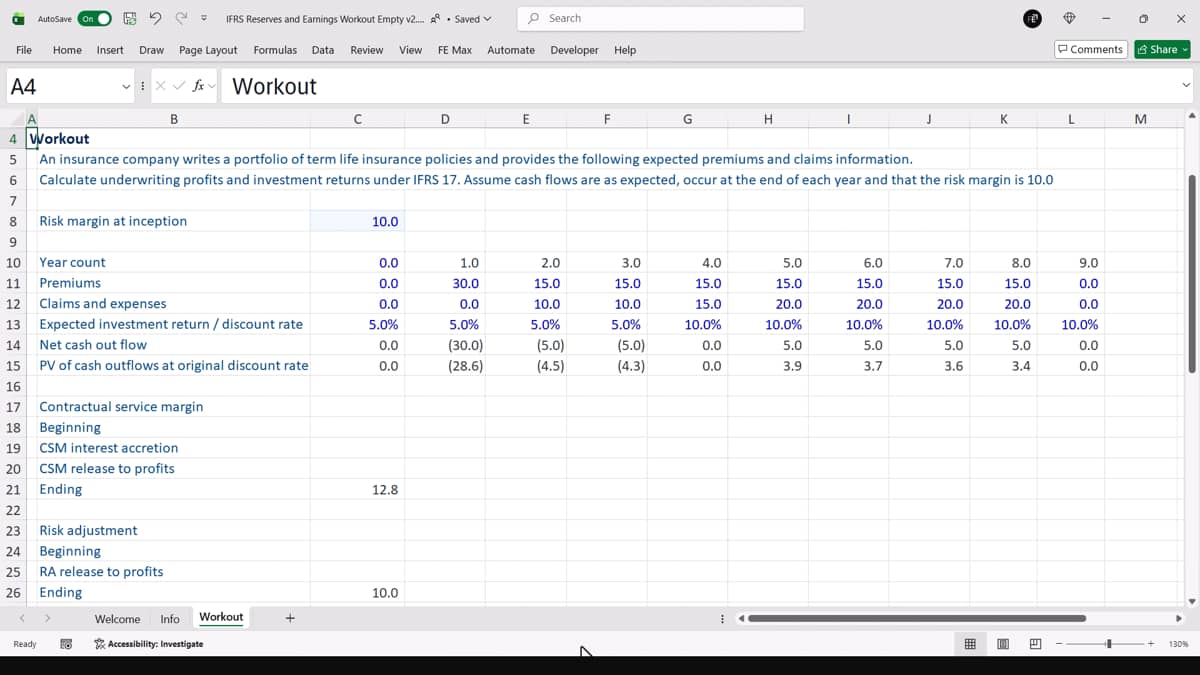
In this workout, we're told that an insurance company writes a portfolio of term life insurance policies and provides premiums and expected claims information below. We're asked to calculate underwriting profits and investment returns under IFRS 17, and we'll assume that cash flows are as expected and occur at the end of each year.
We'll also assume that the risk margin is 10.
Now, we've already been given the net cash flows in the contract each year. We also have the CSM balance, the risk margin, and the PV of the cash flows.
So those are already provided to us, and that makes our life a little bit easier.
So the first thing that we're going to do is the calculations for the contractual service margin, which we're just going to refer to as the CSM.
Now, this is going to roll forward each year, and we'll start with the prior year ending balance.
Now, each year, this balance is going to increase because of interest accretion.
Remember that the CSM is a discounted figure.
So we're going to multiply the beginning balance by the discount rate at the start of the contract.
This is a locked-in discount rate.
It doesn't change regardless of what happens in the market.
And that gives a CSM accretion of 0.6.
The next step is to calculate the CSM that's released to profits each year, and that's released as the insurance cover is provided.
Now, the method that we'll use here is to assume that the claims and benefits paid each year as a proportion of the total expected benefits and claims, that's going to unlock the CSM.
So I'll start by calculating the CSM balance, and that's the beginning balance plus the interest accretion, and then multiply this by the claims and expenses in the year, divided by the sum of the total undiscounted claims and expenses.
And I'm just going to lock that final cell reference so I can reuse my formula.
And then I'm going to multiply that by minus one because I want the profit to be released into the income statement.
And I can then sum my base calculation to give the ending balance on my CSM of 13.5 at the end of year one.
I can then roll forward my calculations all the way to the end, and I'm only going to do it to the end of year eight because there's no cash flows in year nine, and that gives me my CSM calculation.
And you can see how the CSM is being released in line with the claims and expenses that occur each year, and that by the end of the policies, there is no CSM balance left.
It's all been released to the income statement.
Now, the next step is to calculate the risk margin each year, and this is going to be very similar to the CSM calculation, but there is no discounting. Okay, so we are going to release the risk adjustment or the risk margin to the income statement each year using the same methodology as the CSM, but there is no interest accretion this time.
So I identify, first of all, the beginning risk margin.
I then calculate the amount that's released each year, and that's based on the claims divided by the total expected claims.
And then we sum the beginning balance and the amount released to give the ending balance.
And just like with the CSM calculation, we're going to roll that forward to the end of the policies.
And again, we have the risk adjustment or the risk margin being released to profits each year as the policies are paid out, and by the end of the policies, that risk adjustment is zero. The final step is to calculate the present value of the cash flows in the contract.
And again, we'll start by identifying the beginning balance, which is based on the prior year ending balance.
Now, just a quick note, that ending balance, that's the present value of the cash flows. Okay. We can see in that calculation we've used the NPV function, but note that we're using the actual discount rate each year.
So that's going to update whenever there's a change in market interest rates.
That's going to affect the NPV of the cash flows in the insurance contracts.
Now, the next step is to subtract the net cash outflows because any cash outflows are effectively the insurance company settling the liability.
And that's shown as a positive here because we effectively receive some premiums, which increases the liability because those are going to start off as unearned premiums.
The next step is to calculate the interest accretion on the cash flows, because these are discounted, so over time, that discount will unwind.
And we're going to take the beginning balance and we're going to multiply that by the prior year discount rate. And this is going to update each year as market rates change, but we'll assume that the discount rate from the previous year is enforced until right at the end of each year.
I'm going to leave the next line blank. We're going to come back to this.
So the next step is just to roll forward the NPV of the contract cash flows, and that's just reusing the formula that we were already provided.
I can now roll forward my calculations all the way to the end of the contract, and we can now go back and explore row 32.
Now, this needs to show the effect of the change in the discount rate.
So when the discount rate changes, that's going to affect the present value of the cash flows, and this is going to be captured within this line here, this effect of that change.
Now we can calculate that explicitly or what we're going to do here is effectively calculate this as a plug. The movement in all the items relative to the actual ending balance.
And we get zero in that first year, and that's because there is no discount rate change. But when we roll forward the calculation, we can see that actually in year four, that's the year where we get the effect of a discount rate change, and that's because in year four, as you can see in row 13, that's the year when the discount rate does change. It changes quite dramatically here.
That's really just to kind of really demonstrate, quite visibly what's going on with the valuation. The next step is to calculate the insurance contract liability, and this is very straightforward.
As you can see, it's being calculated at inception as the contractual service margin plus the risk adjustment plus the present value of the cash flows. And we can just simply roll forward that calculation to the end of the policies.
And as you can see, this liability grows initially as the premiums are received and then falls as the claims are paid out and as the CSM and risk adjustment are released to the income statement.
The final balance sheet calculation is the investments balance, and that starts at zero, and that's going to become our beginning investments balance in the next year.
Now, this beginning balance is going to generate an investment return.
An investment return is the beginning balance multiplied by the discount rates from the previous year.
And unsurprisingly, that gives us an investment return of zero in that first year.
We then need to add any cash flow that comes in, and we've got the net cash flow above.
Change the sign on that because we want the premium income to be shown as a positive in our investments balance.
And when we add together the investment returns and the cash flows, we have our ending investments balance of 30.
Now let's roll forward our calculation to the end of the policies.
So that's all the balance sheet calculations.
We now need to extract the income statement numbers from this.
We start with the underwriting profits, which under IFRS are referred to as our insurance service result, or within that, the insurance service revenue, and that's the contractual service margin and the release of the risk adjustment. So we just need to pluck those numbers from our calculations above.
So that's our insurance service revenue, and if we just pause there just to look at the profile of the profit recognition here, you can see that both the CSM and the release of the risk adjustment peaks when most of the claims are being paid out, that's later in the policy.
We now need to calculate the investment returns or the investment result, and that's firstly the return on the investments from our calculations above.
However, we also need to deduct the interest cost on the insurance liabilities. That includes the interest accretion on the cash flows plus interest accretion on the CSM.
These are effectively the cost of the insurance company holding insurance liabilities to generate an investment return, and the net investment result is going to be the difference between the actual return and that interest cost.
The final entry that we need to make is the effect of the discount rate change, which we've completely ignored up until now.
Now we have it identified within our present value of our cash flows.
That's in row 32. But under IFRS, there is a choice as to where to present that effect.
It can either be included within the investment result, or it could be included within other comprehensive income. That's OCI.
So why does IFRS offer that choice? Well, it allows the insurance companies to offset where the gains on fixed income investments are recorded.
If most of the fixed income investments are recorded at fair value through profit and loss, then the insurance company is likely to choose to include any discount rate change effects within the investment result also in the income statement. Whereas if most of the investments are recorded at fair value through other comprehensive income, the insurance company is likely to choose to include discount rate changes in other comprehensive income as well. This helps to reduce earnings volatility.
So let's grab the figure from row 32.
Reverse the sign so that any increase in discount rate is going to be shown as a gain.
And there we have the reserves and earnings calculations under IFRS using the general model.

 IFRS Reserves and Earnings Workout Empty