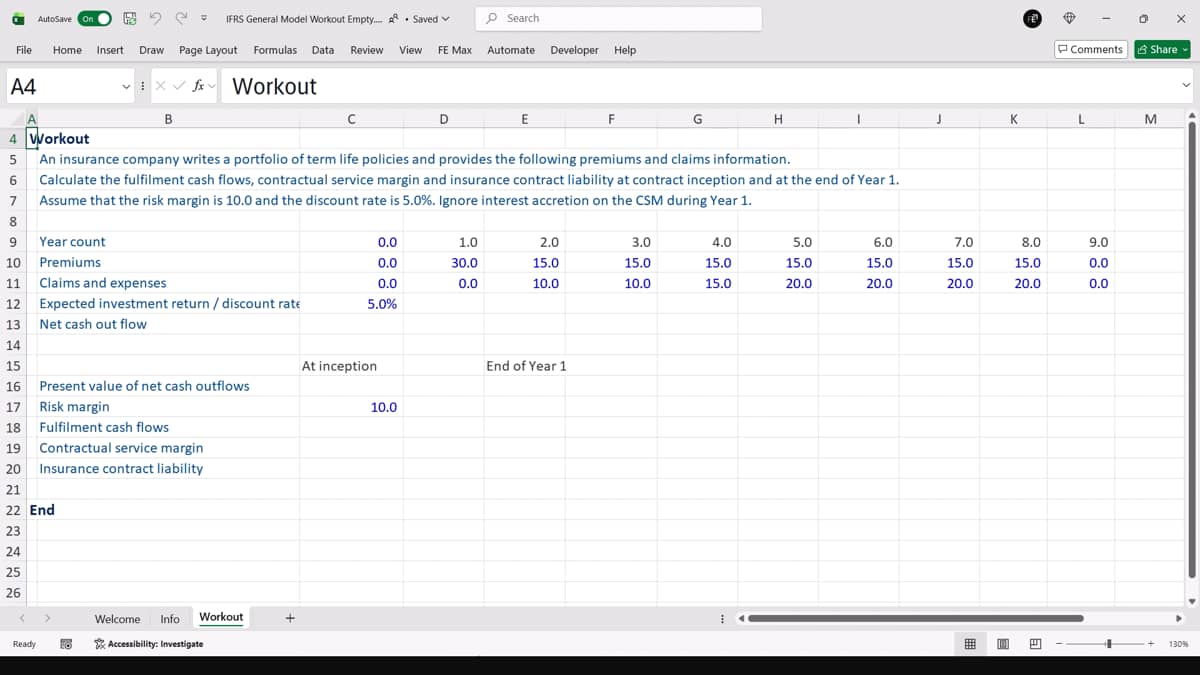
In this workout, we're told that an insurance company writes a portfolio of term life insurance policies and provides premium and expected claims information below.
We're asked to calculate the fulfillment cash flows, the contractual service margin, and the insurance contract liability at contract inception and at the end of year one.
We'll assume that the risk margin is 10 and the discount rate is 5%, and we're going to ignore interest accretion on the CSM during year one.
Now, the very first thing that we're going to do is we're going to calculate the net cash outflow that's going to happen each year in the contract.
And that's the claims and expenses less the premium.
Now, the building blocks approach used by IFRS assumes that the fulfillment cash flows are the present value of the net future cash outflows plus the risk margin.
And at inception, these are equal to the contractual service margin.
So that's basically saying that the present value of the future profit in the contract is equal to the risk-adjusted present value of the future cash flows in the contract.
Now, we're going to start off by calculating the present value of the net cash flows, and we're going to use the NPV function for that.
And we grab the discount rate of 5%, and then we select all of the cash flows, starting with the first year's cash flow.
And that gives us a net present value of the cash flows of 22.8.
And that's a negative because actually at the start of the contract, you assume that there's going to be a net cash inflow in present value terms because there should be some profit in there.
However, it's not all profit because we also have a risk margin of 10, and that's to allow for uncertainties in those cash flows.
So if we add the present value of the cash flows and the risk margin, that gives a net present value of the fulfillment cash flows of 12.8.
Now, this is effectively the profit that's baked into the insurance contract.
So we'll take those fulfillment cash flows, make them a positive, because we want to show profit as a positive figure, and that gives a contractual service margin of 12.8.
When we add together the fulfillment cash flows and the contractual service margin, that gives us the insurance contract liability at the start of the contract, which is normally going to be zero.
And that should make sense at this stage because the present value of the fulfillment cash flows is equal to the future profit in the contract.
So when we add those together, we get a value of zero.
Now, let's look at what happens a year later once premiums of 30 have been received.
Now, we're going to recalculate the NPV of the net cash flows, and we'll use the same discount rate.
And we just want the future cash flows, so we're starting with year two this time.
And this is now a positive figure. We're showing an NPV of 6, and that's because we now have 30 of premium received, so the present value of the future claims and expenses now exceeds the present value of the future premiums.
Now, at this point, we're going to assume the risk margin is still 10, and that's because the same risk is still present in the contract.
This only starts to reduce once claims are actually being paid out.
When we now add the present value of the cash flows and the risk margin, we have a present value of fulfillment cash flows of 16.
Now, the contractual service margin in the contract, that's still 12.8.
So let me just link that to the previous value.
And the reason it's not changed is because that only starts to get released to the income statement once benefits are actually being paid out.
Also note that in the question, we're told to ignore interest accretion on the CSM in year one, just for simplicity here.
So if we want to calculate the insurance contract liability at this point in time, we again add the fulfillment cash flows and the contractual service margin, and we now have an insurance contract liability of 28.9. Remember, previously this was zero, so why has it changed? Well, it reflects the fact that we've now received premium of 30, and that's effectively unearned premium at this stage, and that's captured in the insurance contract liability.
However, the contract liability isn't exactly 30 because it includes the effects of discounting.
So we can think of the insurance contract liability as having two elements.
There's the liability from the net fulfillment cash flows in the contract and the future profit that has not yet been earned on the contract.

 IFRS General Model Workout Empty