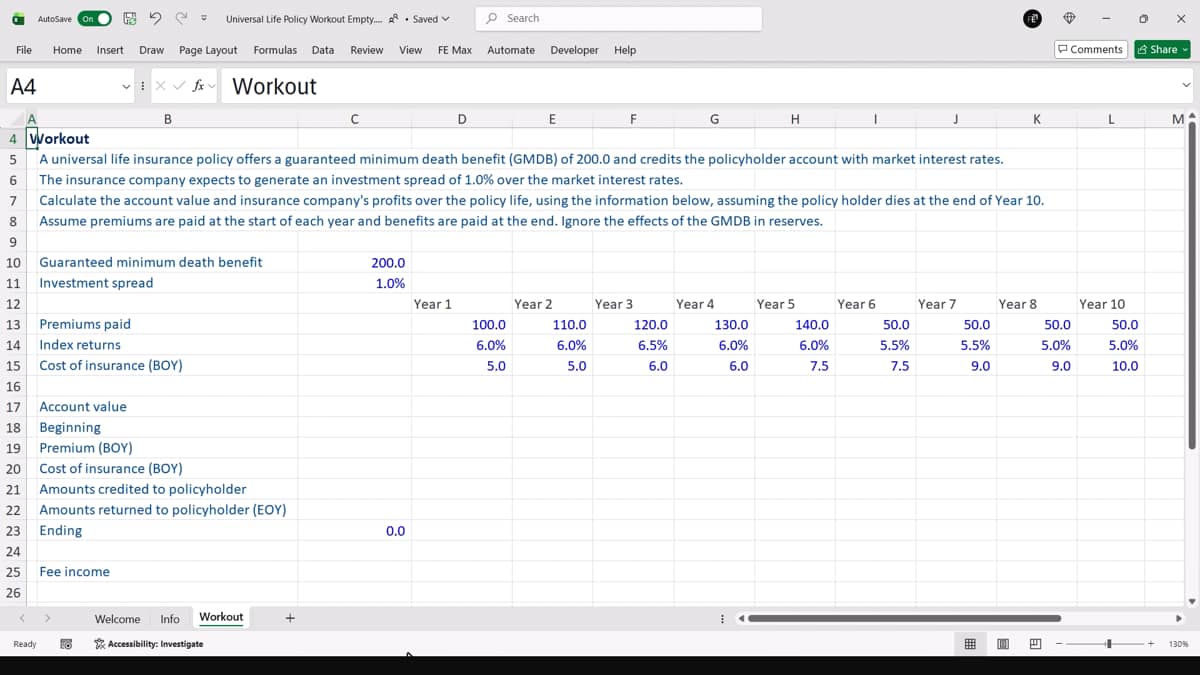
In this workout, we're told that a universal life policy offers a guaranteed minimum death benefit of 200 and credits the policyholder with market interest rates. We're also told the insurance company expects to generate an investment spread of 1% over the market interest rate.
We're asked to calculate the policyholder's account value in the balance sheet and the revenues and expenses in the income statement each year using the information below and assuming the policyholder dies at the end of year 10.
We'll assume that premiums are paid at the start of each year and benefits are paid at the end of each year.
Now, universal life policies are effectively treated as an investment product, with the policyholder's account value shown in the balance sheet as a liability in the same way that a bank would show a customer deposit.
So the first thing that we're going to do is to calculate the account value each year.
The beginning value of the account is going to be zero, and we're going to make that the beginning value in the first year.
We then need to add the premiums paid at the beginning of each year, as these are like the policyholder paying into their savings account.
Note that BOY stands for beginning of year.
So we add the premiums paid.
However, this policy does offer a small guaranteed minimum death benefit, which means that the insurance company will deduct a fee each year to cover the cost of offering that guaranteed benefit.
And this is deducted as soon as the premium is paid, and it's deducted as a cost of insurance. So we take the cost of insurance from above and deduct that.
We can then add the amount credited to the policyholder, and that is the market interest rate applied to the account balance at the end of the year. So we start by summing the account balance, and that's the beginning balance, plus the premiums paid in less the cost of insurance, and then multiply that by the rate that's credited to the policyholder.
And that gives 5.7 being credited to the policyholder in year one.
We then need to allow for any amounts returned to the policyholder, which are going to be zero unless the policy is surrendered or the policyholder dies.
So I'll just pop a zero in there.
And we can then calculate the ending account value just by summing all of the items above.
So the policyholder's account value is 100.7 at the end of year one, and this amount will be recorded in the balance sheet within policyholder's account balances.
We can now roll forward our calculation to the end of the policy.
However, we now need to calculate the amount returned to the policyholder in the final year, and that's going to be the higher of the account value and the guaranteed minimum death benefit.
So I'm going to use the max function to show this, although we can immediately see that the account value is much higher than the guaranteed minimum death benefit in year 10. Therefore, we expect the payout to be higher than the 200 minimum.
So we now have the account value each year, but we need to now work out the income statement entries. And we'll start with the fee income.
Now, the fee income reflects the charges levied on the policyholder account, and in this case, it's the cost of insurance.
So I'm going to grab that cost of insurance from above, make that a positive, and that will be included within revenues.
However, there is a further source of revenue for the insurance company, which is the investment income, and that's from investing the premiums.
For this, we're going to need to calculate the investments balance each year, so we can then calculate the return on those investments.
Now, we start off with a zero balance, and then at the beginning of each year, that's going to be the amount from the previous year, plus any premiums received.
And that gives us an investment balance at the start of year one of 100.
We then calculate the investment return generated by the insurance company, and that's going to be the index return, the market rate, plus the investment spread that's expected. And I'm going to lock my reference to that cell, so I can reuse my formula, and then I multiply that by the beginning balance.
And that gives me an investment return of seven in the first year, which I then add to the beginning balance to give the ending balance on the investments in year one of 107.
We can then roll forward this calculation to the end of year 10, and we now have our investments balance and investment income for each year of the policy.
Now let's create our income statement entries, and we'll start with the amount credited to policyholder accounts.
We're just going to lift that from the account value calculations above.
And we now can calculate total revenues and expenses.
Now, revenue includes the fee income and also the total investment return generated each year, giving total revenue in year one of 12.
And for expenses, that's the amounts that are credited to the policyholder each year. I'm going to show that as a negative.
We can then roll forward that calculation to the end of the policy.
And we now have our calculation of revenues and expenses for each year, and we can see here that the revenue item that reflects the fees and the investment income that's being generated, whilst the expenses show the amount of that investment income that's effectively being credited to the policyholder each year.
Note that the revenues include fee income and investment income. It does not include the premiums paid by the policyholder. So for universal life type policies, the accounting is slightly different, and we don't show the premiums in the income statement.

 Universal Life Policy Workout Empty