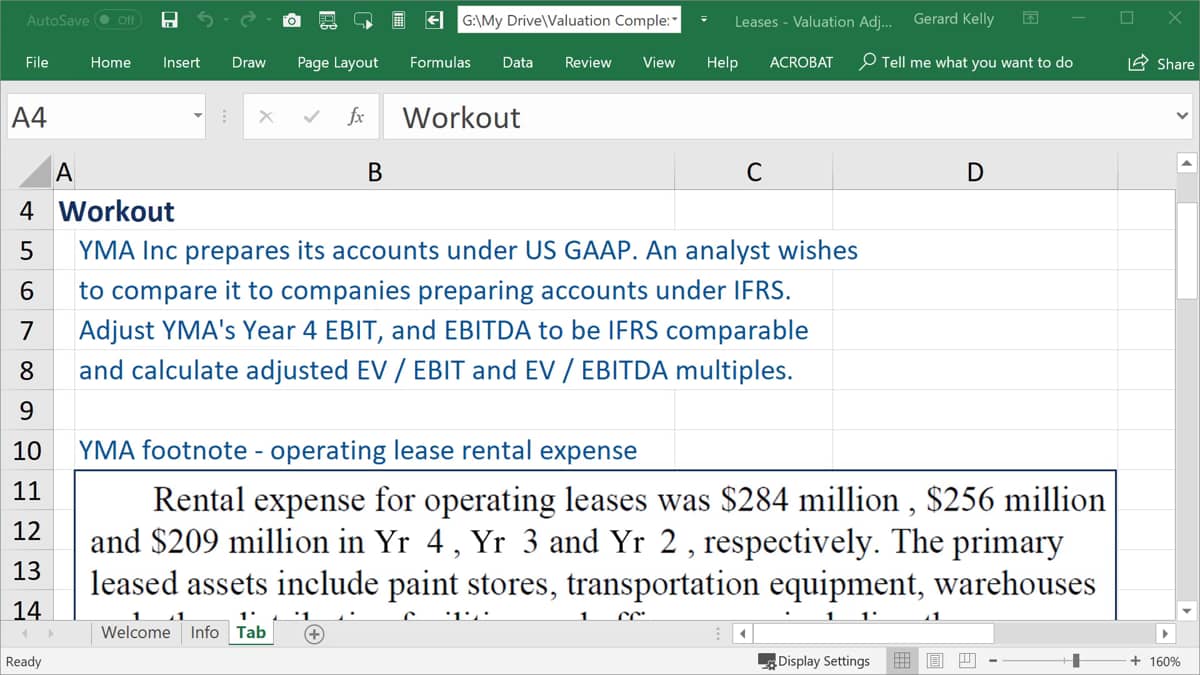
In this workout, we're told that YMA Inc. Prepares its accounts under US GAAP. An analyst wishes to compare it to companies preparing accounts under IFRS. We're asked to adjust YMA's year four,= EBIT and EBITDA to be IFRS comparable and calculate adjusted EV/EBIT and EV/EBITDA multiples. Underneath that we've got a YMA footnotes. It tells us that their rental expense for operating leases was $284 million in year four, and that's going to be useful to us. So let's scroll down and we're given lots of information to note. All figures are already in millions. We're given EBIT as reported and D&A depreciation and amortization as reported so we can calculate EBITDA as reported. So let's get on with EBITDA first.
My EBITDA as reported is going to be the sum of EBIT and D&A great 6,185.7. But I now want to add back the rental expense in full. This is because under IFRS, lease expenses or rental expenses are reported in the interest line and the depreciation line of the income statement. So if I can add back this 284 rental expense in full, and that's from the footnote, then I'm now looking at earnings before the rental expense and interest and before the rental expense into depreciation. I'm now looking at a figure that is comparable with IFRS and you might notice that that that that is actually EBITDAR earnings before interest tax depreciation, ation and rental expense. This EBITDA figure of 6,469.7 does not include any rental expense at all. And under IRS, it would be exactly the same. Let's move on to EBIT. We start off with the EBIT as reported that figures 5,686.2. If we think what EBIT is, its earnings before interest and tax under IFRS. Some of the rental expense will have been reported in interest. So I want to leave that still down in interest, that's fine. But under IFRS, some of the rental expense is reported in depreciation and that is above EBIT.
So what I need to do is I need to leave that depreciation part above EBIT, which is fine, that's been included in the US GAAP. But the interest proportion of it, I need to exclude from the US GAAP EBIT. We need to get rid of it. So I'm going to add back the interest proportion of rental expense. Now Moody's suggest a proportion of one third. They say one third of your rental expense is kind of interest, and the other two third is really depreciation. So I'm going to take 33.3% of the 284 rental expense. So I'm now going to add back some of that interest cost.
We'll pretend that instead that cost is now going into the interest line that's further down my income statement. That's past EBIT, I don't care about it. So my EBIT adjusted is now the sum of the two figures above 5,780.8. Lastly, we need to calculate the EV. Scroll up a little bit, find equity, add long-term debt, add back that finance and operating leases, and subtract off cash to get to an EV of 75,432.1. I can now calculate my multiples. Let's have a look at my EV EBIT multiple as it was reported, and that gives me a multiple of 13.3 times. Now let's see what happens if we use EV divided by my adjusted EBIT and it has now come down because my EBIT had increased, that reduces the multiple. Let's see what happens with EV EBITDA. Take my EV, divide it by EBITDA as reported.
12.2 is my multiple, whereas now let's take that EV and divide it by my EBITDA when adjusted.
And that's come down to 11.7. So changing the figures of this US GAAP company changing its rental expense where it's reported in the income statement means I've now got multiples that I can compare to IFRS companies.

 Leases-Valuation-Adjustments-Workout-Empty