Leases can have an effect on multiples valuations. If I calculate the multiple for one company under US GAAP, and then I calculate the multiple for one of its peers under IFRS and they've both got leases, they're going to be treated differently and I won't be able to compare those multiples together.
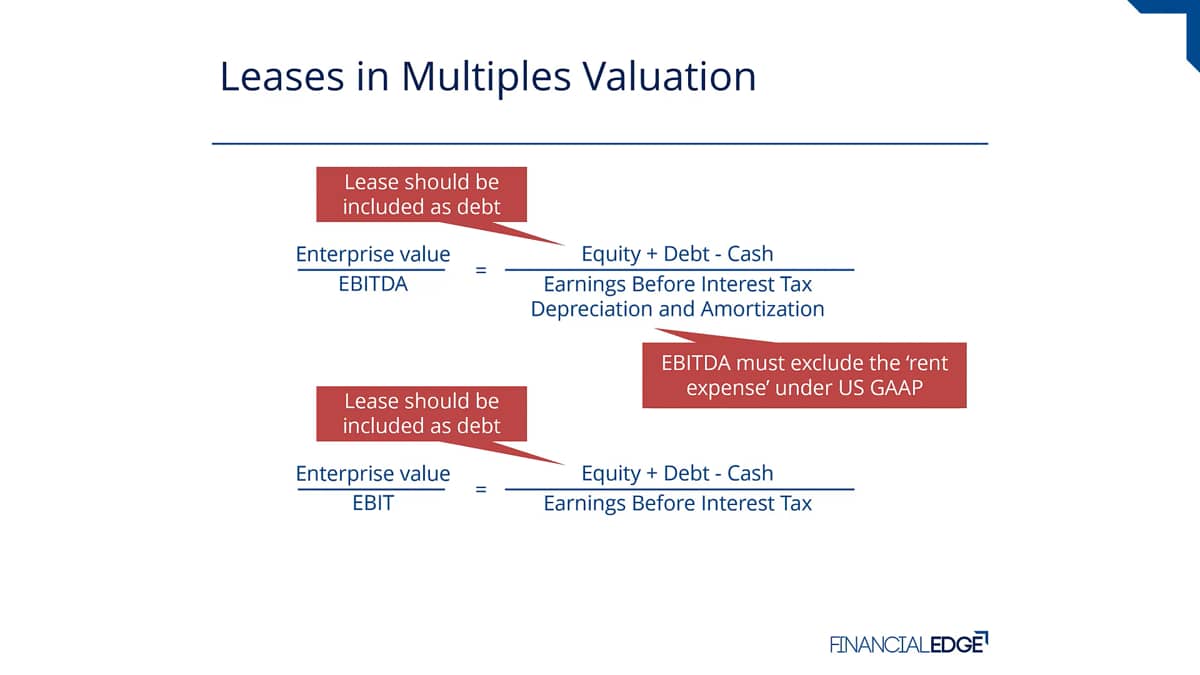
Let's have a look. Here we have a common multiple enterprise value over EBITDA. Let's have a look at the calculation of each of those items. The numerator, enterprise value, is calculated as equity plus debt minus cash. When we're doing this under US GAAP, but we want to make sure that it's comparable to IFRS, the lease should be included as debt, so we'd still take plus debt minus cash, but the leases are now included as debt or debt equivalent.
What about the denominator EBITDA? Well, that's earnings before interest tax depreciation and amortization. Under IFRS, rent expense is split into interest and depreciation. So under IFRS, EBITDA is before interest and before depreciation. So your EBITDA is before your rent expense.
That means if we're doing this under US GAAP, that EBITDA must exclude the rent expense under US GAAP. Let's look at another multiple being EV over EBIT. Our numerator is exactly the same equity plus debt minus cash, and the only thing we have to remember is that the lease should be included as debt, the same as before. But our denominator is slightly different. Now we've got EBIT being earnings before interest and tax. Remember, under IFRS, the rent expense is split between interest and depreciation. So our EBIT here being before interest, that EBIT is before some of the rent expense under IFRS, it's before some of the rent expense, so we need to do exactly the same under US GAAP. We need to calculate our EBIT before some of the rent expense so that EBIT must exclude the interest portion of rent expense under US GAAP. How would we calculate that? We would normally take the rent expense and take one third of it as interest. The other two thirds of depreciation, that's fine. We can just ignore that. By making these adjustments to the US GAAP, EBITDA and EBIT, and thus our US GAAP multiples, I'll then be able to compare my US GAAP companies and my US GAAP multiples with IFRS companies and IFRS multiples.