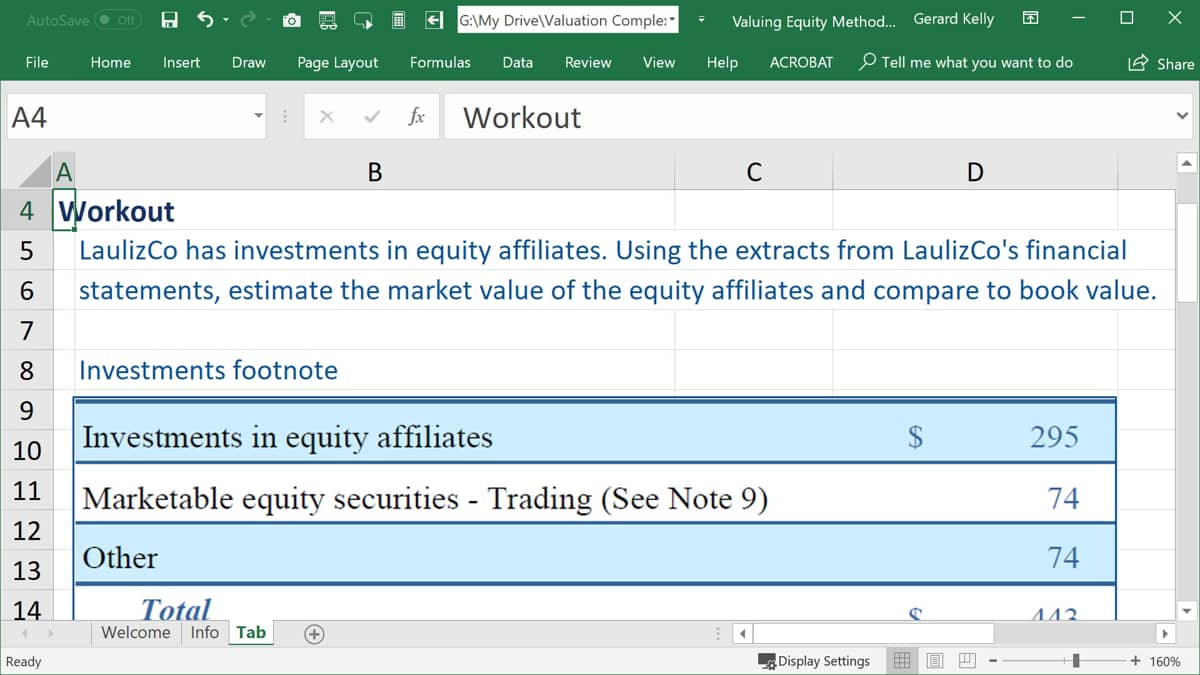
In this workout, LaulizCo has investments in equity affiliates using the extracts from LaulizCo's financial statements estimate the market value of the equity affiliates. And compared to book value. Underneath this we've got investments footnotes, and you might notice that it says investments in equity affiliates, the figure there is 295. That is the book value of the equity affiliates. Underneath this, we've got a second footnote from the company and it's other income we might notice in here. The second line item says share of net earnings or losses of equity affiliates and the figure there is 101.
So the first thing I'd like to do is put those two figures together. I'll put the book value of associates 295, and the associate income 101. If I've got the value at the top and I've got an income at the bottom, I could turn that into a PE multiple imply a PE multiple for the associates of 2.9 times. However, I'm worried that using the book value of Associates, the 295 maybe undervalues the associates and thus the 2.9 is a bit low. Let's compare it to LaulizCo's PE multiple itself. We've got a share price for them divide that by the EPS diluted 28.5. It does appear that the associates' multiple is too low. Instead a figure of 28.5 has been driven by market forces we've actually used the real share price and the real EPS.
I'd like to use that 28.5 to help me value the associate. However, I'm a little worried that that 28.5 is a bit high, that the associate instead, because it's not quite as liquid as the company, the company's got a share price, for instance, can easily be traded because it's not quite as liquid. We should take a liquidity discount and here we're going to use 30%, so 28.5 times that by 1 minus the 30% gets me 20 times. So I'm now going to estimate the market value by taking the 101 of associate income, but now multiply that by the 20, not the 2.9 to get to the 295, but the 20. This gets me an estimated market value of associates of 2017.6. Compare that to the book value that we had, 295 and there's clearly a very large difference. So if I was putting this into an enterprise value calculation or trying to get from enterprise value to equity, I'd have to make sure that I use the estimated market value rather than the book value. Otherwise, it would've a dramatic impact on the company's valuation.

 Valuing Equity Method Investments Workout Empty