Broadly speaking, provisions can be split into two categories. The first of these are operational, and the second are debt or finance like. Operational provisions happen in the normal course of business. A good example would be a TV manufacturer having a provision for warranties. It creates a provision for next year, in where it expects a small number of its TVs to have defects. Thus the warranties will be used and the TVs will be returned to them. They'll have to give the customers some new TVs. They're operational because they're linked to the company's products and they're recurring in nature.
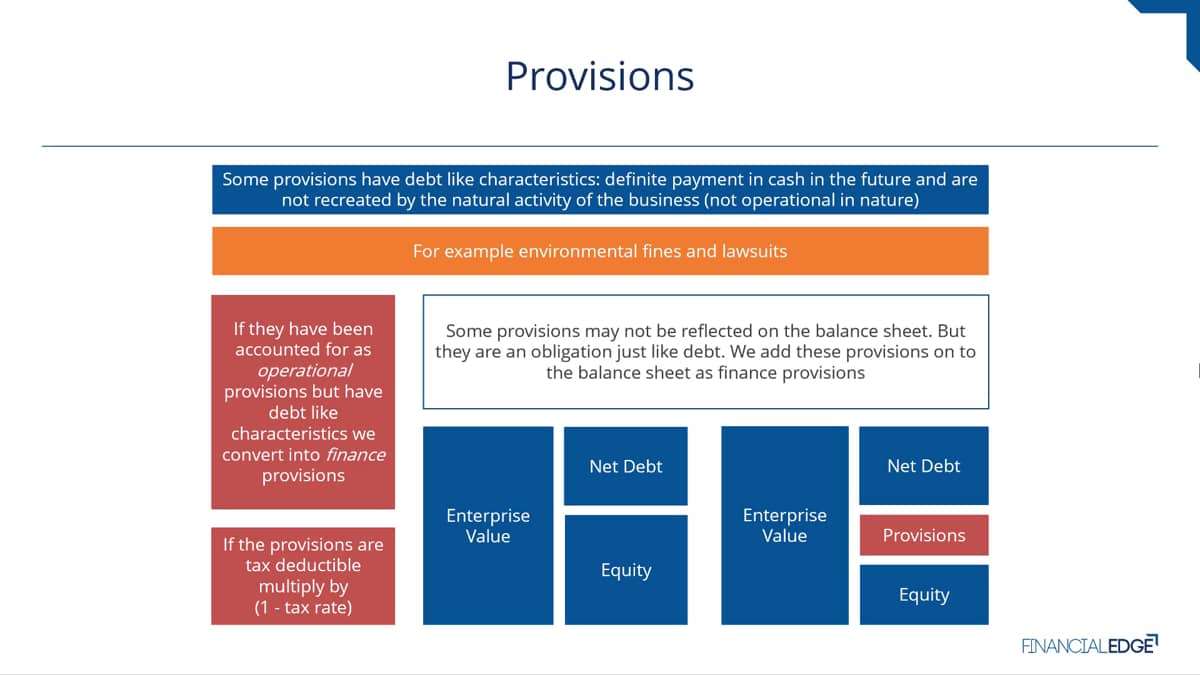
But finance or debts like provisions are slightly different, and they affect the valuation of a company. Some provisions have debts like characteristics. There's a definite payment in cash in the future, and they're not recreated by the natural activity of the business. They're not operational in nature. A great example here is environmental fines or lawsuits. If they have been accounted for as operational provisions, but they have debt like characteristics, we convert them into finance provisions, and some provisions may not be reflected on the balance sheet, but they are an obligation just like debt. We add these provisions onto the balance sheet as finance provisions.
So in short, some operational provisions we might turn into finance provisions and some off balance sheet provisions. We might turn into finance provisions. What impact does this have for valuation? Well, here's a company's basic enterprise value calculation. Here, my equity plus net debt equals enterprise value, but now I realize that a provision should be on this balance sheet and is not. So here it is, the enterprise value is unchanged and the net debt is unchanged, but the provision now has to be added. It's much like a debt item, so it goes on the same side as debt. That means it reduces the company's equity. So now my enterprise value calculation is equity plus provisions, plus net debt equals enterprise value. Clearly, this has a big impact on the equity value of the business. If the provisions are tax deductible, then you can multiply them by one minus the tax rates to get to the value that needs to go into that enterprise value calculation.