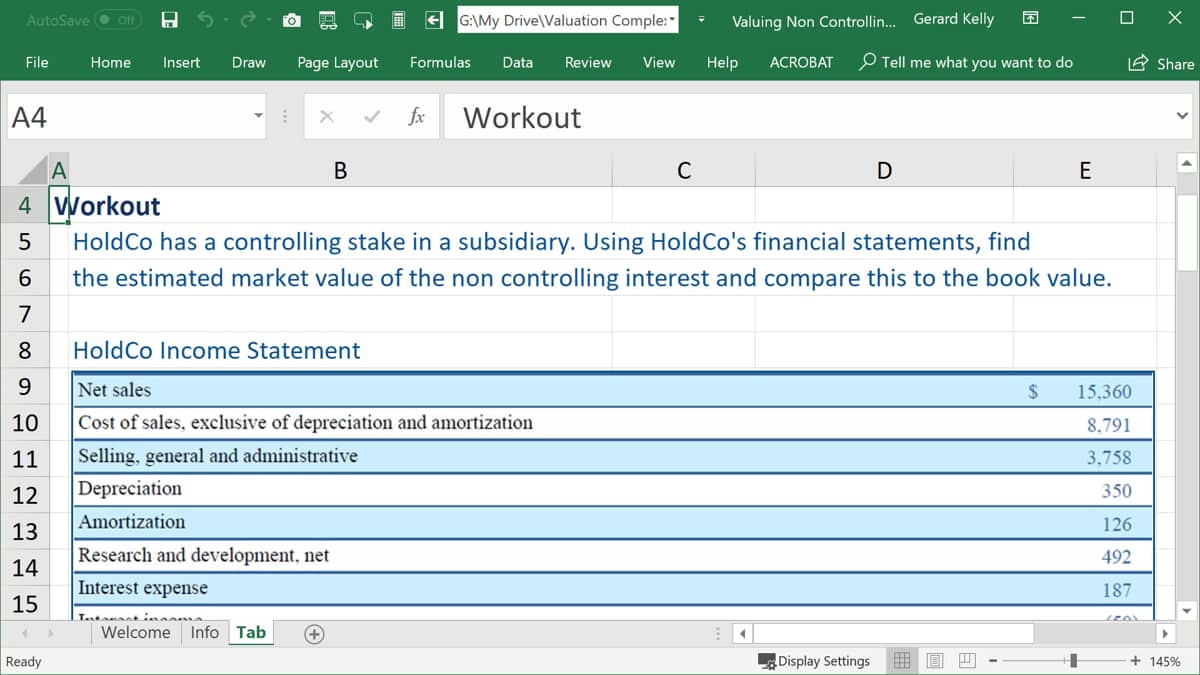
In this workout, we're told that Hold co has a controlling stake in a subsidiary using Hold Co's financial statements, find the estimated market value of the non-controlling interest and compare this to the book value. So the first financial statement we have is Hold co's income statements. It looks normal. Pretty much the same as every other income statement we've seen, but there's one particular item want to point out. It's the item second to bottom where it says less net income attributable to non-controlling interests. And that number is 57. Next we've gone extract from Hold co's balance sheet it looks at their equity. And the item third from bottom is non-controlling interest of 85. This is the book value of the non-controlling interest.
So let's do some calculations. Firstly, I want to put the book value of NCI that was 85 and I want to put the NCI income that we saw in the income statement that was 57.
If I've got a figure that's a value and I divide that by figure, that's an earnings that gets me a PE multiple. So the PE multiple that we see for here is 1.5 times that seems remarkably low. Let's check that with Hold co's PE multiple. If we take Hold co's share price and divide that by Hold co's EPS diluted, that gets me a PE multiple of 28.5. That sounds much more reasonable. It's actually a very high multiple. Therefore I'm thinking that 1.5 is probably not to be relied upon for a market value that 28.5 has come from market values. This 1.5 has come from book values. So I'd like to use the 28.5 to help me value the NCI, but I'm going to apply a liquidity discount. My liquidity discount's going to be 30%, so that 28.5 I multiply that by one minus the 30% discounts to find the resulting 70%. I think we should use a PE multiple of 20 times.
So I now am going to take the 57 NCI income, but instead of multiplying that by the 1.5 to get to the 85 book value, I'm now going to multiply it by the 20 times. That 20 times has come from the 28.5 based on a real company share price and a real company's EPS much closer to market value. So I multiply it by the 20 and I get a figure of 1138.6. Let's compare that to the book value, the book value was a mere 85. There's a huge difference there. If I was trying to value the entire company and let's say I was trying to find its enterprise value, well I would now take its equity value plus its debt as normal, but I'd now add on the market value of NCI rather than the book value. And we can see that value is more than a thousand higher. As the NCI is more than a thousand higher than its book value, then this is going to increase the enterprise value. So you must be careful to use market value rather than book.

 Valuing Non Controlling Interest (NCI) Workout Empty