The US tax code had a significant impact on corporations financial statements.
The biggest single change, of course, was to the headline tax rate changing, which flowed down into the effective tax rate of pretty much all US corporations.
So we are much closer to 21%.
Obviously remember to include the state taxes and any other permanent differences.
But generally speaking, most corporations saw a fall in their effective tax rate.
Obviously, marginal tax rates also changed and that affected your cost of capital.
For example, a lot of the deferred tax assets and liabilities wouldn't need to be written down.
Now remember, if you write down a deferred tax asset, that is a negative impact to the corporation.
And if you write down a deferred tax liability, that is a positive impact to the corporation.
So these will have knock on impacts in the shareholder's equity and a company's leverage ratios.
Let's have a look at some companies financial statements.
So in most companies, financial statements, there will be discussion about the new US tax code.
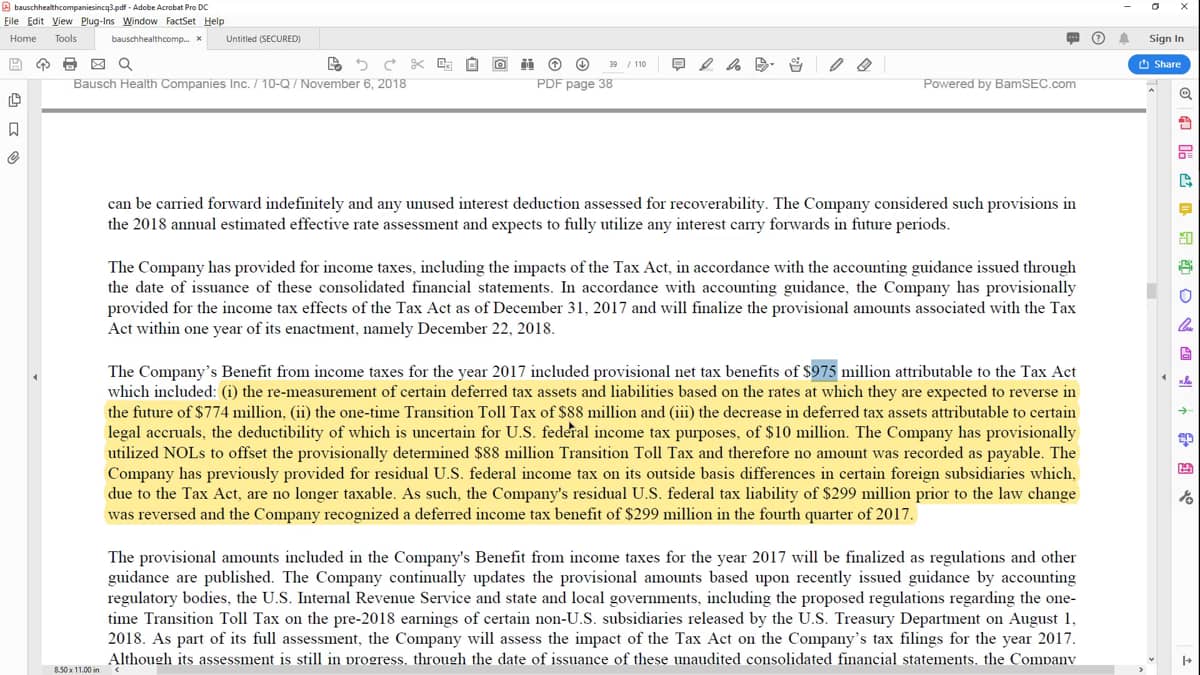
And you can see at the top here for this company, Bausch Health Company, there are some significant discussions about it.
And for Bausch Health Company, the big issues were the changing tax rate from 35 to 21%, but also the transition toll tax.
They also go on to talk about the impact of gilt on their foreign earnings and also beat, which is the interest deduction limitations.
And in the case of BA Health Company, they're highly leveraged and have a relatively low ebitda. So it's likely that they will be limited in their interest deduction by this 30% threshold.
Now, they do go on to say that even if they can't deduct the interest in the current year, they do expect to be able to utilize that deduction in future periods through the carryover mechanism.
So just bear in mind that if you can't deduct it in the current year in the company's financial statements, they will still deduct it from the income statement, but they just won't get the cash deduction in that year.
And what they will do is they'll create a deferred tax asset going forward.
Now, in terms of the overall impact of this, it's pretty significant at $975 million you can see here.
And they're breaking that down.
And the biggest single item is the remeasure of the defe tax assets and liabilities of $774 million.
They also talk about the one time transition to tax of $88 million.
And gone to say, because they've got lots of NOLs, they're not going to pay this. They're going to use it with NOLs to offset the 88 million.
Here we're taking a look at Apple's financial statements.
And one interesting thing about Apple, they had to defer tax liability related to their foreign income, which they had not repatriated of $36.4 billion.
And this is being replaced by the repatriation tax, this 15.5% on monetary assets.
And you can see the numbers are pretty similar size going forward.
Of course, there's been a significant reduction in their effective tax rate from 24.6% down to 18.3%.
Now, although those taxes in the tax note were called payable, you can see that they're not actually going to be due immediately, and that's because there's an eight year time period to pay them off.
And you can see here in the non-current liability section, previously they had this deferred tax liability, which relates to the tax they'd have to pay when they repatriate the earnings.
Now, because of the tax changes, that's moved effectively to a payable, but it's not a deferred tax, it's just a tax payable, and that's because it's gonna be paid over eight years.
So interestingly, the overall effect on Apple's financial statements actually isn't that great, other than the changing effective tax rate.

 Bauschhealthco