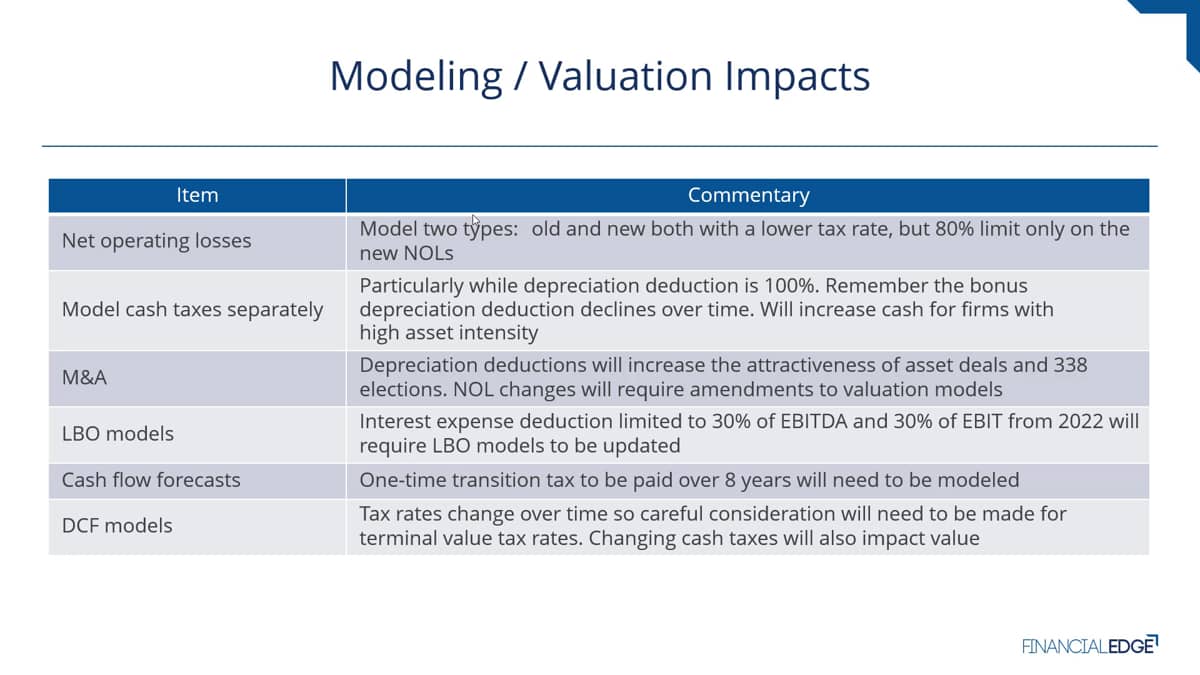
There were a number of significant modeling and valuation impacts as a result of the US tax code changes.
We're gonna cover the major ones here.
There are others, but these are the main things that you need to think about when you are modeling and valuing corporations.
The first is net operating losses.
You need to model the preexisting NOLs separately from the newly created NOLs.
The main reason you can use the preexisting NOLs against 100% of future income, but the new NOLs, you are only able to use 80% of future income.
Cash taxes will need to be modeled separately, particularly where a company has a lot of capital expenditure and therefore depreciation because of the bonus depreciation, which allows you to deduct a substantial portion of CapEx against tax.
So this will increase cash, particularly for firms with high asset intensity.
From an M and a perspective, the key thing is the deduction of depreciation, and that will make asset deals a lot more attractive deals with three 30 H 10 elections.
Also, the changes to NOLs will potentially affect their valuation.
The new NOLs will be less valuable than the old NOLs.
So think about the one you having to value and pay for NOLs.
From a leveraged buyout perspective, the biggest change is the interest deduction, limiting that to 30% of EBITDA, and that is actually a tax ebitda.
Another cashflow impact is the one time transition tax.
Now, this will need to be modeled over an eight year period because that's the period that it has to be paid.
Bear in mind that if a company has pre-existing NOLs, they'll probably want to use that first to shield that transition tax DCF models because the tax regime is changing and it's not a one-time change, but it changes gradually.
You'll need to think carefully about your terminal value calculation in your DCF.
A lot of the changes to things like deferred taxes and potentially the one-time transition tax is going to affect shareholders' equity, and that will have a follow on impact onto your leverage ratios.
So for a normal forecast model, it's likely that you'll want to model taxes separately.
Well, let's go through the key items that you should include.
Depreciation. Typically, we would take the pre-form depreciation amortization and just assume that runs over time and as normal, no particular changes there.
But the new capital expenditure, 100% of CapEx, was deductible up until 2023, and then it phases down by 20% per year.
And bear in mind that this is a bonus deduction.
And then from the new CapEx, when it ratchets down, the remainder amount will be depreciated and deducted Normally interest deduction, remember you've got the threshold of 30% of EBITDA before 2022, which drops down to EBIT from 2022, And you will need to model the carried over interest deduction.
So in other words, if you can't deduct all your interest in one year, you'll need to then carry over that interest and potentially deduct it in future years.
Net operating losses, again, you need to split these into two old n NOLs.
Pre 2018 will be modeled as normal, but new NOLs will need to be modeled separately based on an 80% deduction of against taxable income in any one year.
And also, remember, the tax rate that you are using should be modeled at 21%, and that will affect the effective tax rate.
Plus, of course, any state taxes.