We're now going to model the NOLs under the new US tax regime.
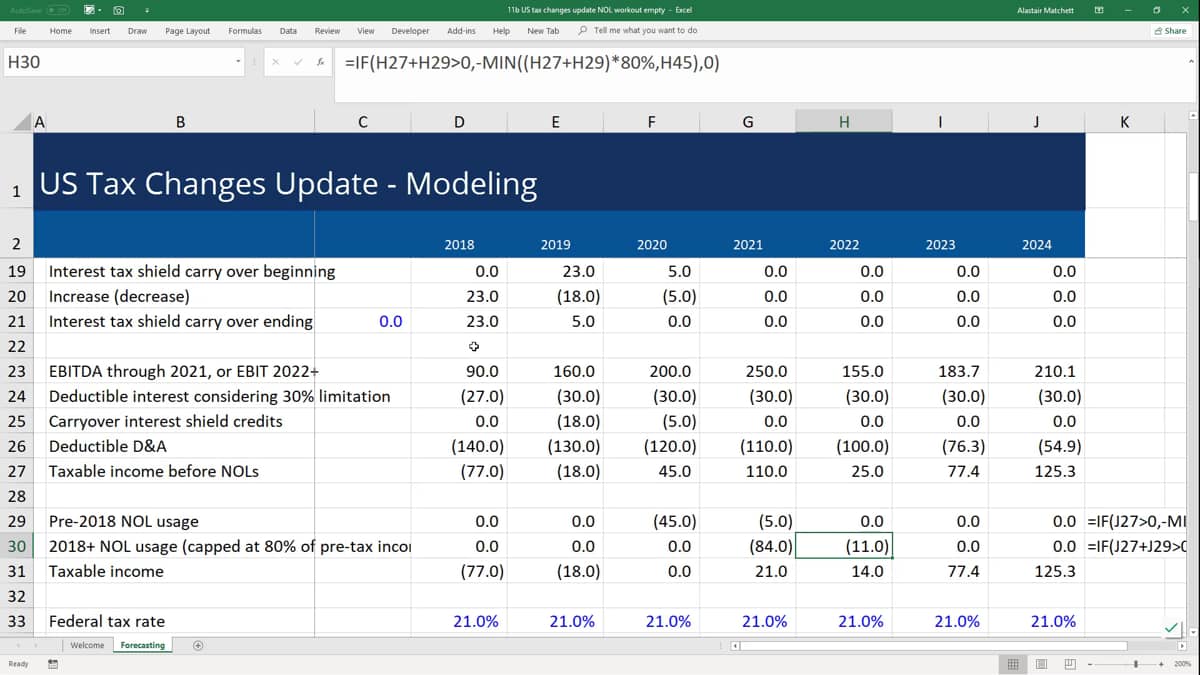
In this case, we've got a company, it's loss making in two years and then it becomes profitable.
Also, we have some pre-existing NOLs prior to 2018.
These we can set against a hundred percent of taxable income.
And I'm gonna quickly do a little base calculation here with the beginning balance and then some the ending balance.
And then I'm gonna do the same thing for the base calculation for the NOLs created post 2018.
You have to model these separately because NOLs created after 2018 can only be offset against 80% of taxable income, unlike pre 2018 NOLs.
So once you've done that, then what we're going to do is going to the easy portion, which is the pre 2018 NOL usage.
So I'm doing a little if statement here that says if my taxable income is greater than zero, then I do want to start to utilize the N no L, but I want to take minus the minimum of my profitable income or the beginning balance of the N NOLs at 50 million.
If we are not profitable, then I'm gonna put zero in the cell.
'cause I don't want to utilize any of these NOLs, so I'll just copy that, right? So we're saying if we're profitable, utilize the N NOLs.
If not, don't.
If I come down and put this line into my base calculation, and you'll see that what will happen is that when we're profitable, we'll start to use the NOLs and then we'll go to zero.
Perfect. It gets a bit more complicated for the NOLs post 2018.
So I'm going to do another if statement here that says, if I've got positive taxable income, including any NLS that I've used from prior to 2018, so if that's greater than zero, then I'm going to do another minus min function.
But this time the min is going to be the minimum of any taxable income after the preexisting NOLs times the 80%.
And this is the key difference, and I'm hard wiring that that's not gonna change, or I'm going to take the beginning balance of the post 2018 NOLs.
So that's what happens if a profitable, if we're loss making, I'm gonna put zero in this cell.
So then what I'm going to do to copy that right across there, and it's zero.
And the reason it's zero is that we haven't done the base analysis for the post 2018 NOL.
So let me go ahead and do that.
In this case, the base analysis is going to be minus the minimum of my taxable income or zero.
So in other words, if your loss making, we want to add those losses.
And then I'm gonna add any NOL usage because that will be negative and you'll see how this will work in a moment.
So we are generating what we are creating new NOLs here.
When we become profitable, we use the old ones first and then we start to use the new NOLs.
But if I come to the top and calculate taxable income, just using a quick sum function, take taxable income for NOLs, then the effective NOLs, You'll see that what happens is when we become profitable, we utilize all the preexisting, but we can't use all the new NOLs in 2021. So we still make some profits in 2021 because of that 80% threshold.
And then we use the remaining amount in 2022, we can go ahead and calculate cash taxes and I'm gonna assume that we are calculating cash taxes or tax expense on a cash basis.
So I'll take the taxable income times the tax rate or zero.
So if we are making losses, we won't put any taxes in there and most financial modelers are doing that.
I should probably make that negative.
So let me pop a minus sign in front of that so they're not calculating tax expense and deferred taxes.
But then I'm going to do state taxes the same way, minus the maximum of my taxable income times the state taxes or zero that a lot of the states haven't incorporated the federal tax changes in their regulations.
So some analysts are using gap income for state taxes.
Finally, we can calculate the total cash taxes by adding the federal and state taxes together.

 Modeling-NOL-Workout-Empty