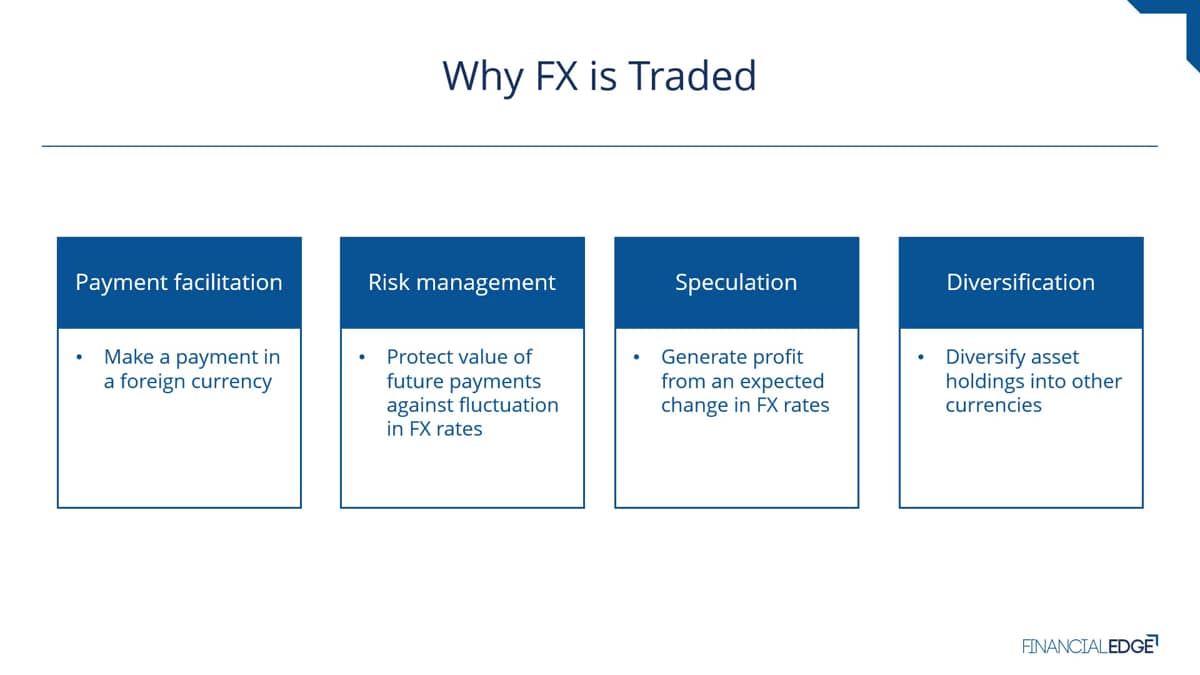
Let's start this session with a short definition of foreign exchange or more specifically what's a definition of FX transactions. Each FX transaction is the agreement between two counterparties to exchange an agreed upon a amount in one currency against and agreed upon a amount in another currency. Now, the ratio between the two currency amounts is given by the agreed upon price and is called the FX or the foreign exchange rate. So how's this market structured? Well, the FX market is a global over-the-counter market which means it is decentralized and there's no exchange or execution facility on which trading has to take place. And due to this decentral nature, currencies are traded actively around the clock five days a week starting on Monday morning in Asia and finishing on Friday evening in the US. Granted, market liquidity will generally be higher when Europe and the US are in but the FX market is a true 24 hour market. Speaking of liquidity, the FX market is the largest and most liquid market there is. Every three years, the bank for international settlement, BIS, performs a survey amongst central banks and other authorities in 52 jurisdictions. And according to the April, 2016 survey trading in FX markets averaged the amount of 5.1 trillion used dollars per day. And such a large number of course raises the question why the FX market has grown so much. Well, most currencies in the world nowadays are flexible which means that they are not linked to another currency in any way. And prices are primarily driven by supply and demand for the particular currency. And of course, when there is a change in supply and demand there's a change in the exchange rate as well. This chart here shows a five year history of the Euro/US dollar exchange rate. Over the period, the high was just below 140, the low around 105. So this slide nicely shows how much flexible exchange rates can fluctuate, in other words, how volatile they can be. And this volatility offers possibilities but also challenges to market participants and it's ultimately the reason why FX is traded so actively. And let's have a look at some of the main reasons why investors engage in foreign exchange transactions. The first one is very intuitive and we've probably all at least to some extent, made these type of transactions. Very often foreign currencies are bought to make a payment in this particular currency, for example, to pay an invoice received from a foreign supplier. Now, very closely linked to that is the next reason, trade effects for risk management purposes. Because in global trade, they often are agreed delays between the order of a good and the actual payment for this order. Of course, on first site, these payment targets are beneficial for the buy off the goods as it's generally positive to make payments later. However, in the case of foreign transactions it introduces foreign currency risk to the transaction. For example, if a European importer agreed to buy some commodities and pay for them in US dollars in two months from now, while the price in US dollars is fixed, the importer will not know the actual cost for the import in Euro terms until the purchase of US dollars has been completed. As until then, the FX rate can change significantly. But several products are available in the FX markets to limit or eliminate this risk completely and risk management is therefore a significant driver of FX transactions. The same products can of course also be used to create exposures to change in foreign exchange rates for speculative purposes. For example, when a macro hatch fund wants to generate a profit from the expected appreciation of one currency versus another one. And last but not least, many FX flows are generated by global investors looking to spread their investments across several countries, and of course across different currencies as well. So that foreign exchange transactions are also driven by diversification efforts.

 Foreign Exchange and Commodities Slides
