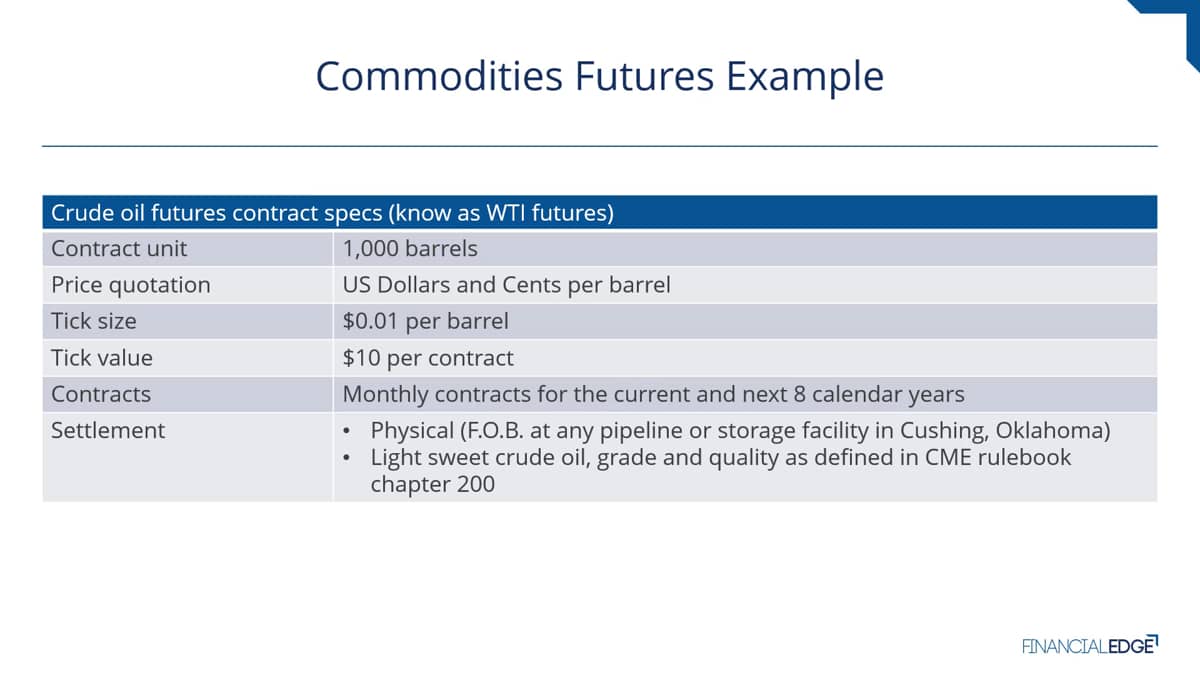
How exactly are commodities traded? First, there's a spot market, also referred to as physical trading, and this is a market where participants exchange commodities for cash, so commodities are bought and sold for immediate delivery and payment. While for pure financial assets, immediate delivery usually means two business days from the trade date, in commodities, we often need a longer settlement period, and this is due to the fact that, often commodities are produced in one location, but consumed in another. And as commodities are real goods, they actually have to be transported to the location where they are needed. This also means that a significant amount of infrastructure and specific logistic expertise is required to facilitate this kind of trading, which is why investors often prefer to get exposed to commodity prices via the futures market, and futures are contracts to buy or sell a certain amount of a specific commodity. The price of the transaction is agreed upon the trade date, but settlement occurs at a specific date in the future. As positions and futures can generally be closed through offsetting trades prior to the settlement date, even if the contracts foresee physical settlement, buyers and sellers actually do not have to make or take delivery of the underlying goods, and consequently, futures offer a convenient way for producers and consumers to hedge their natural risk positions, as well as for investors to build exposure to commodity prices without having to deal with the physical goods, and most commodity trading and practice takes place in the futures market for that reason. In order to trade on a market, commodities have to be defined and standardized in order to be exchangeable, and is especially true when traded on an exchange. On the screen, you can now see the contract definitions for WTI futures traded on the CME. The contract size is a thousand barrels, and the price is quoted in US dollars and cents per barrel. In other words, if you were to buy one futures contract at $56 dollars, this means you agree to buy a thousand barrels of oil at a price of 56 US dollars per barrel at futures expiry, which gives the contract a value of 56,000 US dollars. The tick size, which is basically defined as the smallest possible price change of the futures contract, is one US cent. And as each contract is for a 1,000 barrels the smallest possible change in value of the contract is $10. Now they are monthly contracts for around nine years into the future, which means it's possible for producers and consumers to hatch their exposures quite far out. The underlying of these futures is light sweet crude oil that meets the quality specifications defined in the Nimex Rule book chapter 200. Like for example, a sulfur content of 0.42% or less. The important thing to remember when trading these futures though is that they are actually physically settled. So if positions are not closed before expiry traders have to make or take delivery of the physical oil and delivery shall be made free on board at any pipeline or storing facility in Cushing, Oklahoma. As commodity futures are so important for hedging and speculation, market participants pay a lot of attention to the shape of the futures curve. In general, a futures curve links together the futures prices for the different expiry dates, and shows how the prices at which commodities can be bought or sold at, differ for the various expiring months. To describe the shape of the commodity futures curve market participants user terms contango and backwardation. Contango describes an outward sloping curve which means that prices increase with time to expiry and backwardation describes a downward sloping curve. So futures prices decrease with time to expiry.