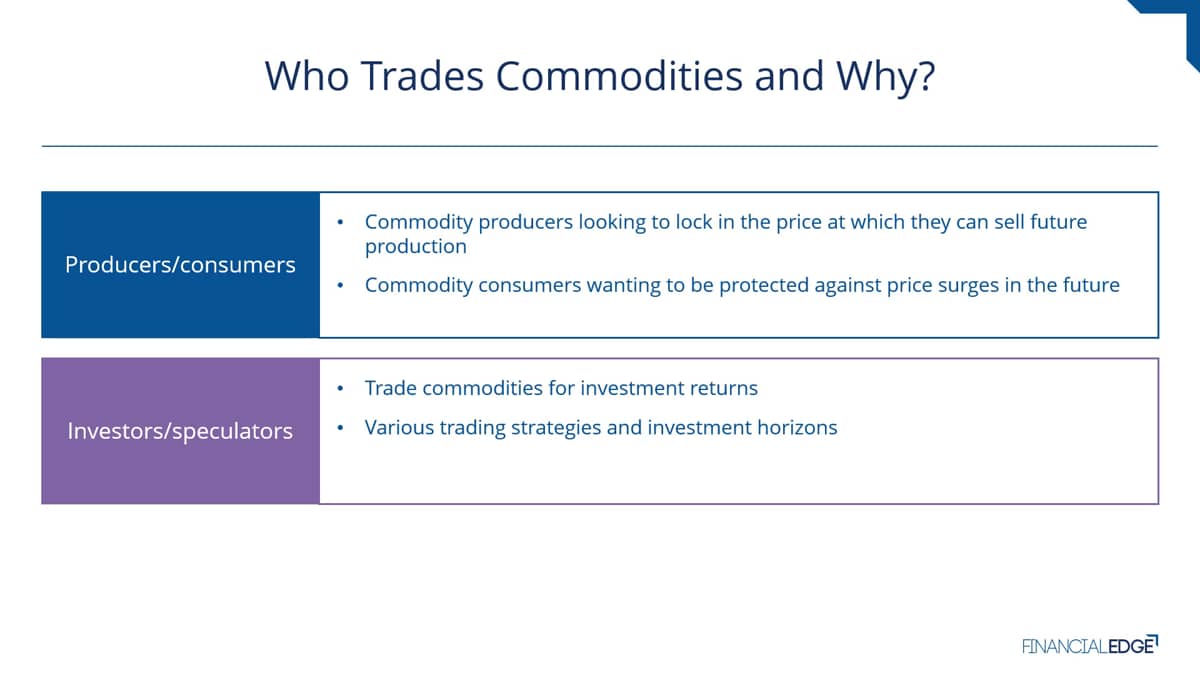
So what are commodities? Well, commodities are usually raw materials that are either consumed directly or used to produce other goods. And while there are many different types of commodities we can distinguish two main types, soft and agriculture commodities and hard commodities. Soft commodities are commodities that are usually grown as for example, coffee, corn, soybeans or pork bellies. Hard commodities are commodities that are usually mined or extracted as for example, crude oil and precious metals. What all commodities actually have in common is that they're real or physical assets as to opposed to classic or financial assets like stocks or bonds that represent a claim on future cash flows. And because commodities are either essential goods or important input factors for the production of other goods and are often difficult to substitute, at least in the short term, demand for commodities is relatively inelastic. This means that demand for the commodities does not change very much when the price changes which is especially intuitive for food items. We have to eat even if food feels to be too expensive. In contrast, when investors believe that stocks are overvalued, they can simply decide not to buy anymore or even to start selling. In addition, for most commodities, there's some sort of restriction in supply. There's obviously not an infinite amount of oil or gold available for extraction on this planet, new bonds and stocks on the other hand can be issued as long as there is sufficient demand from the investor side. And all these features just mentioned taken together explain why commodity prices can be very volatile. As an example, see here how the price of Western Texas Intermediate Oil has developed over the last 20 years or so. The low was around $20 and after reaching an all-time high of around $150 in 2008, prices collapsed during the financial crisis to below $40 per barrel. An impressive example of market volatility. And exactly this volatility explains why commodities are so actively traded, but who exactly trades commodities? Well, first there are the producers, for example, oil companies, farmers, et cetera, as well as the consumers of commodities. So the buyers that use commodities as input into their production process. Because of their business activities these companies are directly exposed to price swings in commodities and trade commodities and commodity related products to mitigate these risks. Commodity producers, for example, have a natural long position in commodities and look to secure the prices for future output. Consumers on the other hand seek protection against future price surges, for example, in case of a poor harvest. Nowadays, commodities also play an important role in many investment portfolios, and consequently, the second group involved in commodities trading are investors and speculators. Now, they all trade commodities in order to generate investment returns, but of course, the applied strategies and investment horizons might differ significantly.