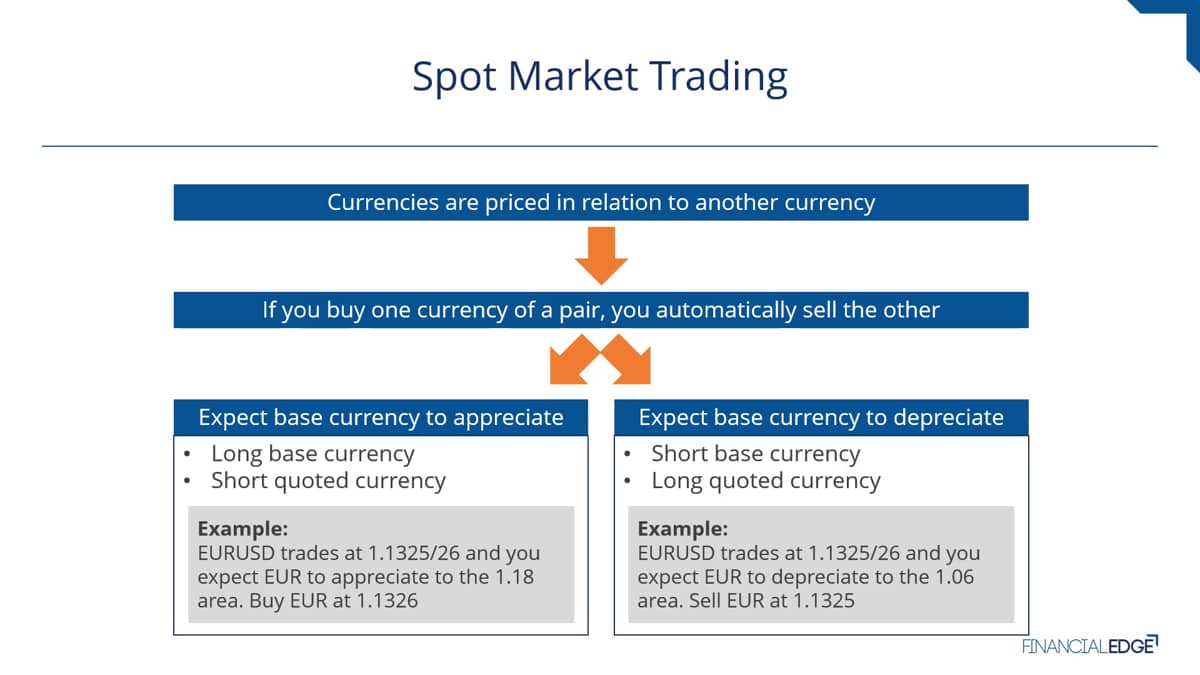
All price quotes in professional trading have a bid side and an ask side, and FX rates are no exception. The bid side of the quote, 1.1325 in this case, is a price at which the market taker can sell the base currency which is Euros in the Euro-US dollar pair. The ask side, which is quoted at 1.1326, is a price at which the market taker can buy the base currency. So if a client sells euros, the bid price applies. If a client buys euros, the ask price applies. As currencies are priced in relation to another currency, they're always quoted in pairs. This also means that if you are buying the base currency, you are automatically selling the quoted currency and vice versa. And this leads to a very simple rule for trading foreign exchange in the spot market, if you expect the base currency to appreciate, in other words, to gain value versus a quoted currency, you buy the base currency and sell the quoted currency. If you expect the base currency to depreciate, so to lose value versus the quoted currency, you sell the base currency and buy the quoted currency. The rule is very simple, but the challenge, of course, lies in predicting whether the base currency is going to appreciate or depreciate in the future. So let's have a look at some of the drivers behind foreign exchange spot prices. It all of course comes down to supply and demand, at least in case of flexible exchange rates. When the demand for a certain currency relatively to another currency increases, the value of this currency will increase relatively to the other one as well. But what drives such a change in demand and supply? While numerous studies have been done to explain the behavior of FX rates, and many factors have been found to have an impact simultaneously, which is what makes forecasting of future FX rates very challenging at practice. Here are just a couple of the points that an FX forecast would have to consider. Interest rate and inflation differentials are significant short-term FX drivers. Higher real interest rates offered by a currency attract capital inflows and should lead to currency appreciation. But as market prices are driven by expectations, not only the current real interest rates are important, but also the expectation of how those will develop in the future, which will depend on future economic developments, and monetary policy in the two countries affected. Political stability is, of course, another driver, and as a long-term factor, the purchasing power parity principle is often mentioned, and behind this principle stands the idea that similar goods should have similar FX adjusted prices in all countries.