Pensions and OPEBs Introduction

- 06:31
Understand the concept of defined pension benefit plans and other post employment benefits
Understand the concept of defined pension benefit plans and other post employment benefits
 Pensions Summary
This is an introduction to pension and other post-employment benefits, also known as OPEBs. We're going to start by just understanding the difference between the two main types of pension scheme, a defined benefit scheme, and a defined contribution scheme. Let's start with defined contribution. Here the contributions going into the pension scheme are guaranteed, and this is typically calculated as a percentage of an employee's salary. So each year, five to 10% of employees salary is put in a pension scheme. The actual end pension you get is going to be dependent on the investment performance of the fund. And critically, the employee bears the investment risk, not the company. So there's no potential liability other than the yearly contribution that the company faces. Compare this to defined benefit schemes. These are very different. In this case, the contributions coming out of the pension scheme at retirement are guaranteed, and this is typically calculated as a percentage of the employee's final salary. And sometimes these schemes are actually known as final salary schemes.
Normally, in this situation, a pension fund is established with which to take the contributions that the company and potentially the employee make and invest them. And that pension fund is guaranteed by the company. In other words, if there's not enough assets at retirement, the company has guaranteed to make up the difference. In other words, they're bearing the investment risk.
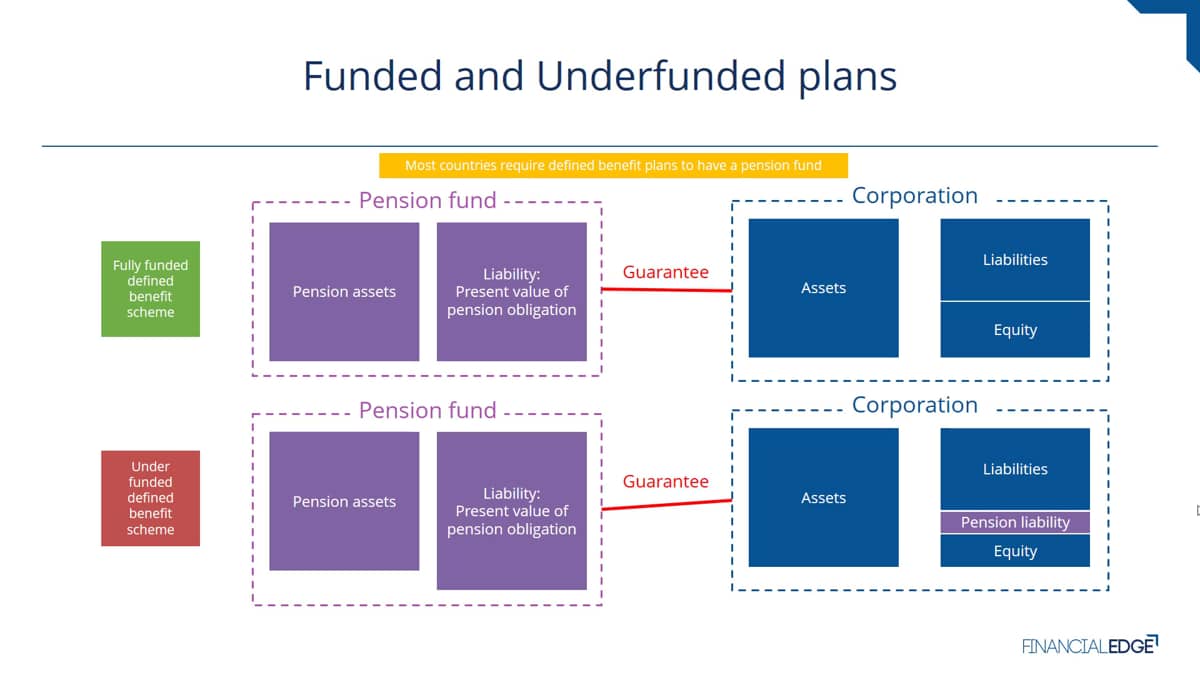
Now, there's some other terminology which is useful to understand, and that's the difference between funded and underfunded plans. So we're not talking about unfunded, but we're talking about funded and underfunded. If we take a regular corporation, it has some assets, liabilities, and equity. And let's assume in this case they have some employees with a defined benefit pension plan. This means that there will be a a separate pension fund, and we're going to make the assumption that the pension fund is fully funded. And what that means is the pension assets exactly equal the liabilities that the pension fund faces, which is essentially the present value of the future pension payments you're going to make to the employees once they have retired. And if those two items are equal, there's no outstanding liability to the corporation. And remember, the corporation has given a guarantee to the pension fund. Now, where does this guarantee become important? It becomes important when the scheme becomes under funded. So what this means is, is that this started out as a funded scheme, a pension fund or set up with, with some assets contributed by the company typically in cash. And that cash then gets invested. However, over time, the liability has grown faster than the pension assets. And there can be a number of reasons for that. But you can see here there's a deficit because the liability is larger than the pension assets. Now remember, the corporation has a guarantee has guaranteed the pension fund. So this means that that difference is a liability facing the corporation, and that will be reflected on the corporation's balance sheet. So if a defined benefit scheme has become underfunded, where the pension assets are less than the liabilities, because of that guarantee, that pension, pension liability needs to be reflected on the corporation's balance sheet. Now, most countries require defined benefit plans to have a pension fund. There's some exceptions to that, specifically countries like Germany. So you need to just take care and to evaluate each situation. But most countries would expect if there's a defined benefit scheme for the corporation to have set up a pension fund. And if that pension fund is underfunded, the difference would be reflected on the corporation's balance sheet.
Lastly, let's take a look at unfunded schemes. This is where we have a corporation with assets, liabilities, and equity. And remember, the pension or OPEB in this case, has a claim against the corporation's assets and cash flows. And the reason for this is because it's unfunded, it means there's no separate pension funds separated out from the company. In other words, the pension fund and the company are one. So this means that typically the corporations don't invest in any financial assets, they just invest in their operations. So the full liability will be reflected on the balance sheet, and this could be an OPEB liability or a pension liability. OPEB liabilities, generally speaking, are most common in the United States because healthcare costs are key post-employment benefit. In most countries around the world, it's pensions, which are the primary issue. So to recap, defined contribution schemes, no risk to the corporation. After they've made the yearly contribution. Defined benefit schemes, the corporation has guaranteed the pension at retirement. If it's a defined benefit scheme and it's underfunded, then the difference, the underfunded piece will be on the corporation's balance sheet. If it's an unfunded scheme, for example, in countries like Germany, in this case, the corporation and the pension fund are one, and you'll see the full pension liability on the balance sheet.
|
AI for Analysts Series - Accelerate your workflows with Claude, ChatGPT, Endex and more. Watch the recordings! |
You are trying to access premium learning content.
Discover our full catalogue and purchase a course Access all courses with our premium plans or log in to your accountYou are trying to access premium learning content.
Discover our full catalogue and purchase a course Access all courses with our premium plans or log in to your accountYou have reached the limit of annotations (10) under our premium subscription. Upgrade to unlock unlimited annotations.
Find out more about our premium planYou are trying to access content that requires a free account. Sign up or login in seconds!
Create a free account or log in to an existing oneYou are trying to access content that requires a premium plan.
Find out more about our premium plan or log in to your accountOnly US listed companies are available under our Free and Boost plans. Upgrade to Pro to access over 7,000 global companies across the US, UK, Canada, France, Italy, Germany, Hong Kong and more.
Find out more about our premium plan or log in to your accountA pro account is required for the Excel Add In
Find out more about our premium planThank you for already submitting feedback for this course.
CPE stands for Continuing Professional Education, by completing learning activities you earn CPE credits to retain your professional credentials. CPE is required for Certified Public Accountants (CPAs). Financial Edge Training is registered with the National Association of State Boards of Accountancy (NASBA) as a sponsor of continuing professional education on the National Registry of CPE Sponsors.
For self study programs, 1 CPE credit is awarded for every 50 minutes of elearning content, this includes videos, workouts, tryouts, and exams.
You must complete the CPE exam within 1 year of accessing a related playlist or course to earn CPE credits. To see how long you have left to complete a CPE exam, hover over the locked CPE credits button.
CPE exams do not count towards your FE certification. You do not need to complete the CPE exam if you are not collecting CPE credits, but you might find it useful for your own revision.
