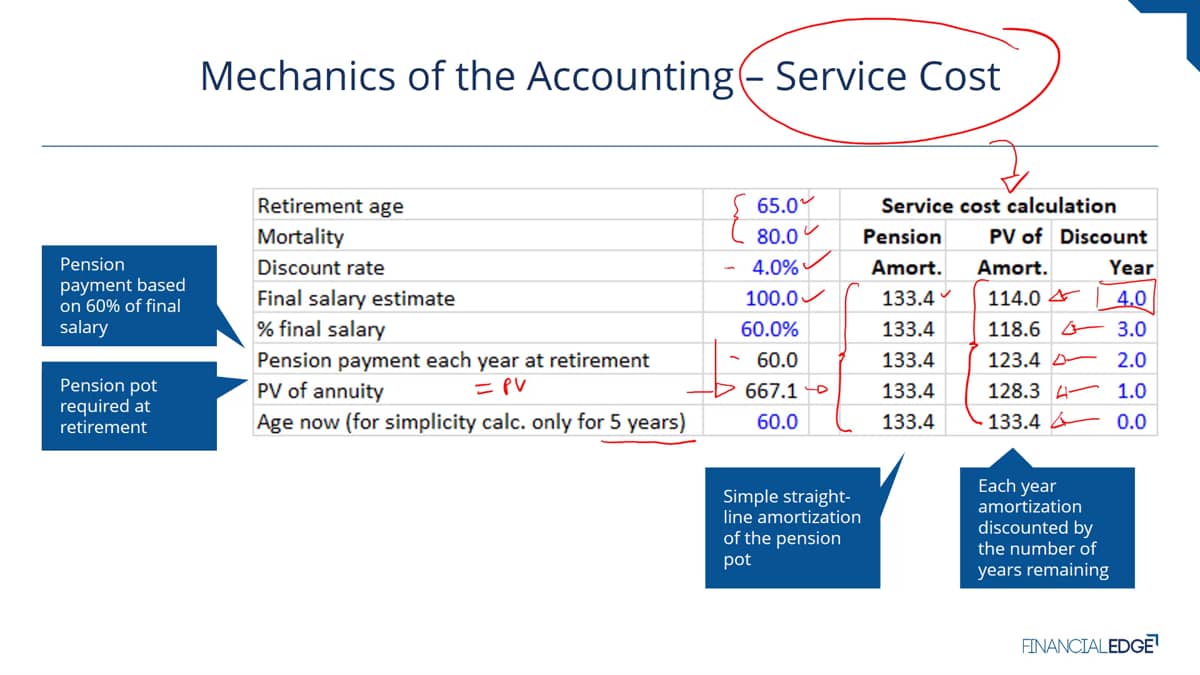
We're going to take a look at pension and OPEB accounting mechanics. We're going to start with a calculation of a pension scheme and we've made some simplifications here. We've got a situation where somebody's retiring 65, we expect them to die at 80. Yeah, we've got to be pretty morbid with some of our assumptions. We've got a discount rate of 4% and in this case, we expect, and this is an estimate, the person to have for final salary of 100. Now in this scheme, we're going to assume that the benefit is 60% of your final salary. So this means the person is going to get a pension of 60 each year from age 65 until they die. We estimate that's going to be age 80. Now, to make things simple, we've assumed that that 60 doesn't grow by inflation. It's just flat and that just makes math easy. In addition, we've assumed that the person that we are looking at here is age 60 already pretty unrealistic. But the benefit is, it means we've only got five years worth of contributions. And it makes the, the numbers simple and easy and you can see them all on one screen. We have run the numbers using the present value function in Excel, so that's equals pv. And we have run in that calculation the discount rate of 4%. We have put the payment of 60 and we have done that for a period of 15 years. The difference between the retirement age and mortality. That has spat out a figure of 667.1. So that is the present value of the annuity that we'd have to buy to give that person their pension. In other words, we've got to generate a fund as a company equal to 667.1. Now the accountants take that and they say, well how long have we got? In this case, simplistically we've got five years. So that 667.1 is then divided by 5. And in this case you can see we've got to kind of straight line amortization. Now it wouldn't make sense to use a straight line amortization because we can make contributions and invest them and get a return. So actually we should think about present values. So what we've done in each period, we've taken 133.4, we've present valued it. Assuming that we make the payment at the end of the first year, it means that we've got four years left. Then we've just discounted that by four years to get the present value of 114. And next year it'll be discounted by three years to get a payment of 118. And next year it'll be two years and then one year, and then just before the person retires, we'll make one final payment. And of course then they just retire. So there's no no difference between the payment and the present value. So we'll make the contribution of 133.4. So all these contributions that we've got to make or estimate, estimate that we've got to make are what we call service cost. And this is what gets expensed on the company's income statement. So just to reiterate, it's simple straight line amortization of the pension pot, and then we present value that, and that gives us the service cost which gets expensed on the income statement. Let's take a look at the detail. We'll see in the notes of the accounts, which potentially will go on the balance sheet if the scheme is under funded. So we'll start with the projected benefit obligation, which is often shortened to PBO. And we start with the existing liability. So if the scheme has been running, then the company would've built up our liability. Then we add the service cost to it because remember that's the incremental benefit we're giving because the person's worked an extra year. So in this case, the service cost gets added to the projective benefit obligation. And of course that means we kind of assuming that that's the correct estimate and it could not be. Then we have an interest cost. Now remember that service cost was a present value, so over time it grows. And not only that, the existing base will grow as well. So the interest cost just reflects the discount, the unwinding the discount and gets you to the future value. Then if we have made a mistake in the estimates, and that could be anything, it could be the discount rate, it could be the final salary estimate, it could be the mortality estimate. If any of those are wrong, we're going to have to adjust the future service cost calculations. But not only that, you've also got to adjust any built up liability. So these actuarial adjustments can be really big and it can make a big problem. It can suddenly put a scheme which is fully funded into something which is really underfunded. Now, when we make a cash payment, either buying an annuity or make payments to the employees who retired, that means we will deduct or subtract from the projected benefit obligation and that will give us the ending amount for the year. Now, what goes on to the income statement? Well, it's the service cost, which represents the incremental benefits we're giving to the pensioners or the employees who are eventually going to retire and the service cost because that's the unwinding of the discount. Now, in some situations you may also have an amortization of their actuarial gains and losses, and that's true of US GAAP, but it's not true of IFRS and we'll cover that in another video, but that kinda gives you an overview of the projected benefit obligation. Now let's hop over to the plan assets. Now remember, if the projected benefit obligation is larger than the plan assets, the scheme is underfunded. We start out with any existing asset base and hopefully the company that's got a scheme ready, we'll have been building up assets over time. Then we make cash contributions and When the company makes cash contributions, they get added to the plan assets that go from the company into the pension fund and hopefully we will get a return on those assets and we'll put the actual return because of course you can't lie about that into the plan asset number. And that can be pretty volatile. If the pension fund is invested in equities could be very volatile. Typically in my experience, it's more likely that European pension funds will be invested in equities if they're invested in fixed income, less volatile. And my experiences tend tends to be US schemes tend to be more invested in to fixed income, but nevertheless, they still potentially will both be different than the discount rate that we've used on the liability side. And then of course, if we make payments to the pensions, either buying annuities or making payments to them directly, then that will reduce the plan assets because we've paid cash out from the pension scheme and that will give us our ending amount. Does any of this affect the income statement? Well, kind of on the income statement for the company, we don't actually put the actual return on plan assets. And the reason for that, can you imagine if there's a big drop in the stock market or a big hike in the stock market, you'd end up with having a very volatile number on the company's income statement. So instead they only put the expected long term returns on the income statement, and this means there can be a difference between that and the actual returns. And that difference goes to other comprehensive income. So it affects equity, but it won't affect the income statement in that year and it'll reduce volatility. So there's some mechanics of the plan assets. Now let's take a look at while we're here, just the difference between other post-employment benefits and pensions in terms of the ranking. And when I say ranking, I mean this from a kind of credit perspective or debt restructuring perspective. Now, pensions, these are pensions for retirements. These are payments that people get when they retire and are no longer employed. These typically are a very senior liability and in some countries like the US or the UK, these will be regulated. So if you are doing a debt restructuring or indeed an acquisition, you will normally in the US and the UK need to get not only the trustees approval or the pension fund, also the regulated approval. And there've been situations where there trustees have agreed a deal, but the regulators have thrown it out specifically, the KKR acquisition of Alliance Boots. And in most countries there has to be some kind of pension funds set up, and there's some exceptions to that with Germany, for example. And the regulators usually require where the schemes regulated like the US and the UK, a minimum cash payment to go into the trust fund. And as a consequence, if you're doing a leveraged buyout, it's worth getting what the minimum cash payments have to be made into the pension scheme. In terms of seniority, I would put pension liabilities pretty high, and they can be, I would certainly put them equal to senior debt and in some cases they will be more senior than the debt. So if you're doing a restructuring, the pension liabilities will get paid off first, followed by the senior debt and certainly any underfunded amount.
Now, when we come to OPEBs or other post-employment benefits, these are typically healthcare benefits. So this means that this is a big number in the US tends to be small outside the US.
These unlike pensions, which are senior liabilities are subordinated. So they typically will be thrown into the general creditor pool in a debt restructuring. Now that's for debt restructuring. For valuation, OPEBs are still senior to shareholders, so just treat them like debt from valuation purposes.
Now, because these are subordinated and typically they're not necessarily regulated, this means most companies or a lot of companies don't fund them and they just build up the liability and it's kind of pay as you go. That's changing a little bit as these liabilities have become really significant. So a number of companies are starting to fund these schemes. They tend to be only important for the US where healthcare costs are really significant. There are no minimum payments, but remember, the liability is still senior to shareholders. So from a valuation perspective, you still need to deduct this from enterprise value to solve for your equity value.