Pension and OPEBs Valuation Adjustments

- 05:58
Understand the funded status of pensions and how this is reflected in the market share price.
Downloads
No associated resources to download.
Understand the funded status of pensions and how this is reflected in the market share price.
No associated resources to download.
So we're going to take a look at pension and opep valuation adjustments, both under IFRS and US GAAP.
Let's start by just doing a recap of the enterprise value bridge.
We start with enterprise value, we add non core assets, add associates, add short term investments, add cash, then we flip over and deduct the claims prior to shareholders.
Obviously this is going to include debt, but also pensions and eps net of tax in most countries, possible exception in Germany.
There's less preference shares, less non controlling interest to give us the diluted market capitalization.
So that's our standard bridge.
Remember, you want to use fair values, market values where possible.
Now, in terms of coming to post-employment benefits, and I'm including pensions in the definition of post-employment benefits.
Remember that defined contribution plans, there's no investment risk to the corporation, so there's no valuation impact.
So don't worry about defined contribution plans.
And increasingly pensions are defined contribution.
However, to find benefit plans, this is where you've got an issue.
So for older industries where they've got an old workforce and they've got to find pension plans, this is where you need to make the adjustment.
So the first question is, are they over or underfunded? If they're overfunded, there are some cases where you can rate the pension scheme, but it's rare.
It depends on the jurisdiction.
And most analysts kind of ignore overfunded pension schemes.
So you just do your standard bridge from an enterprise value to active value, ignoring an overfunded pension scheme.
If it's unfunded or underfunded, you've got a valuation impact.
So you start with an enterprise value, subtract net debt and subtract the pension or OPEB deficit net of any tax liability.
And typically the equity will be smaller because what will have happened is the share price will have already priced in the pension liability because it's out there, it's in the financial statements and the share price will have already reduced.
So it's really critical to understand what the funded status is.
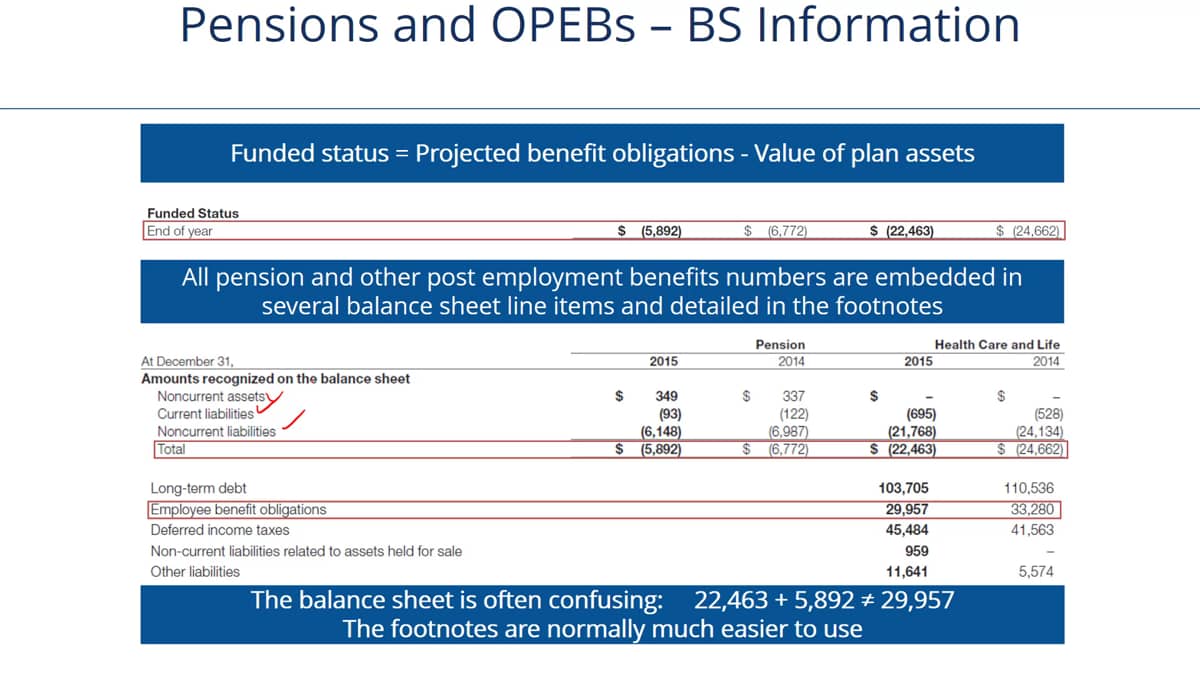
So if we take a look at the balance sheet information here, we normally will go straight to the funded status.
The difference between the projected benefit obligation, less the fair value of plan assets.
If it's negative, in other words, underfunded, you've got a valuation adjustment to make.
Generally speaking, it's always best to go to the notes, to the accounts because actually the numbers reflected on the balance sheet. It's actually not in just one line item.
It's usually sprinkled around two or three.
So you can see here that what we've got is we have got the amounts recognized on the balance sheet are in three different items and you notice there's an asset there, which makes it pretty confusing. So generally speaking, you're going to get the best result by taking the funded status in the footnotes.
Okay? And most companies will list that.
So in order to make the valuation adjustments, there's a bit of a kind of decision tree that you need to go through.
Firstly, calculate the fund is stated from the footnotes. You know, that's the difference between the present value of the obligations versus the fair value of the assets.
If the assets are above the obligations, you can ignore it from a valuation perspective because we don't treat the surplus as a cash equivalent. There are some rare situations where you could do, but generally speaking, I wouldn't make any adjustment if it's overfunded in terms of the enterprise value calculation, if it's not, in other words, the plan assets are less than the obligations.
The projected benefit obligation, you need to make two adjustments.
Firstly, you need to, if it's US GAAP, remove interest cost and amortization of the actual gains and losses from above the EBIT line to below.
The easiest way of doing that is by adding back the full pension costs and then just deducting the service cost.
If it's IFRS, you need to check the notes.
In most cases, in my experience, under IFRS companies split the cost of pensions between the service cost and they leave that above the EBIT line and then interest below the EBIT line.
Remember, under IFRS, you don't have amortization of actuarial gains and losses, they just stay in other comprehensive income.
For the balance sheet, you need to calculate the debt equivalent.
Now in most countries, you will get a tax deduction when you make a contribution into the pension plan.
So we'll take the deficit minus 1, 1 times 1 minus the marginal tax rate.
And IFRS often you can identify the deferred tax assets.
You don't even need to do the calculation.
You can just take the underfunded amount, less the deferred tax asset related to it.
However, do you remember in some countries the um, if they're unfunded like Germany, typically the expense is deductible when you expense the pension, not when you pay cash into the fund.
So just be careful if you are doing this adjustment for German companies or potentially Austrian companies, you may not need to tax adjust it.
One other issue is that even if it's overfunded, you may need to make an adjustment to EBIT because remember, you'll typically have more interest in income than interest expense.
And so under US GAAP, you still need to clean EBIT.
So you are only representing service cost.
|
AI for Analysts Series - Accelerate your workflows with Claude, ChatGPT, Endex and more. Watch the recordings! |
You are trying to access premium learning content.
Discover our full catalogue and purchase a course Access all courses with our premium plans or log in to your accountYou are trying to access premium learning content.
Discover our full catalogue and purchase a course Access all courses with our premium plans or log in to your accountYou have reached the limit of annotations (10) under our premium subscription. Upgrade to unlock unlimited annotations.
Find out more about our premium planYou are trying to access content that requires a free account. Sign up or login in seconds!
Create a free account or log in to an existing oneYou are trying to access content that requires a premium plan.
Find out more about our premium plan or log in to your accountOnly US listed companies are available under our Free and Boost plans. Upgrade to Pro to access over 7,000 global companies across the US, UK, Canada, France, Italy, Germany, Hong Kong and more.
Find out more about our premium plan or log in to your accountA pro account is required for the Excel Add In
Find out more about our premium planThank you for already submitting feedback for this course.
CPE stands for Continuing Professional Education, by completing learning activities you earn CPE credits to retain your professional credentials. CPE is required for Certified Public Accountants (CPAs). Financial Edge Training is registered with the National Association of State Boards of Accountancy (NASBA) as a sponsor of continuing professional education on the National Registry of CPE Sponsors.
For self study programs, 1 CPE credit is awarded for every 50 minutes of elearning content, this includes videos, workouts, tryouts, and exams.
You must complete the CPE exam within 1 year of accessing a related playlist or course to earn CPE credits. To see how long you have left to complete a CPE exam, hover over the locked CPE credits button.
CPE exams do not count towards your FE certification. You do not need to complete the CPE exam if you are not collecting CPE credits, but you might find it useful for your own revision.
