Let's calculate HSBC's efficiency ratio.
And in order to do so, we're gonna need to grab some information off of the income statement.
So let's just take a look at the information we've got in front of us.
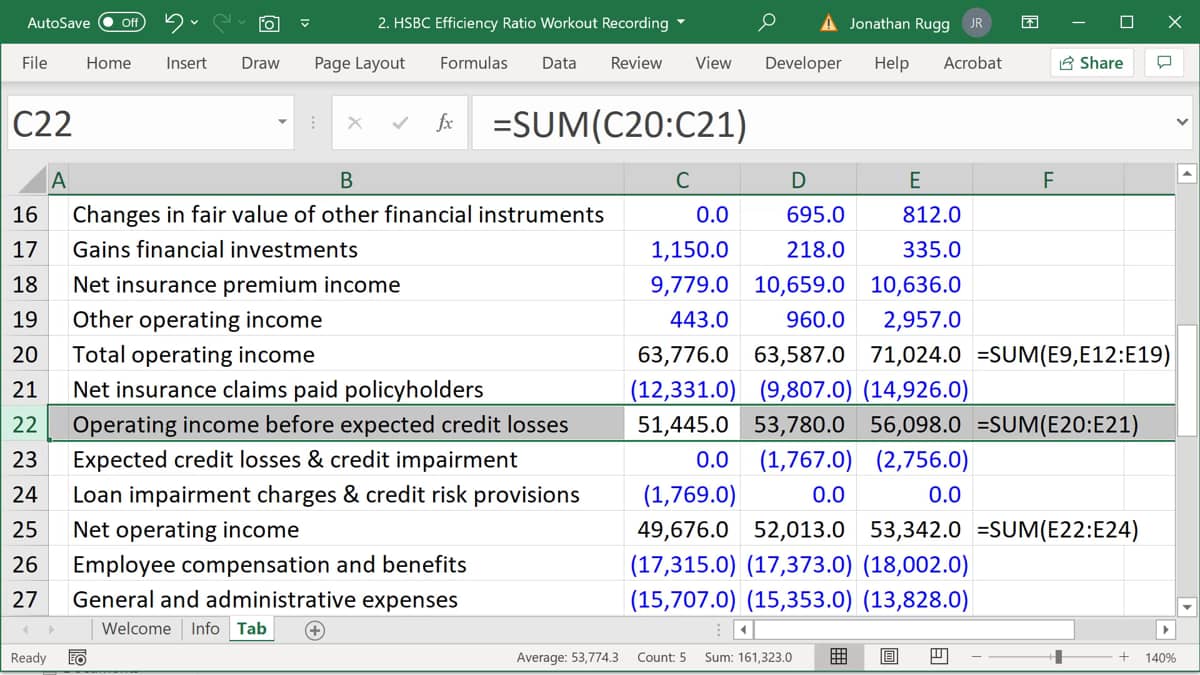
This calculation is gonna need us to pick up the operating income, and we pick up here the operating income before expected credit losses.
And we're gonna need to compare that to the operating expenses.
So if we scroll a little bit further down, we find the total operating expenses on row 31, but you might notice that directly above that we've got goodwill impairment.
Goodwill impairment is an example of a non-recurring item.
And if you think about it, we're gonna compare the efficiency ratio from one year to the next.
It's pretty important to calculate that on an underlying basis.
So we're gonna strip out that non-recurring item.
Let's throw those numbers together in the calculation below.
So we're gonna go and grab, first of all, as suggested from row 22, the operating income before expected credit losses.
And then we're gonna go and grab the total operating expenses, which is on row 31.
But as suggested, we're gonna make an adjustment for the non-recurring goodwill impairment. So let's just make sure we adjust for that.
And now of course, we've got the recurring total operating expenses.
All we need to do now is grab those recurring operating expenses and divide them by the operating income before the expected credit losses to calculate the efficiency ratio.

 HSBC-Efficiency-Ratio-Workout-Empty
