HSBC Net Stable Funding Ratio Workout

- 06:16
HSBC Net Stable Funding Ratio Workout
HSBC Net Stable Funding Ratio Workout
Okay, we're gonna calculate the net stable funding ratio for HSBC.
And in so doing, we wanna think about what is funding the banks, the available stable funding.
For example, equity capital, which should be a hugely stable source of available funding.
We also want to think about required stable funding.
So if, for example, HSBC choose to hold, uh, investment mortgage backed securities on their balance sheet, then that will require a certain amount of stable funding.
The more risky these assets are, the more stable funding they will require.
So if we have a look at the answer section of the question, we're gonna first calculate the available stable funding.
And in order to do so, we're gonna go and grab for equity capital the available stable funding factor of a hundred percent and then multiply that out by the appropriate line item on the balance sheet. So we're gonna pick up total equity of 60, let's just copy that out.
We're gonna do exactly the same for deposits. Now as I'm grabbing these, I want you to think about in this question, the available stable funding factors that I'm picking up, equity capital was given at a hundred percent deposits was given at 95%.
The inference there is that both of those are hugely stable sources of funding.
All other liabilities are given an available stable funding factor of zero.
So we are literally just gonna go and grab all the other items at the bottom section of the balance sheet that we have not yet picked up.
So we're gonna go all the way down from D 39 to D 50, let's just copy that out.
And they're all given zero.
So if we add that up, we've got the available stable funding for HSBC, but we wanna think about the required stable funding.
And the first thing we've got here is cash.
So I think everyone would consider holding cash to be fairly low risk.
And as a consequence, the required stable funding factor is zero.
Let's multiply that out by the appropriate line item on the balance sheet. So we're gonna have a look at the assets and grab the, the cash number there.
Let's just copy that out.
And then we're gonna go and do exactly the same thing for multiple securities.
So you'll notice that the required stable funding factor for multiple securities is 5%.
The inference there is it's slightly more risky to hold multiple securities than it is to hold cash to require, uh, a little bit more stable funding.
Let's go and pick up under the asset section of the balance sheet, the Hong Kong government debt certificates, which look like the marketable securities we are looking for.
And we also wanna do exactly the same thing for financial investments.
So we're gonna pick up the appropriate funding factor, we've got 5% there, and multiply that out by on the balance sheet. If we go and have a look at the asset section of the balance sheet, the financial investments, uh, which is debt, and just copy that out to the right.
Okay, investment grade corporate debt.
Now interestingly, if we go and look at the required stable funding factor for investment grade corporate debt, you'll see it's 15%.
The inference there is a little bit more risky, so it requires a little bit more stable funding.
Let's go and have a look at the asset section of the balance sheet again and see what we've got.
So I can see on row 27, we've got some investment grade corporate debt there.
Let's copy that out.
And then investment mortgage backed securities.
Now we're getting a little bit more risky there.
Uh, we mentioned this earlier, these have got a, a required stable funding factor of 50%, but HSBC are not showing any of those on the face of the balance sheet. So we're gonna have zero there.
We're gonna do exactly the same thing for the derivatives.
So they've got a required stable funding factor of a hundred percent and we're gonna multiply that out by the derivative assets sitting on the balance sheet.
So if we go and find those there, they're on row 24 again.
Let's copy those out.
Now all the other assets, uh, uh, we're gonna lump together, they have in this question, um, a required stable funding factor of a hundred percent.
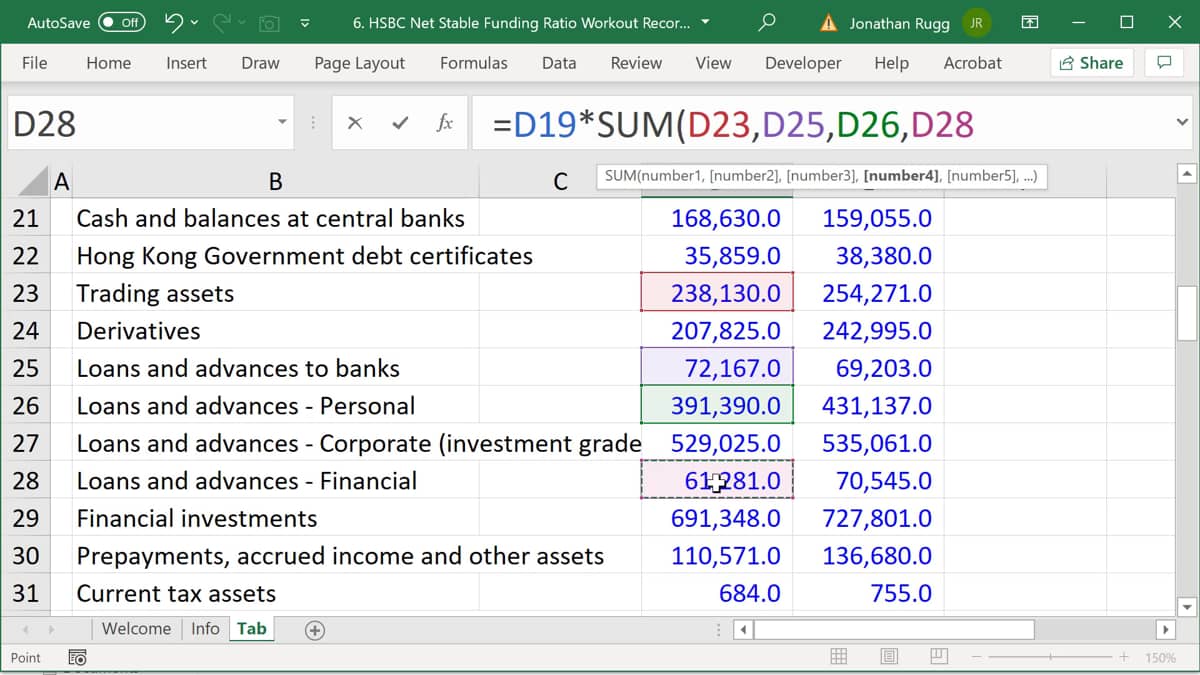
So we're gonna multiply that out by really everything else we are finding on the asset section of the balance sheet.
So let's just go back up, uh, and pick up everything that we have not picked up.
So I think we're looking at, um, E 23.
Uh, I think we're looking at E 25.
So let's just go back up and grab E 25, which is the loans and advances to banks.
I think we are looking at, uh, loans and advances personal in 26.
I think we are looking at loans and advances financial, uh, I think we're looking at prepayments.
We're looking at accrued tax assets, interests in associates, goodwill, and deferred tax assets.
So we're looking at all of those items.
Let's copy that out to the right.
Now having done that, we can add up the required stable funding.
And the final thing we need to do if we're gonna calculate the net stable Funding ratio is go and grab the available stable funding.
So let's go and grab the available stable funding from above and divide that by the required stable funding.
And we notice that the available stable funding is greater than the required stable funding.
|
AI for Analysts Series - Accelerate your workflows with Claude, ChatGPT, Endex and more. Watch the recordings! |
You are trying to access premium learning content.
Discover our full catalogue and purchase a course Access all courses with our premium plans or log in to your accountYou are trying to access premium learning content.
Discover our full catalogue and purchase a course Access all courses with our premium plans or log in to your accountYou have reached the limit of annotations (10) under our premium subscription. Upgrade to unlock unlimited annotations.
Find out more about our premium planYou are trying to access content that requires a free account. Sign up or login in seconds!
Create a free account or log in to an existing oneYou are trying to access content that requires a premium plan.
Find out more about our premium plan or log in to your accountOnly US listed companies are available under our Free and Boost plans. Upgrade to Pro to access over 7,000 global companies across the US, UK, Canada, France, Italy, Germany, Hong Kong and more.
Find out more about our premium plan or log in to your accountA pro account is required for the Excel Add In
Find out more about our premium planThank you for already submitting feedback for this course.
CPE stands for Continuing Professional Education, by completing learning activities you earn CPE credits to retain your professional credentials. CPE is required for Certified Public Accountants (CPAs). Financial Edge Training is registered with the National Association of State Boards of Accountancy (NASBA) as a sponsor of continuing professional education on the National Registry of CPE Sponsors.
For self study programs, 1 CPE credit is awarded for every 50 minutes of elearning content, this includes videos, workouts, tryouts, and exams.
You must complete the CPE exam within 1 year of accessing a related playlist or course to earn CPE credits. To see how long you have left to complete a CPE exam, hover over the locked CPE credits button.
CPE exams do not count towards your FE certification. You do not need to complete the CPE exam if you are not collecting CPE credits, but you might find it useful for your own revision.
 HSBC-Net-Stable-Funding-Ratio-Workout-Full
