We're gonna calculate HSBC's liquidity coverage ratio.
And in order to do so, we need to identify HSBC's high quality liquid assets.
Let's just remind ourselves that current assets are, is listed in order of liquidity on a business' balance sheet. And that might help us and give us some guidance, but we're gonna need more guidance.
We're gonna need to know in more detail what is included in these high quality liquid assets.
So if we scroll further down the question, we will notice that the high quality liquid assets are broken down to a couple of level, level one and level two.
And if we look at level one on row 28, it looks like they include cash and central bank reserves and marketable securities.
Level two appears to include corporate debt with certain credit ratings, residential mortgage backed securities.
But it's also true that at level two, a haircut is applied.
Now it would be difficult for us to read that information directly off the balance sheet.
So we might not necessarily be able to find that just on the face of the financial statements.
Let's go and calculate these numbers.
So first of all, we're gonna go and grab the level one high quality liquid assets.
And in fact, what I'm gonna do is grab the cash and balances at central banks.
The items in the course of collection and Hong Kong government debt certificates, they all meet that level one criteria.
Let's copy that out to the right.
We also want level two, but as suggested, it's gonna be difficult to read that off the face of the balance sheet.
So you'll notice in the question we've got the level two high quality liquid assets for HSBC on row 24.
Let's just copy that across.
Now what we want, of course, the total high quality liquid assets, we're gonna add those together and copy that out.
Now what we wanna do is compare the, the assets that they're sitting on against the the cash outflows.
So if we go a little further up the question, we've got some detail here on outflows.
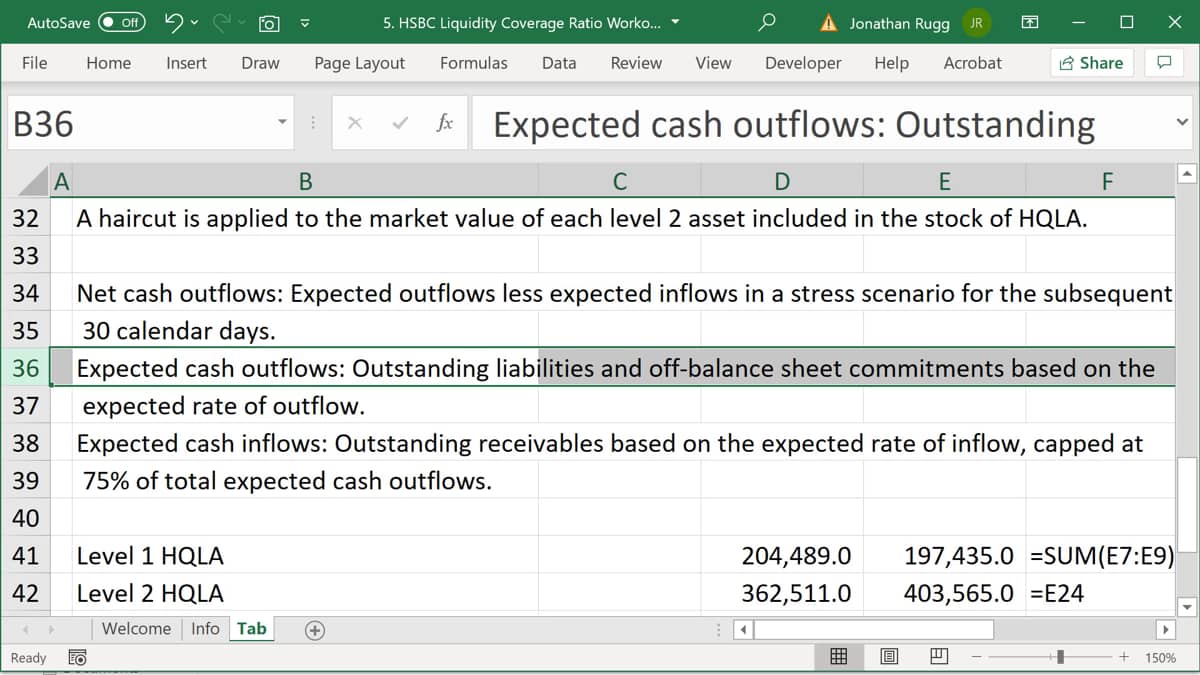
Well, we're gonna look at the expected cash outflows, and these are the outstanding liabilities and off balance sheet commitments based on expected rate of outflow.
We've got some inflows relating to receivables, and they're capped at 75% of the expected cash outflows. Again, it's gonna be difficult to read these from the first face of the financial statements.
However, we do have in the question already given to us, if we scroll a little bit further up the net cash outflows, they're on row 25.
Let's grab those and copy those across to the right.
So the liquidity coverage ratio, what we're gonna do is go and grab the total high quality liquid assets and divide it by the net outflows and let's copy that across.

 HSBC-Liquidity-Coverage-Ratio-Workout-Empty
