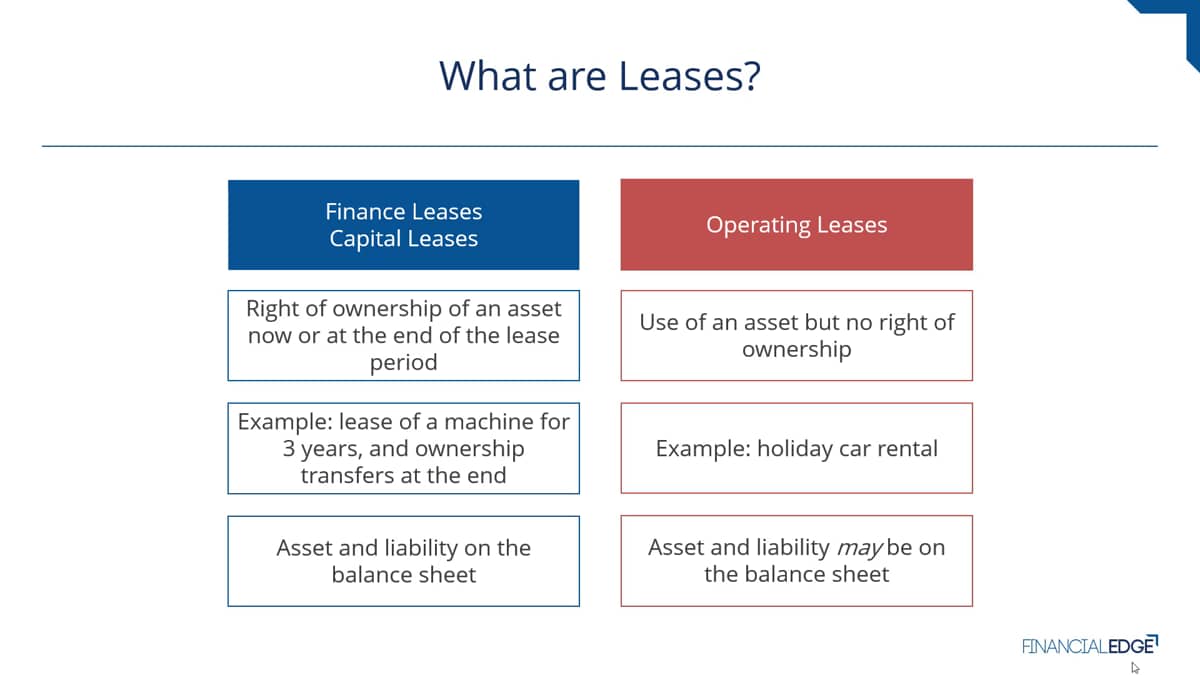
What are leases? Well, for private individuals, it might be hiring or renting a car on holiday. Again, for a private individual, if you were to lease or rent a room in a house or rent a flat or house itself, all of these are examples of leases for private individuals. Now, similar things can happen for companies. A company may hire things such as a bus or a store, a warehouse or an airplane.
Companies can lease or rent or hire any of these items. These can happen in the short term or the long term. Let's have a look at a relatively long term example. Here we have a three year lease, and it's going to cost 33,000 in rent per annum or lease expense per annum. Now, the way the accounting works follows what's actually happening in the real world. Our company is going to have the right to use this bus for the next three years, and so our accounting will then create an asset. So we have the right to use the asset for three years. However, we now have an obligation. We owe some money to a leasing company for the next three years. So we have a contractual obligation to pay them rent for three years. This creates an asset and a liability on our balance sheets. Now, you might think this is different to if I was paying with cash, if I bought something with cash, my assets or bus would go up and my cash asset would go down. But with leases economically, this is similar to using a bank loan to buy the assets. With a bank loan, your debt or liability would go up and your assets or bus would go up. So the accounting for leasing is initially very similar to using a bank loan to buy something.
The accounting follows the economics of the transaction rather than assuming that rent is just a business expense, i.e. an asset and a liability are created. You wouldn't just see the rent being expensed through the income statements. Instead, we have the asset and liability being created. Let's look at the lease accounting and mechanics in more detail. I know I need to create an asset and a liability, so I'm going to recognize an asset of 90,000 and a liability of 90,000 as well. Now, you might be thinking, hang on, the math doesn't work here. There's a three year lease on the left hand side at 33,000 per year. That means it should be 99,000 asset and a 99,000 liability. But instead, the present value of the rental payments is calculated, and this time it's at 90,000. It's that figure that goes on the balance sheet as the asset and the liability. So the present value is calculated using the contractual lease term and the lessees cost of debt.
Now, of course, there are always exceptions to every rule. When would we not use these accounting mechanics? Well, the exceptions are when you have leases of less than 12 months and those with variable lease payments, those exceptions that lease expense or rent expense straight through the income statements, and it does not create the assets and the liability.

 Leases Summary