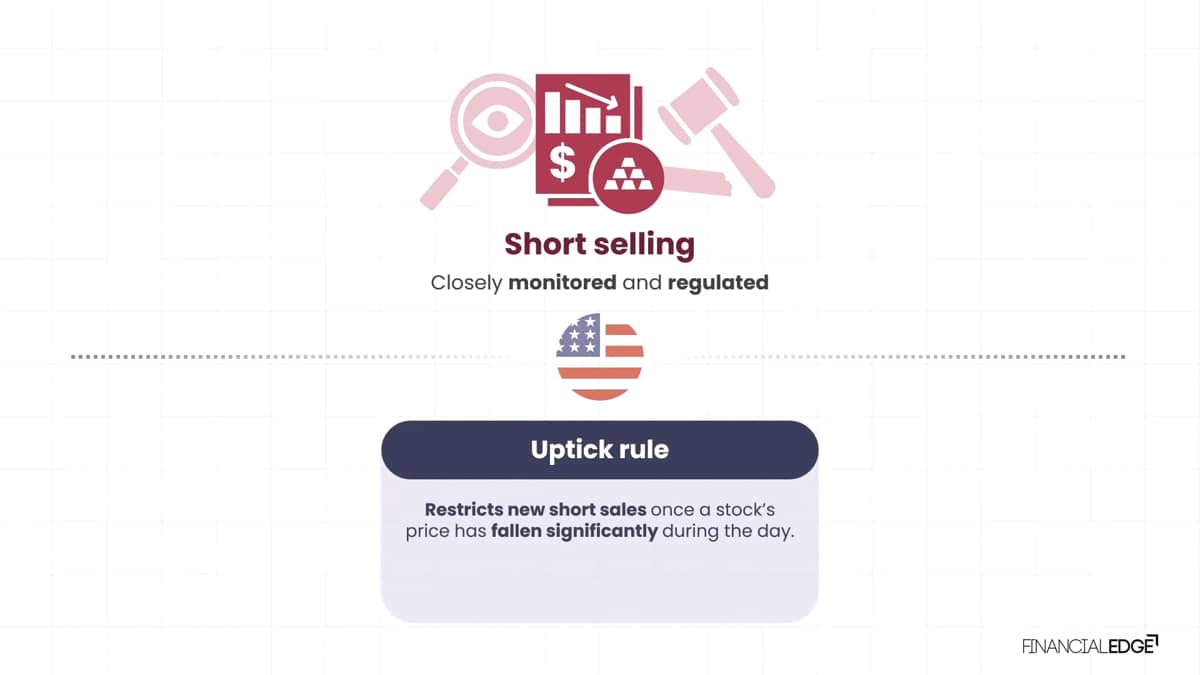
Short selling is closely monitored and at times restricted by regulators.
In the United States, an uptick rule restricts new short sales.
Once a stocks price has fallen significantly during the day, the idea is to prevent short sellers from accelerating a downward spiral.
Here's how it works. If a stock has dropped by 10% or more from its previous day's closing price.
Short sales can still take place, but only on an uptick, meaning at a price above the current best bid.
For example, if the best bid is $20, and the best offer is $20 and 2 cents, a short sale can be executed at $20 and 1 cents, $20 and 2 cents, or any price above $20, but not at $20 or below.
This rule forces short sellers to wait for a small upward price move before selling, helping to slow momentum and stabilize trading when markets become stressed.
Historically, during periods of market stress, such as the 2008 global financial crisis, many countries temporarily banned short selling completely for certain sectors such as banking or insurance stocks.
To stem panic.
There are also operational risks to consider, such as stock recall and short squeezes.
A stock loan agreement allows the original investor to recall shares if needed, for example, to vote or to sell them.
When this happens, the prime broker usually replaces the borrowed stock from another source, but in tight markets, recalls can create buying pressure and force short sellers to repurchase shares to cover their short position at higher prices.
This is what's known as a short squeeze when a stock with a large, outstanding short interest suddenly rallies and short sellers rush to buy back shares driving the price even higher.
Short interest measures the number of shares currently sold short, but not yet covered.
It's often expressed as a percentage of total shares outstanding or as the days to cover ratio, which indicates how many days of normal trading volume it would take to buy back all outstanding shorts.
Rising short interest can suggest growing bearish sentiments.
While a sharp decline often indicates covering or renewed confidence in a stock or sector.