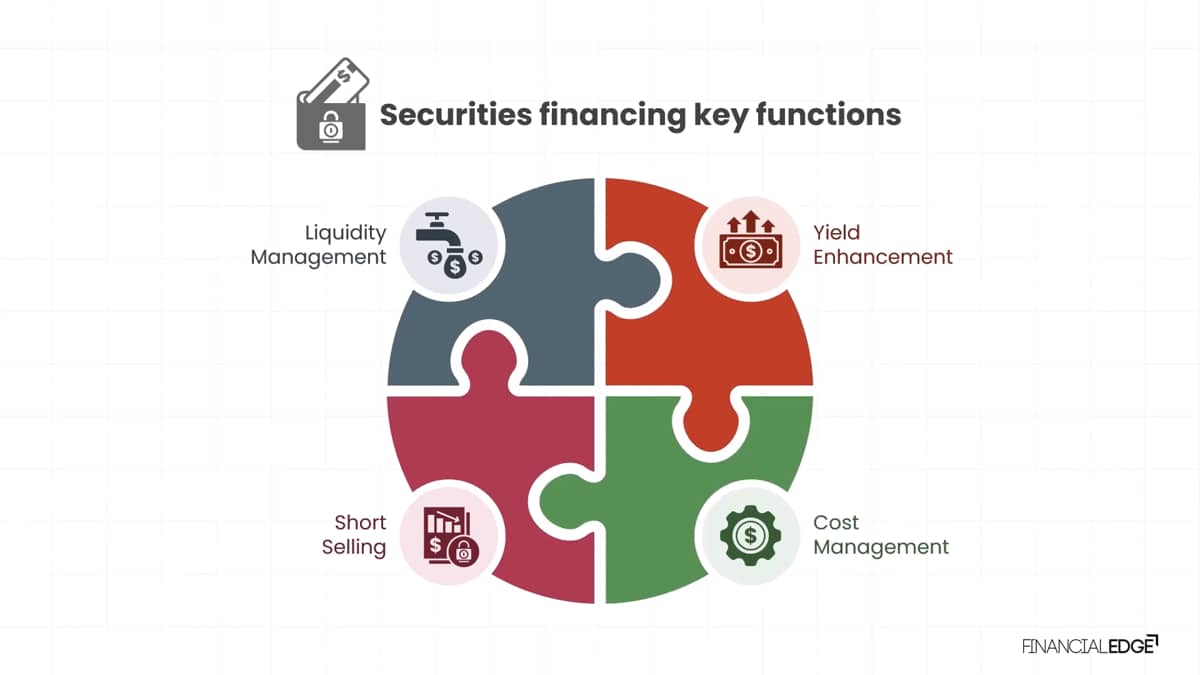
Securities financing serves four key functions across the financial system, and together they're what make markets run smoothly beneath the surface.
Firstly, liquidity management institutions use securities financing to ensure they have enough cash on hand for operations or settlement needs.
It's often a more flexible and cheaper alternative to short-term bank loans.
Secondly, yield enhancements by lending out securities through repos or stock loans.
Investors can earn extra income in the formal fees or interest boosting the overall yield of their portfolios.
Thirdly, short selling traders borrow securities to sell them short, aiming to profit if the price declines and they can buy them back later at a lower price.
This process adds liquidity, price, discovery, and depth to the markets, though it can also create short-term volatility and at times controversy.
Fourth is cost management.
Repos and stock loans can provide cheaper collateralized funding compared to unsecured borrowing, especially for short-term financing needs in practice, most of these transactions are governed by standardized legal frameworks such as the Global Master Repurchase Agreement, GMRA for repos, or the Global Master Securities Lending Agreements, GM SLA.
For stock loans. These agreements help ensure consistency across markets and manage counterparty and legal risk.
In some cases, the collateral received in these transactions can even be reused or re ated, temporarily lent out again to another party.
This adds further liquidity to the system, but also introduces additional complexity and counterparty risk, which is why such practices are tightly regulated and monitored by supervisors and clearing houses.