Let's have a look at the mechanics of what reinsurance treaties actually cover.
Most reinsurance policies are set up on a proportional basis.
However, non-proportional treaties do exist as well, but are normally only used in certain bespoke circumstances.
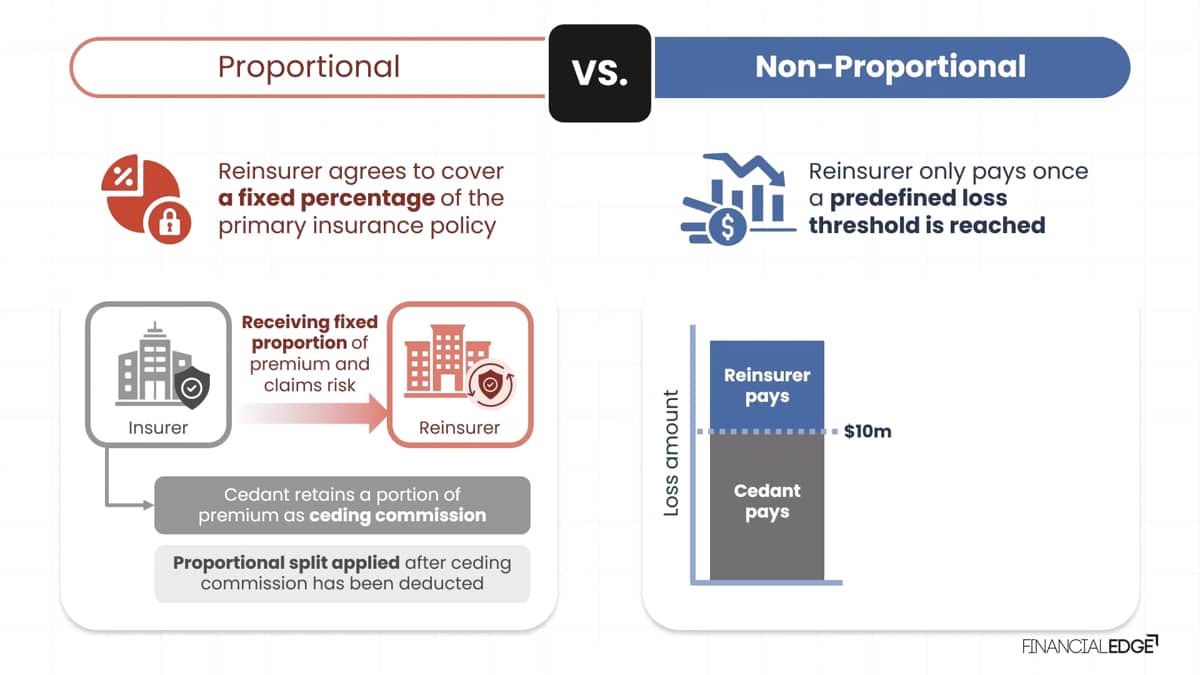
At a high level, proportional treaties are where the reinsurer agrees to cover a fixed percentage of the primary insurance policy, receiving a fixed proportion of the premium, and taking on the same fixed proportion of the claims risk.
In this situation, the primary insurer, the decedent, will retain a portion of the initial premium, a seeding commission to cover the costs of entering into the insurance policy in the first place, with a proportional split applied to the remaining premium after the seeding commission has been deducted.
Non-proportional reinsurance treaties operate by only providing cover to the primary insurer only once a predefined loss threshold is reached.
For example, the reinsurer might be required to cover the full amount of any losses exceeding $10 million.
These non-proportional treaties are often used for catastrophic events, where the principle focus of the arrangement is to protect the primary insurer against extreme losses.
Within proportional reinsurance treaties, there are a number of subcategories, including quota share, surplus share, and facultative obligatory treaties.
Under a quota share treaty, a fixed percentage of each insurance policy is taken on by the reinsurer.
For example, if the quota share is 30%, then the reinsurer takes 30% of the premium after the seeding commission and pays 30% of any claims made.
This type of treaty is straightforward and predictable way of sharing risk between the decedent and the reinsurer, and is most commonly used for high volume, low severity insurance risks, such as motor property or casualty insurance.
An alternative version of proportional treaties are surplus share treaties.
Under this type of arrangement, the reinsurance treaty only kicks in and provides cover for risks exceeding the primary insurer's retention limit.
This means that any losses below the retention limit are all the responsibility of decedent, meaning they have no reinsurance protection up to the retention limit.
The decedent is retaining all of the risk below this level.
Above the retention limit, losses are shared on a proportional basis.
For example, if the insurer retains $1 million per policy, then the reinsurer will only have to pay their proportion of claims on any amounts over $1 million.
Surplus share treaties are typically used for insurance policies where the range of sums insured is large.
For example, property and engineering, where the primary insurer is comfortable covering lower levels of claims without reinsurance, but wishes to offset risk from larger claims only.
It is also possible to combine both of these approaches within a combined quota share plus surplus treaty, which provides regulatory capital relief from The the quota share, but also adds flexibility for larger, more complex risks.
And finally, there are facultative, obligatory, or fac oblique treaties.
This involves the primary insurer seated risks on a facultative or case by case basis.
Under the terms of the reinsurance treaty, the reinsurers obligated to take on the risk up to the limits set in the treaty.
This is typically used in emerging markets and for specialist insurance, where facultative arrangements are more common for non-proportional reinsurance treaties, there are a range of different types, but fundamentally, they all operate in the same way.
The reinsurer covers all losses above a certain threshold referred to as the attachment point.
At a high level, these treaties are crucial for managing tail risks, large losses arising for more unlikely, catastrophic events, such as natural disasters where losses can be astronomical or from multiple large claims.
The aim here is to stabilize underwriting results and reduce capital requirements by reducing the financial strain from unusual or extraordinary losses, ensuring the ongoing solvency of the primary insurer.
Non-proportional treaties could apply to a single risk such as a building or aircraft, which is referred to as risk, excess of loss or risk XL to the aggregate of losses from a single catastrophic event such as a flood, hurricane, or earthquake referred to as catastrophe, excess of loss, CAT xl to the aggregate of losses within a specific time period, typically one year, which is referred to as aggregate excess of loss or AG xl, or alternatively to the decedent's entire loan portfolio where the reinsurer has to cover all further losses once a specific loan loss ratio has been reached, referred to as stop-loss reinsurance.
This helps to protect the underwriting profits of the.