Skip to content
Felix
  • Topics
    • My List
    • Felix Guide
    • Asset Management
    • Coding and Data Analysis
      • AI
      • Data Analysis and Visualization
      • Financial Data Tools
      • Python
      • SQL
    • Credit
      • Credit Analysis
      • Restructuring
    • Financial Literacy Essentials
      • Financial Data Tools
      • Financial Math
      • Foundations of Accounting
    • Industry Specific
      • Banks
      • Chemicals
      • Consumer
      • ESG
      • Industrials
      • Insurance
      • Oil and Gas
      • Pharmaceuticals
      • Project Finance
      • Real Estate
      • Renewable Energy
      • Technology
      • Telecoms
    • Introductory Courses
    • Investment Banking
      • Accounting
      • Financial Modeling
      • M&A and Divestitures
      • Private Debt
      • Private Equity
      • Valuation
      • Venture Capital
    • Markets
      • Economics
      • Equity Markets and Derivatives
      • Fixed Income and Derivatives
      • Introduction to Markets
      • Options and Structured Products
      • Other Capital Markets
      • Securities Services
    • Microsoft Office
      • Excel
      • PowerPoint
      • Word & Outlook
    • Professional Skills
      • Career Development
      • Expert Interviews
      • Interview Skills
    • Risk Management
    • Transaction Banking
    • Felix Live
  • Pathways
    • Investment Banking
    • Asset Management
    • Equity Research
    • Sales and Trading
    • Commercial Banking
    • Engineering
    • Operations
    • Private Equity
    • Credit Analysis
    • Restructuring
    • Venture Capital
    • CFA Institute
  • Certified Courses
  • Ask An Instructor
  • Support
  • Log in
  • Topics
    • My List
    • Felix Guide
    • Asset Management
    • Coding and Data Analysis
      • AI
      • Data Analysis and Visualization
      • Financial Data Tools
      • Python
      • SQL
    • Credit
      • Credit Analysis
      • Restructuring
    • Financial Literacy Essentials
      • Financial Data Tools
      • Financial Math
      • Foundations of Accounting
    • Industry Specific
      • Banks
      • Chemicals
      • Consumer
      • ESG
      • Industrials
      • Insurance
      • Oil and Gas
      • Pharmaceuticals
      • Project Finance
      • Real Estate
      • Renewable Energy
      • Technology
      • Telecoms
    • Introductory Courses
    • Investment Banking
      • Accounting
      • Financial Modeling
      • M&A and Divestitures
      • Private Debt
      • Private Equity
      • Valuation
      • Venture Capital
    • Markets
      • Economics
      • Equity Markets and Derivatives
      • Fixed Income and Derivatives
      • Introduction to Markets
      • Options and Structured Products
      • Other Capital Markets
      • Securities Services
    • Microsoft Office
      • Excel
      • PowerPoint
      • Word & Outlook
    • Professional Skills
      • Career Development
      • Expert Interviews
      • Interview Skills
    • Risk Management
    • Transaction Banking
    • Felix Live
  • Pathways
    • Investment Banking
    • Asset Management
    • Equity Research
    • Sales and Trading
    • Commercial Banking
    • Engineering
    • Operations
    • Private Equity
    • Credit Analysis
    • Restructuring
    • Venture Capital
    • CFA Institute
  • Certified Courses
Felix
  • Data
    • Company Analytics
    • My Filing Annotations
    • Market & Industry Data
    • United States
    • Relative Valuation
    • Discount Rate
    • Building Forecasts
    • Capital Structure Analysis
    • Europe
    • Relative Valuation
    • Discount Rate
    • Building Forecasts
    • Capital Structure Analysis
  • Models
  • Account
    • Edit Profile
    • Manage Account
    • My List
    • Restart Homepage Tour
    • Restart Company Analytics Tour
    • Restart Filings Tour
  • Log in
  • Ask An Instructor
    • Email Our Experts
    • Felix User Guide
    • Contact Support

Intro to Blockchain and Cryptocurrencies

Understand why the emergence of the interest and application of the technology behind the blockchain, i.e, the dynamics of distributed systems. Deep dive into its application in the form of Bitcoin and Blockchain. Explore the possible future of cryptocurrencies and blockchain technology from the perspective of finance.

Unlock Your Certificate   
 
0% Complete

9 Lessons (31m)

Show lesson playlist
  • Description & Objectives

  • 1. Intro and Trusting Centralized Authority

    04:07
  • 2. Distributed System v Alternative Structure

    03:45
  • 3. Distributed Systems Dynamics

    10:02
  • 4. Application Bitcoin

    01:38
  • 5. Application Blockchain

    01:28
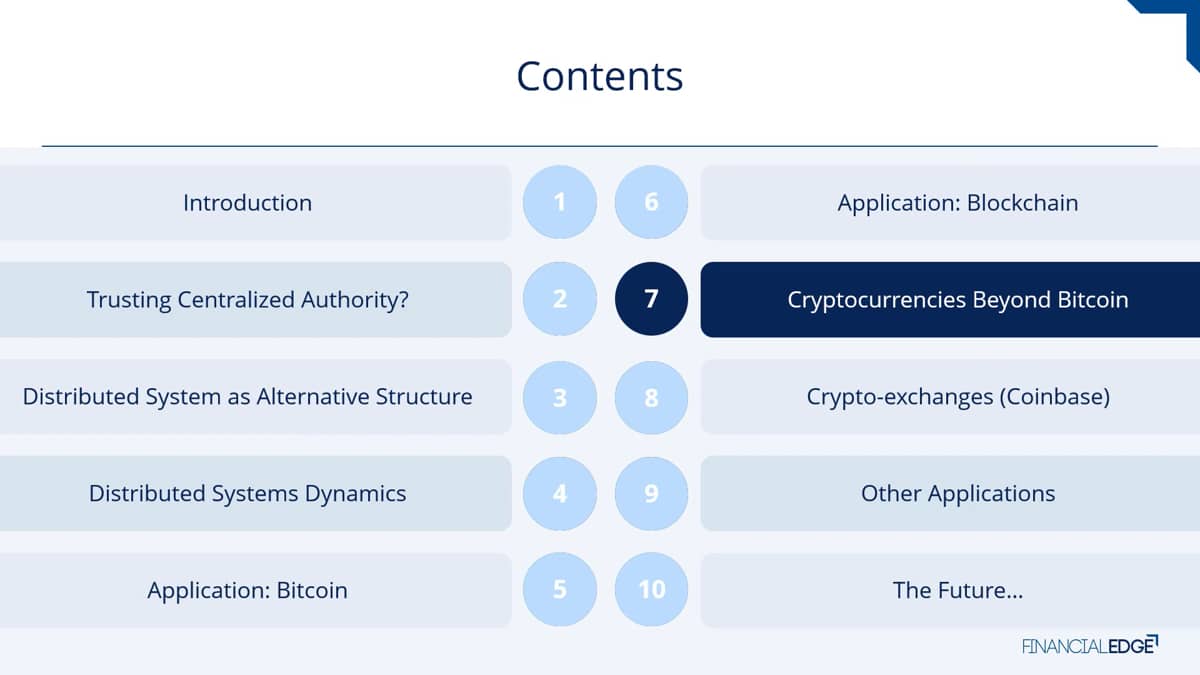
  • 6. Cryptocurrencies Beyond Bitcoin

    03:46
  • 7. Crypto Exchanges

    03:28
  • 8. Other Applications

    01:19
  • 9. The Future

    02:25

Prev: Intro to Hedge Funds

Cryptocurrencies Beyond Bitcoin

  • Notes
  • Questions
  • Transcript
  • 03:46

Explore the use of and some of the issues around cryptocurrencies beyond Bitcoin.

Downloads

No associated resources to download.

Glossary

Bitcoin Cryptocurrency
Back to top
Financial Edge Training

© Financial Edge Training 2026

Topics
Introduction to Finance Accounting Financial Modeling Valuation M&A and Divestitures Private Equity
Venture Capital Project Finance Credit Analysis Transaction Banking Restructuring Capital Markets
Asset Management Risk Management Economics Data Science and System
Request New Content
System Account User Guide Privacy Policy Terms & Conditions Log in
Transcript

Blockchain and cryptocurrencies beyond Bitcoin.

Since the introduction of Bitcoin, other cryptocurrencies known as Altcoins have been launched. These are broadly classified into two types, security tokens and utility tokens. Security tokens are linked to a business and are typically launched in an initial coin offer or ICO, like equity shares of businesses. These may represent ownership and involved dividends. Utility tokens on the other hand are tokens issued as a claim on services.

This table shows the top 10 and bottom 10 cryptocurrencies as of January, 2021. As can be seen from a market capitalization perspective, Bitcoin takes the top spot in all there. Were close to 9,000 cryptocurrency offerings at the time, each serving its own purpose.

The cryptocurrency with the second largest market capitalization is the Ether Cryptocurrency generated by the Ethereum network. The objective of Ether is to replace internet third parties. Uh, for example in the mortgage market currently, ether is listed on a number of exchanges, including the CME, where Ether Futures can be traded. To date, the Ethereum network has given rise to many Ethereum blockchain based tokens such as bin coins, whether it is Bitcoin or Ether. The value of cryptocurrencies displays significant volatility. The two price graphs show the price movement of Bitcoin and Ether respectively during the period April 15th, 2021 to May 15th, 2021. The high low for Bitcoin during the period was from 63,237 to 48,666. A 29.9% difference while the high low for Ether during the same period was 4,179 on May 11th to 2,211 and 89% difference with this kind of volatility, if companies such as Tesla were to accept Bitcoin as payment, would the valuation of companies be significantly impacted in order to take a risk off approach and avoid volatility arising from cryptocurrency based holdings and transactions? And another type of cryptocurrency that ties its value to the US dollar was introduced. Stable coins are digital assets designed to maintain a stable price between the cryptocurrency and the US dollar when sending and receiving money, but still retain the advantageous features from the crypto ecosystem. Note that stable coins are not only backed by US dollars, they can be backed by other fiat currencies, commodities, And even other cryptocurrencies. For example, a wrapped Bitcoin. Also important to note that stable coins are not always stable. Their prices often vary markedly. Tether as a cryptocurrency with the third largest market capitalization at 30 billion US dollars is designed to replicate the US dollar with a main objective to facilitate business transactions using cryptocurrency, ensuring efficiency, hence low cost and transparency. Tether was incorporated in Hong Kong and is traded on 162 exchanges, mostly as Bitcoin pairs suggesting that there is a clear demand for users and traders of stable coins.

Content Requests and Questions

You are trying to access premium learning content.

Discover our full catalogue and purchase a course Access all courses with our premium plans or log in to your account
Help

You need an account to contact support.

Create a free account or log in to an existing one

Sorry, you don't have access to that yet!

You are trying to access premium learning content.

Discover our full catalogue and purchase a course Access all courses with our premium plans or log in to your account

You have reached the limit of annotations (10) under our premium subscription. Upgrade to unlock unlimited annotations.

Find out more about our premium plan

You are trying to access content that requires a free account. Sign up or login in seconds!

Create a free account or log in to an existing one

You are trying to access content that requires a premium plan.

Find out more about our premium plan or log in to your account

Only US listed companies are available under our Free and Boost plans. Upgrade to Pro to access over 7,000 global companies across the US, UK, Canada, France, Italy, Germany, Hong Kong and more.

Find out more about our premium plan or log in to your account

A pro account is required for the Excel Add In

Find out more about our premium plan

Congratulations on completing

This field is hidden when viewing the form
Name(Required)
This field is hidden when viewing the form
Rate this course out of 5, where 5 is excellent and 1 is terrible.
Were the stated learning objectives met?(Required)
Were the stated prerequisite requirements appropriate and sufficient?(Required)
Were the program materials, including the qualified assessment, relevant and did they contribute to the achievement of the learning objectives?(Required)
Was the time allotted to the learning activity appropriate?(Required)
Are you happy for us to use your feedback and details in future marketing?(Required)

Thank you for already submitting feedback for this course.

CPE

What is CPE?

CPE stands for Continuing Professional Education, by completing learning activities you earn CPE credits to retain your professional credentials. CPE is required for Certified Public Accountants (CPAs). Financial Edge Training is registered with the National Association of State Boards of Accountancy (NASBA) as a sponsor of continuing professional education on the National Registry of CPE Sponsors.

What are CPE credits?

For self study programs, 1 CPE credit is awarded for every 50 minutes of elearning content, this includes videos, workouts, tryouts, and exams.

CPE Exams

You must complete the CPE exam within 1 year of accessing a related playlist or course to earn CPE credits. To see how long you have left to complete a CPE exam, hover over the locked CPE credits button.

What if I'm not collecting CPE credits?

CPE exams do not count towards your FE certification. You do not need to complete the CPE exam if you are not collecting CPE credits, but you might find it useful for your own revision.


Further Help
  • Felix How to Guide walks you through the key functions and tools of the learning platform.
  • Playlists & Tryouts: Playlists are a collection of videos that teach you a specific skill and are tested with a tryout at the end. A tryout is a quiz that tests your knowledge and understanding of what you have just learned.
  • Exam: If you are collecting CPE points you must pass the relevant CPE exam within 1 year to receive credits.
  • Glossary: A glossary can be found below each video and provides definitions and explanations for terms and concepts. They are organized alphabetically to make it easy for you to find the term you need.
  • Search function: Use the Felix search function on the homepage to find content related to what you want to learn. Find related video content, lessons, and questions people have asked on the topic.
  • Closed Captions & Transcript: Closed captions and transcripts are available on videos. The video transcript can be found next to the closed captions in the video player. The transcript feature allows you to read the transcript of the video and search for key terms within the transcript.
  • Questions: If you have questions about the course content, you will find a section called Ask a Question underneath each video where you can submit questions to our expert instructor team.