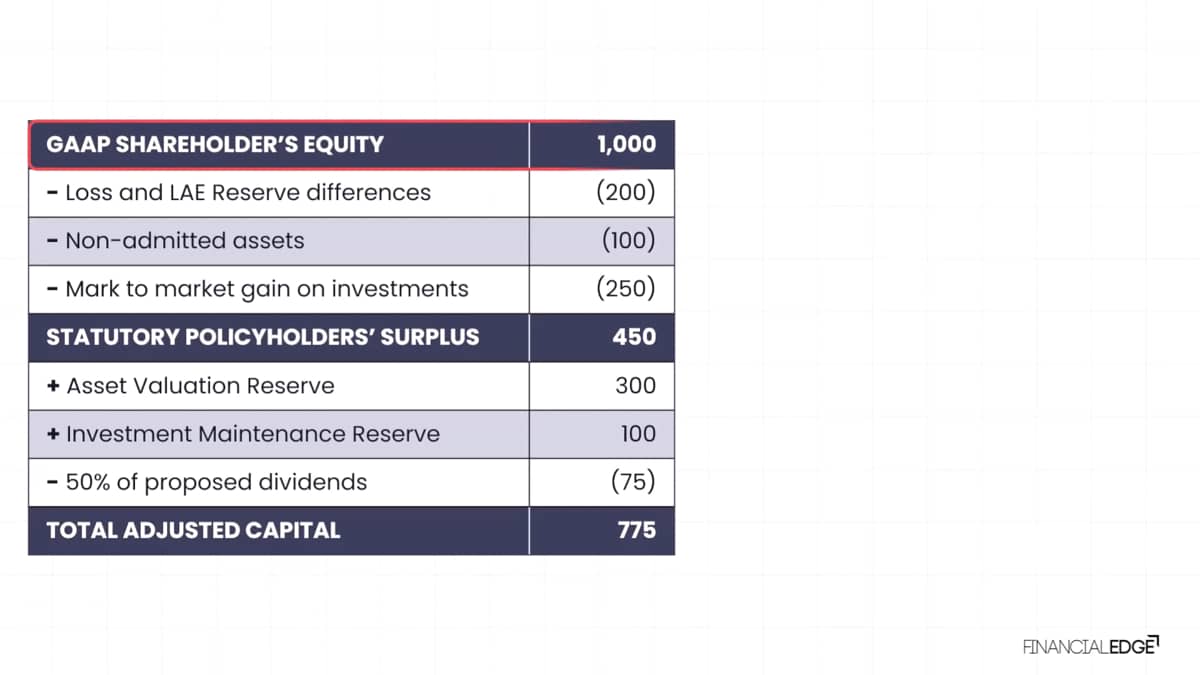
As can be seen here, starting from a GAAP shareholders' equity of 1,000, a number of adjustments are then made which have the effect of making the statutory accounts more conservative than the GAAP accounts.
The loss and loss adjustment expense, or LAE difference, reflects the fact that the statutory accounts calculate policy liabilities on a formulaic prescribed basis, rather than the present value basis of the GAAP accounts.
This typically results in policy liabilities being higher in the statutory accounts than the equivalent GAAP accounts.
Next, we have non-admitted assets being deducted.
There are a range of assets, such as deferred acquisition costs, reinsurance recoveries, and goodwill, and goodwill and other intangibles, which are either not allowed or not admitted into the statutory accounts, or only allowed to be included on a reduced value to reflect illiquidity or an inability to liquidate for cash.
The final adjustment shown here is the removal of any marked market gain on investments. Certain fixed income investments in the GAAP accounts may be shown at fair value, but need to be shown within the statutory accounts at amortized cost, meaning that a gain needs to be removed from the GAAP accounts to arrive at the statutory policyholders' surplus.
Then, to calculate total adjusted capital, some further adjustments need to be made.
First, we have to add two reserves, the asset valuation reserve, which removes the effect of expected credit losses from the statutory accounts, and the investment maintenance reserve, which removes the effect of gains or losses in relation to changes in interest rates for life or health insurers.
The effect of the investment maintenance reserve is to smooth the effect of market value changes from within the statutory accounts.
And then finally, 50% of any proposed dividend needs to be deducted, reflecting the reduction in cash that paying a dividend will cause.
This gives us our final total adjusted capital of 775.