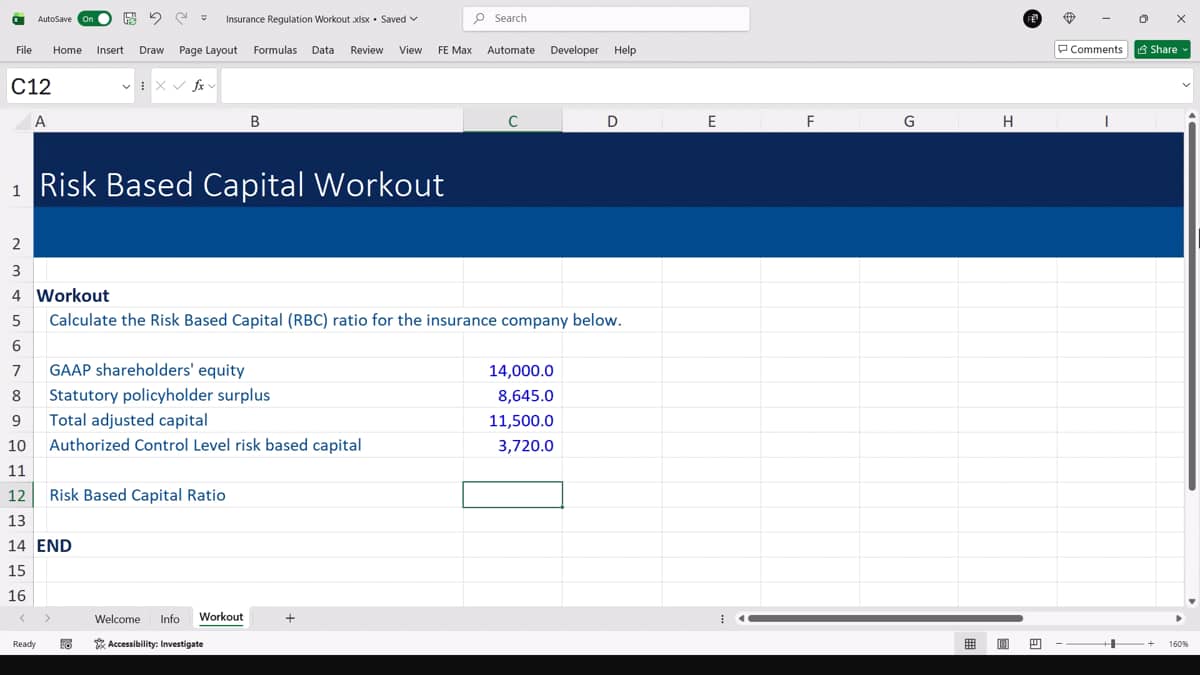
In this workout, we've been asked to calculate the risk-based capital, or RBC ratio, for the insurance company below.
We've been given the shareholders' equity on a financial statement basis under US GAAP of 14,000. We've got the statutory policyholder surplus from the statutory accounts of 8,645, and the total adjusted capital of 11,500.
We're also given the authorized control level risk-based capital, and some space to calculate the risk-based capital ratio.
So to calculate the risk-based capital ratio, it's really quite straightforward.
All we've got to do is to pick up the right metric for capital and divide it by the authorized control level risk-based capital, and for US regulators, that right number for the level of capital is the total adjusted capital.
We need to divide this by the authorized control level, or ACL risk-based capital, to give us the risk-based capital ratio of 309.1%.
This is above the 300% minimum, saying that there will be no additional requirement for this company to undertake any additional requirements.

 Insurance Regulation Workout Empty