Alternative investment strategies, private equity.
Now, private equity investments or funds generally invest in companies either startup or established that are not listed on public exchanges or they invest in public companies with the intent to take them private.
There are different stages and types of private equity investing and the focus of private equity firms, which may manage several different private equity funds may change through time as business conditions change or the availability of financing changes.
In terms of structure, like hedge funds, private equity firms are typically structured around a partnership in which outside investors are the LPs or limited partners, and the private equity firm is the GP or the general partner.
And also like hedge funds, most private equity firms charge both a management fee and an incentive fee.
Now, in terms of the investor base, it's primarily institutional with your usual suspects, pension funds, insurance companies, sovereign wealth funds, and you also have some very high net worth individuals who will invest in private equity also.
Now, all of these investors have one thing in common, and that is that they have a very long time horizon.
Private equity investments are generally locked up for extended periods, could be five years, it could be 10 years, it could be longer.
Now let's dig in deeper into the types of private equity.
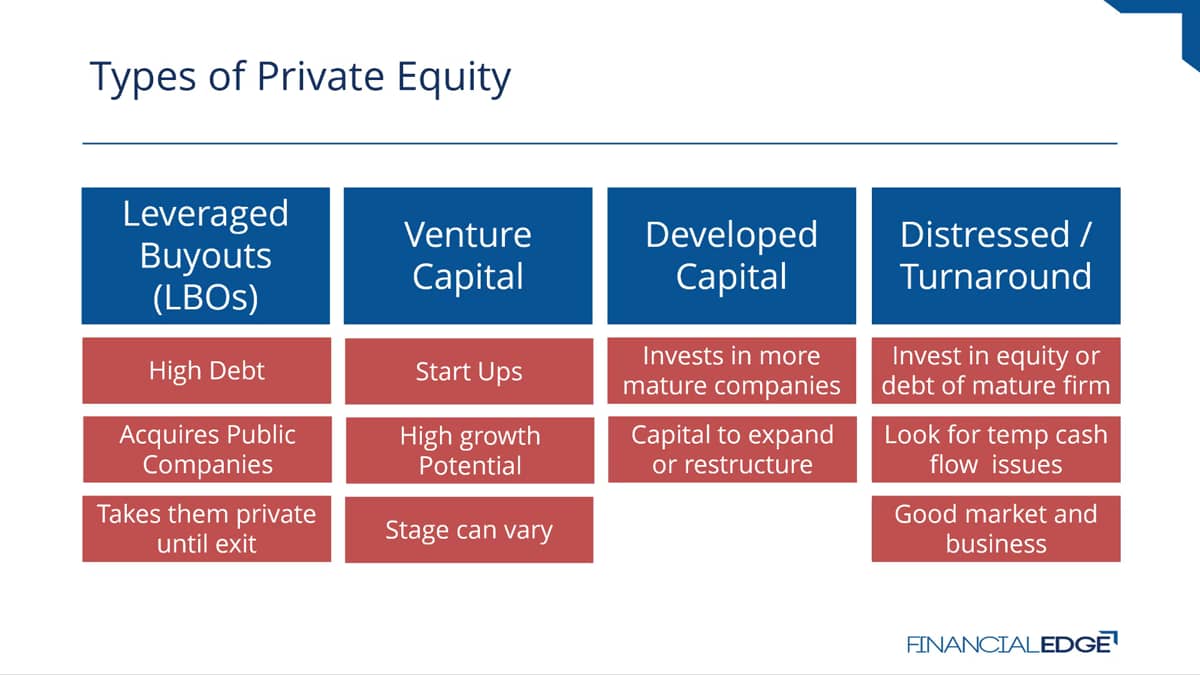
While classifications may vary, there are typically four types of private equity strategies.
Leverage buyouts, venture capital, developed capital and distressed or turnaround first, LBOs.
LBOs are high debt transactions or highly leveraged transactions in here.
The private equity firm uses that debt to purchase public companies or establish private companies, and if they were public, these firms are taken private.
The targets companies assets typically serve as collateral for the debt and the company's cash flows are expected to be enough to service the debt.
With LBOs, target companies are expected to stay private at least until the exit from the investment.
Moving on to venture capital strategies.
Here, the private equity firm is investing or providing financing to private companies with high growth potential.
Now, typically these are startup or very young companies, but venture capital can be provided at a variety of stages.
Next, developed capital.
Now here it generally refers to a minority equity investment in more mature companies that are looking for capital to either expand or or restructure operation or even enter new markets or finance, uh, an m and a transaction.
And lastly, distressed or turnaround strategies. Here, Private equity firms are buying the equity or the debt actually of mature companies in financial difficulties, and their goal is to identify companies that have a temporary cash flow problem, but still have a good business environment and good business plan.
Their goal is to help the company survive in the near term and in the long term flourish.
Now that given that LBOs or leveraged buyouts make up some of their biggest transactions within private equity, let's take a deeper dive into what makes a good LBO target.
Well, first of all, has to be a company that the private equity firm feels they can make operational improvements to, which would ultimately increase the value of the firm when they try to exit.
They also look for firms with, uh, generally low cash needs, low capital expenditure needs, and high cash flow generation from operations.
And of course, they want a attractive price, so a low acquisition multiple is on top of their minds.
Also, the potential to exit the investment via an IPO or another transaction is very important.
And here is a quick look at some of the biggest private equity and LBO firms.
In the top firms are names that are very well known, including Apollo, Blackstone Carlo, and of course KKR.