Alternative investment strategies.
Venture capital. Now, unlike private equity funds and hedge funds, venture capital can be investments directly into a fund that's similar to those or can be directly into a venture company.
And the company in which the private equity firm is investing is often called the portfolio company 'cause it'll be part of the fund's portfolio.
And to make an investment, uh, a venture capitalist or a venture capital fund needs to be convinced that the portfolio company's management team is competent and that the firm has a solid business plan and a and strong prospects for growth and development.
Now because these investments are in young companies, and usually very young companies that are not in a mature business with the years of operations and financial performance history, the complexity involved in venture capital involves accurately estimating a company's valuation based upon future prospects that may be many years down the line.
Now this estimation is, uh, a lot more of an unknown than let's say, traditional equity market investing or LBO investing, which is investing in more mature, developed companies with a sizable track record and a financial history.
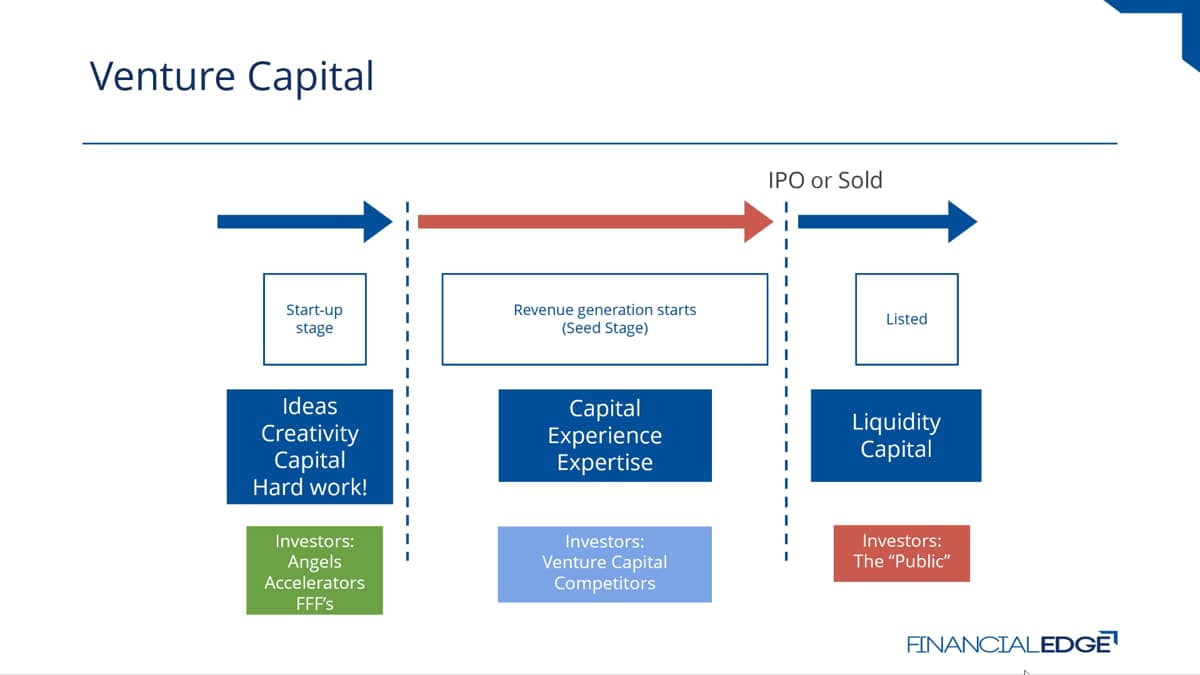
Now let's take a look at the various stages of venture capital.
Now, the stages can range from the inception of the idea for the company all the way up to the point where the company does an IPO or more typically sells to a strategic buyer.
It's also important to note that the required return by investors will vary based upon the stage the company's stage of development. Investors in the very early stage will demand higher expected returns relative to the later stage investors because it's earlier in the process, it's earlier in the stage of development, and that equals higher risk.
Now, the stage with the largest risk is known as the startup stage or the idea stage.
And here is where we have angel investing.
Angel investing is capital provided at this very early stage.
Funds may be used to transform the idea into a real business plan, into access market potential.
Now, the amount of capital raised at this stage is typically pretty small relative to the other stages, and is generally provided by individuals, often family and friends rather than actual venture capital funds.
Moving on to the next stage known as the seed stage here, financing or seed capital generally supports product development or marketing efforts, including market research generally at this point, this is the first stage at which venture capital funds will invest In the last stage is the IPO or the sale of the company.
And this is usually where venture capital investors exit the investment.
Now, of course there's many sub stages in between these three, but this is a general overview of the process a.