Trading Comparables and Pro Forma Adjustments - Felix Live

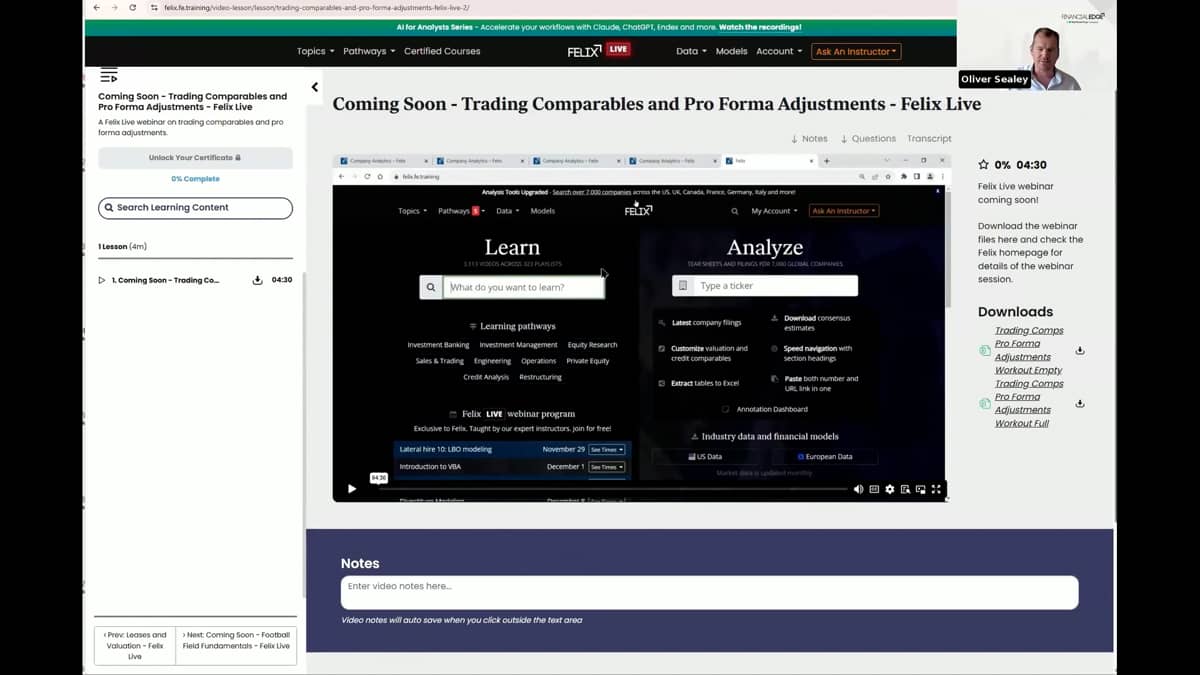
- 49:09
A Felix Live webinar on trading comparables and pro forma.
 Trading Comps Pro Forma Adjustments Workout Empty
Glossary


Transcript
Hello, everybody. My name's Ollie.
I'm from the team at Financial Edge.
Okay, we run the Felix platform. Okay, and as part of that, we run the Felix live webinars. Lots of them going on, as you know, and a real trend towards AI, as you can imagine. Okay, this one isn't so much about AI.
Okay, it's about trading comps.
Okay, so you can see we've got some materials there.
I'm also going to use this PowerPoint.
Okay, and then we're going to use empty as well. Okay, which I'll just open up now, and so that's this empty file.
Okay, I'm just going to put that link in one more time.
All right, so what are we up to then? All right.
I'm going to assume that you know how trading comps work on a basic level.
Okay, so if we take a look at-- I think I'm going to start off talking about Cisco as my first example.
Okay, now if we have a look at Cisco, which is the underlying technology for the internet, you can see all sorts of multiples here.
EV/EBITDA is the one that we'll often be talking about today. And you can see that we've got this LTM one here.
We could also find calendar year one, calendar year two.
Okay, Felix is actually quite neat at this.
Hello? Okay, so if we went to Cisco, we had a look at the valuation tab. You can see Cisco here, and we've got LTM stuff. We've got forward-year stuff.
We've got a forward EV/EBITDA.
Okay, so the problem with these multiples is that we don't really know how these have been prepared.
We don't really know how that's been prepared.
I mean, there's an asterisk, and I guess if I dig, I could find the method, and if we're being very high detail, which we might be in a number of roles that we'll talk about in a minute, then these issues might cause big distortions to the multiple, which would make a multiple misleading, when you compare against peers, and especially when you compare it against calendar year one, calendar year two multiples.
Okay, so if I, for example, grab comps for Cisco, and I'm on Factor now, just in case you're wondering.
And if I grab valuation, okay, you can see EV/EBITDA.
Now it's financial year one, financial year two.
Now those have a progression, which if you're used to EV/EBITDA, is normally trending downwards.
And what we might find is if we calculate our LTM, if we're the ones calculating it, it could end up being quite out of line with this stuff.
Now, the three main distortions are when a company buys another company, which is significant, and especially if it buys it close to year-end.
When a company plans to or has disposed of another company, so divestment.
And probably the least impactful of the three or the most detail-driven anyway, is when a company changes its capital structure between two reporting dates.
The main problem that we're going to grapple with in this session, we've got about 40, 50 minutes or so, is that the data provider, if I go back to the snapshot, it's going to grab stuff at different timing.
Okay, so if I look at, say, the fully diluted market cap, that's going to be changing daily because the share price is updated daily, but the share count isn't updated daily.
Okay, so if I do something with my share count that's significant, then ideally, that number would change.
All right. What else? Well, within that enterprise value, we've got lots of other things, and these things will be changing, but most of them won't be changing daily.
They'll be changing at every reporting date, normally quarters or interim for Europe.
So, for example, for Cisco, if we have a look at, say, the consolidated debt, that will not change every day.
Okay, it'll change every quarter as Cisco brings online a new set of financial statements.
That's one timing issue, which is that the balance sheet is updated every quarter and is a snapshot.
The other issue is the mechanics of the income statement. Okay, and that's even more tricky.
So when Cisco puts together, or Factor puts together its multiples like this one- Anything that's based on income statement ideas, if you take LTM, which is the last trailing 12 months, you run the risk of mismatching a snapshot, the balance sheet, and a flow, the income statement.
And that's probably our biggest issue. I'm just going to copy in the link again.
Okay, our biggest issue today is acquisitions.
And the basic idea is if we have a mid-year acquisition, it has a mismatch, and the mismatch is the income statement versus the balance sheet.
Because the income statement is going to be what we base our EBITDA on, and the balance sheet is partially at least what we're going to base our EV on, this will cause distortion which can make our LTM look really janky compared to forward multiples.
This is also true of disposals, perhaps less so, and it's also true of new financing, but again perhaps less so.
Now, in terms of context, why would you care about this? I think for general benchmarking and very preliminary work, you're probably going to trust these multiples and you're not going to sweat it too much. So you'll just open up whatever your comps analysis is in your data provider and you'll just say, "Okay, here's my comp list," and this is good enough.
Yeah. And if it can put together an LTM, that's fine as well.
Where things get tricky is where perhaps you're on a live deal and things get really, really important in the negotiations, and you need to update your multiples pretty much every day as you update your deck or go into a new meeting or something. And so at that point, this kind of work that we're going to do today might become quite important. I think a lot of the time, for a lot of people, this is probably a bit too detailed. It's good to know how it works, but I'm not sure you'd be doing it unless you're deep in the weeds with a deal.
Okay, that's the context, and we're just going to stop there and see if there's any questions before we move into our first area, which is an acquisition.
Okay, and you can put questions in the chat box.
That's probably what I'd prefer, or you can put it in the Q&A which should be fairly visible to you if you want your question to be a little more anonymous, which is fine as well.
Okay, let's do acquisitions. Now, let's keep using Cisco as an example.
Okay, I'm still in Cisco, and if I have a look at M&A summary, you can see this giant jump here, okay, in transaction value, not in terms of ideal number, relatively small, but the value is really going massive. And that's represented by this one down here, which I hope you can see.
It's probably quite small, where it's Splunk, which is another technology provider that's being taken over by Cisco.
The EV is huge, so this is highly material.
Okay, and EV/EBITDA is also huge, and so this should have quite a big impact on Cisco's multiple as they kind of swallow this new acquisition.
We've got a $20 billion EV.
The EV of Cisco itself, okay, you can see here is more like $484 billion.
So, they're an order-of-magnitude difference, but this is not nothing, okay? And any impact this might have on the multiple would be significant.
Okay, now let's just place ourselves.
So we don't need to write this down or anything.
It's just I find it helpful to jot down thoughts rather than just making it verbal. So we're going to imagine we're responsible for a comp list in tech in 2019.
Okay, so it is 2019. I know it's not 2019, but it's a good teaching case.
Now, we know that Splunk-- oh, excuse me, I've got that completely wrong. Okay, so 2023.
Much more recent.
Okay, so we know that Splunk has been acquired.
Okay? Now, the deal completed, can you see that? 18th of March '24.
All right, so that's great. And let's say that we are looking at the multiples around that date. So it's currently the week of, let's say, 15th of March, and I'm not going to look up whether that's a Monday. Okay? So every day, we're updating our comp lists because we're in a high-detail piece of work.
Imagine that we relied on Factor for our comps, and we can take a look at it in charts, which is actually pretty cool.
See Cisco here.
All right. And I think it's remembered my view from this afternoon, so that's nice. So here we've got 2024.
Okay, so here's where kind of the action is happening.
And then in March-- So what did we say? Okay, it completes in March '24.
Okay, and then the next cycle would be the year-end.
Okay, if we take a look at the company, it has a year end of July, right? Okay, so if we take another look at it, what's happening is in July, suddenly, the multiple shoots from around 10, where it's been for more or less a year, and suddenly shoots up to 12.
Okay, and then a couple of months later, it kind of does the same thing.
Now, a couple of months later, it does the same thing.
So there's something weird happening here.
Now, if we just concentrate on this jump here, because the others are a bit complicated, this is basically a vertical jump over the course of the day. And what it represents is Factset swallowing the new point to make LTM out of.
Okay, so Factset is saying, "Yeah, I know your share price, I know your share price, I know your share price, I know your share price.
I know the net debt's the same, the net debt's the same, the net debt's the--" Oh, bam, here's all the net debt from the deal.
Okay, so what's happening is Factset is swallowing the net debt from the deal in this date.
Okay.
Now, you could then say, well, if it's also swallowing the EBITDA from the deal, wouldn't that cancel itself out? Yeah.
But we've got a problem, which is July '24, there's a new financial statement.
All the new debt gets into the EV.
Okay, so all the new debt comes into the EV.
Bam, there's the acquisition. All of the new shares gets into the EV.
Okay, so the full financing package hits the EV along with all of the assets.
Okay, so we've got a major impact on the EV.
That's going to pull the EV EBITDA up, isn't it? And what you might find is that if the earnings of Splunk were proportionally the same, they should pull it down again.
Okay, but maybe you can spot what's happening here.
What's happening is quite nicely demonstrated by this slide, actually.
Okay, now what will happen is the buyer will run its year end.
Okay, and this is the income statement. You can hopefully see that.
And then what the buyer will do is say, "Well, there's part of the target that I own and the part of the target that I don't, from the point of view of income." The thing about the Splunk deal is that if their year end is July, and if they completed, okay, if they completed 18th of March, can you see that virtually no income is going to get into the financial year '24? Okay, so what we've got is a mismatch.
So at LTM date, which also happens to be year-end at this point, there's very little earnings of Splunk in the income statement, and so it doesn't pull up the EV EBITDA as much as-- or excuse me, pull it down as much as you'd expect. And so what you end up with is these huge distortions if your LTM is close to a huge acquisition.
Okay, this is a distortion to be managed.
Now, we're going to pause there, see if there's any questions, then we'll go ahead and fix it and see how we fix it.
Okay, if you're typing, keep typing.
Now, let's use the workout, and you can do it with me, or you can just watch me and kind of learn that way. Now, workout one, let's just imagine that this is Cisco around the time of the analysis, okay? Just imagine.
I know it's not, but it works. Okay, so just imagine that it's like Cisco, and they have gone with Splunk because it just fits my sort of teaching pattern here.
Okay, and don't worry about the numbers, just imagine that it's Cisco's numbers.
Now, they're going to need us to put together the EV.
So what we do is we grab share price, shares outstanding Total debt, and then net it out.
Okay, now this EV contains Splunk fully.
So 100% consolidation, okay, because it's a balance sheet consolidation, that's how it works.
That's assuming we took over 100% of Splunk, and I actually don't know whether that's the case, so let's just simplify.
Right. Let's put together the EBITDA, and it's pretty simple.
We just add DNA, and we can copy to the right.
And then what we can do is we can say EV, lock it over EBITDA, and then have a look at the multiples grid.
All right. Hopefully, you can see the problem.
Okay, this EV EBITDA, it contains just a portion of the target, right? Splunk's earnings.
Okay? And so when we're dividing through the EV, we're not dividing it very hard, and so we're ending up with a very high multiple.
Whereas these three, which are our forward multiples, when consensus presumably has looked forwards a year, they've said, "Oh, these people are going to take over Splunk.
They're going to be making loads more money." And so next year, next calendar year, financial year, whatever you want to call it, presumably, they're going to make loads more money because of Splunk's earnings.
So this contains 100% of Splunk's forecast. Because, by that point in year one, we will have assumed to have Splunk all year round.
And so can you see there's a massive incompatibility here? Okay, the problem is this progression is highly misleading.
Okay, that's the basic problem here.
I think if you were to look at this and present it, you'd be saying, "This is like a really exciting sector that's going to explosively grow." Like if Cisco is going to bring up its operational profits by 50% from last year to this year, well, that's kind of saying things about the environment, and you might, by extension, say things about the current deal you're working on.
Now, these things are wrong because this is not a like-for-like comparison. So this would be highly misleading.
Okay, we're going to go on to Workout 2 and actually fix it and do pro forma next.
But again, I'm just pausing, seeing if there's any questions.
Okay, I can't see any questions.
If you're typing, keep typing. I know I keep saying that, but I'd like this to be interactive. And so if I'm not being clear about anything, just shout.
Right now, Workout 2, it actually gives us the same company. Look at that.
Okay, and then it says, "Here's the combo." So this is a group.
And then can you see we've got EBITDA 300? So look at the same number there and there.
Okay, so presumably LTM is a full year rather than stitching together some kind of quarters or interims, which you should be aware LTM is usually built out of.
We've then actually got the target, and we didn't have that before.
So the targets numbers are actually in the combo numbers, and we have another bit of information, which is that actually, in this example, and I'm not going to change it, the acquisition closed halfway through the last year.
Okay? Now, this means that, can you see this number here? It's lower than it should be if you're going to compare it on a like-for-like basis going forwards.
So what we're going to do is we're going to say Reported.
Well, that's Reported combined.
We're then going to reimagine the acquisition as if it happened at the start of last year. So we're going to say this contains half of the target's EBITDA. This fixes the comparability problem.
This is now comparable with other companies that didn't do an acquisition, or the same company forecasts.
Okay, so what we do is we say, right, they're going to make 200 last year, half of which was already incorporated, so we need to add another half.
So actually, their pro forma, which is quite a tricksy bit of jargon that gets used a bit too much in my view, but their fixed or normalized EBITDA is 400.
Okay, now we don't really need to rerun the EV. We can just pinch it from above.
Nothing's changed to the EV because the full impact of the acquisition is already living in the EV as a snapshot due to balance sheet consolidation.
We've now got an EV over EBITDA, which is pro forma.
C13.
Okay, and then if we were to plug that in up here and just manually override it, let's say we plug in 400. Can you see that progression tells a very different story now, which is one of growth, but good, measured, sustained growth, not explosive growth from last year to this year, followed by measured growth.
You'd be asking why this growth is taking place if it were like that.
Okay, so we've just fixed the problem, and that problem is one of a mid-year acquisition which distorts LTM, EBITDA, or other multiple value drivers, okay, where the value, the EV usually has already been updated because of the snapshot mechanics of balance sheet consolidation, and we've made it like for like by basically going back and imagining that the acquisition had taken place at the beginning of the year, or LTM period, should I say.
Okay, that's the acquisition.
Again, I'm just going to pause, see if anybody's got any questions, and then we'll move on to divestment or disposals.
All right, let's move on then.
The next one is tricky in a different way, I'd say.
I think it numerically can be easier but has more judgment baked into it, which can make it quite challenging.
It's about divestment, and the problem we've got is, again, one of accounting and how things are shown and how things make their way into our multiples and some of the timing frictions that we might have there. What'll happen is when a company is going to sell another company that's significant, it'll tend to call it a discontinued operation, and it may classify those assets as held for sale under certain circumstances.
Okay.
Now, the tricky bit is that, well the earnings have probably already gone.
So now let's look at that second company that I was looking at before, WPP, and hopefully it'll behave itself now.
Earlier in the day it was being very tricksy.
Okay.
Now I want to look at a 29 or 2019 divestment.
This morning, this just flat would not load, so I'm looking forward to seeing something.
Ah, wonderful.
That's it. Okay. So this is a fairly significant divestment, and it's private equity buying what's called the Kantar Group, which is an advertising house off another major UK conglomerate advertising house called WPP, which is a big player in advertising worldwide.
Okay, so what we're going to do is we're going to place ourselves as 2019 analysts now, which is probably why I got a bit confused last time.
Okay, so here's the acquisition, which we use Cisco.
And now we're going to do disposal, and we use WPP.
Okay, and let's say it's 2019. We don't have to say exactly where it is for this one.
We're updating comps for WPP, and we notice a major disposal.
Kantar.
Okay, and we're thinking, okay, what does that do to multiples? All right. Now, let's take a look.
So if we look at the income statement first, and we show it as reported, okay, you can see that down here we've got some discontinued operations, and in 2019, we've got an 11 here, okay, and then we've got a 15 here.
Okay, and this is the NCI, which I think I'll just ignore from the point of view of this exercise.
Okay, so we've got discontinued operations.
We've got in 2019, 11, and in 2018, 138. So let's actually look at 2018 and imagine that this is them anticipating the sale.
I think it just serves my teaching needs a bit more.
So now it's a planned disposal.
Okay, so we find discontinued operations income of, let's call it 110 in the income statement.
All right. Now, let's take a look at that 110.
I think I've remembered it right.
No, it's more like 138. Excuse me.
Okay. And let's just track it through and see if it's anywhere up here.
Okay. So it says profit from continuing operations, 927, oop, 736. Profit from discontinued 138, and then it adds up to 901.
Okay, and this is after taxation, so that's quite interesting. That, can you see, implies that the profits from discontinued operations are actually in these figures here.
Okay, and that's not always the case.
So the first thing we'd do is we'd check whether this is included in EBIT.
It is.
That's not always the case. Some companies report discontinued way down the line and don't include it within their main sort of income statement.
All right.
Now let's take a look at the balance sheet and see if we can find it.
All right. There's a lot going on here, but I think if we look really carefully, can you see we've got assets classified as held for sale.
And let's assume that these are the assets, and ignore the fact that it's 2019.
Presumably, they became serious about selling them at some point in 2019. So let's keep this really vague because, again, it just suits my purposes, and I'm not going to obsess too much about the nitty-gritty details.
Okay, so we've got assets held for sale, 485.
Okay, and then usually there are liabilities held for sale as well. Can you see it down here? Of 170. So what we're being told there is that's probably Kantar. We'd probably want to read about it, but let's assume that's Kantar.
Okay.
Kantar is also on the balance sheet, okay, with assets held for sale of...
And let's have a look again because I tend to forget figures halfway through.
Okay.
There we go, 485.
And then we've got liabilities held for sale of 170.
Okay, so we could say that on a net asset basis, Kantar appears to be worth 350.
Okay, let's say that our analysis moves on.
It's 2019-ish, let's keep things vague, and Kantar actually sells.
Okay, so Kantar's gone now.
The problem is that regulatory filings haven't caught up yet, okay, but the share price has.
So we've got another kind of mismatch, really.
So if we do do any of your bridge now, then share price will have moved around.
Everything's kind of moving around.
We'd quite like to restate the company without Kantar in it. And even more problematic, forward multiples exclude Kantar.
So if in 2018, 2019, it's pretty substantially obvious that Kantar is going to go, then equity research and consensus will build their FY1, FY2, CY1, CY2. They'll build everything having stripped out Kantar.
Now again, we've got the same problem as before, but now it's just opposite, which is if we base things on LTM or the most recent regulatory filings, we'll be basing on the company with Kantar in it, and that will have a different flavor to it, okay, than the forward multiples without Kantar.
And again, you can be left with these kind of lurches, okay, for different reasons.
So LTM with Kantar, forward without Kantar.
So you can imagine if they dispose of a huge business and maybe use it to pay down debt, then EBITDA might go down quite a lot.
Okay. That would make things look very strange, and you wouldn't know that the net debt has moved because you wouldn't have an updated regulatory filing because you'd have to wait three to six to 12 months.
So we've got another problem. Now, how are we going to fix it? Okay. There's effectively three ways of fixing it.
Well, the first one's obvious. We're going to remove any discontinued ops income from EBIT, EBITDA, which is sometimes not even in there, so we may not have to do anything there.
Okay.
Then what's going to happen is we're going to remove any discontinued operations from the EV, and that happens in one of basically three ways.
Either treat held for sale like debt is in the bridge.
So we'd use it to deduct, get rid of EV.
Okay, I think I've said that the wrong way around Non-core asset.
Just got myself turned around there. Apologies.
Okay, number two, what we can do is we can try and find the details of the bridge to make the deal.
If we distrust held for sale because it's a cost or book, which it often is, and we want something a bit more accurate, we can try and value Kantar by perhaps looking up the deal, or we can value the discontinued operations using a multiple on its income.
Okay, which is tricky, and we'll do a simplified version of that now, but this kind of taking the income and applying a multiple, it's actually very handy for bridge work. It's a good way of valuing minority stakes, NCIs, equity method investments, things like that.
Okay, now we've got the held for sale there, and can you see that's... Oh, we actually worked it out earlier, didn't we? It's 315.
Okay, so we could use that as a non-core and effectively reduce the EV by that, having reduced the EBITDA by the amount in the discontinued, the 138.
We could try and find out the terms of the deal and say, right, where's Kantar again? Yeah. Okay, so 2.4 billion.
Factor. And say, well, that's the EV that we should be knocking off because that's the market value of those assets.
Or we could do a multiple-based approach and say, okay, we know a company like Omnicom.
I only know it because my wife works for them.
They're an advertising agency, and they give you a kind of nice comp list, and they've got a PE of about 18, let's say.
Okay. Then you would find the income, which we said was 138, and then we would value Kantar and then use that to strip out. And can you see, it's actually pretty good.
It's not a bad valuation.
There's some problems with that valuation that you could easily poke holes in, but okay, let's leave it for the moment. Okay.
It's a good learning point.
All right, so you can see that we have to imagine the company without its disposal if it's planned.
Okay, if it's already happened, we have to just strip out the income that's discontinued.
I'm going to stop there and see if there's any questions.
All right. We'll just talk the last one through and have a quick look at a workout.
We won't do the full workout.
Financing. So we've said there is always a bit of a problem of timing here, and that's because LTM gets updated each time there's a new regulatory filing.
Okay, so that might be three or six months, whereas we might desire to update that much more frequently if we want a really high accuracy piece of work. So we might want to look at news articles, or other sources here, investor presentations, news runs, things like that.
Or we could look right at the back of the financial statements, because remember, there's a three-month delay between year-end and publishing, and if anything becomes really clear during that three-month delay, then they'll probably have to tell us about it.
So, for example, I wonder if I can find it real quick.
Say Omnicom.
Subsequent events.
Okay, so Omnicom authorized the repurchase of 5 billion of our common stock. Now, that would be quite a big change in Omnicom's capital structure.
Okay. And you might want to put that into the bridge, and you could say, well, that's a self-righting thing because actually if we repurchase 5 billion of our common stock, we'll be doing it with cash.
Okay, so you could say, actually, that's a bit of a nothing.
But sometimes here things will happen which might have distortive effects or change things again.
So quite a good example is in here, and we'll just take a look at it.
You can see another one of these subsequent events, and this is a real company.
I think it's called Telefonica.
Okay, it says pending Telxus acquisition on January 13th, 2021.
So just after year-end, the company basically said, "I'm going to buy this other company." They committed to buying them for 9.4 billion euros.
And it looks like Telefonica, excuse me, Telxus, had recent operating income of 251.
Now, really, although it's financing and it says financing, this is really the same idea as our acquisition.
Okay? If it's big enough to make the needle move, it's probably an acquisition, and that means that our forward forecasts would probably include Telxus being part of the group, which means FY1, CY2 would contain the operating income.
Which means that if we build an LTM without envisaging the acquisition, we would be creating another incompatible set of multiples.
So what we'd actually end up doing here is very, very similar to what we did in the earlier workout, which is we would take our EV, we would add in the financing package, and we would add in the anticipated EBITDA from the acquisition on an LTM basis as if we owned them from the beginning of the year to say, "Look, let's reimagine the last 12 months as if we own Telxus because we know they're going to be part of the group next year." We know consensus already contains that information, so we'd better change our view of the company so our multiples line up perfectly, okay, and tell the right kind of story.
So what you'd end up doing is you'd end up fixing the pro forma with the EV of the acquisition and fixing the EBITDA with the EBITDA of the acquisition for the last year because that would be the LTM that should have been within the wider group to make it compatible with forward multiples.
Okay, I'd like to leave 10 minutes at the end for questions.
You've been pretty quiet so far, but I'm hoping that's because you've just been enjoying listening and getting something out of it.
Now, feel free to ask questions.
That's the end of the kind of formal session.
If you want more examples or you want me to explain anything again, just feel free to ask. If you're logging off, which is fine as well, then have a lovely afternoon.
If it's anything like here, it's gorgeous weather, then you're going to have a really nice weekend.
Okay, so if you are logging off, have a nice weekend.
If you're staying, please feel free to and ask as many questions as you like.
I'd like to leave 10 minutes at the end for questions.
All right. It's gone a bit quiet, so I'm going to assume that people are busy with something else.
I'm going to close off the share, and I'm going to finish the recording.