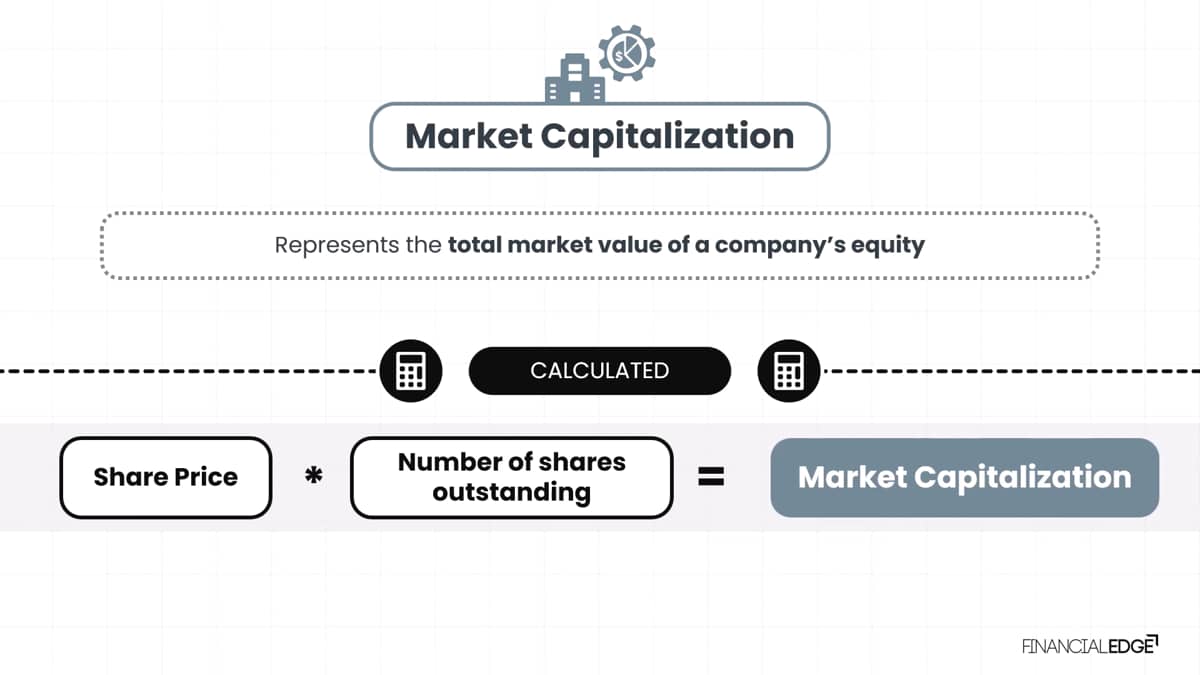
Another important way we classify equities is by market capitalization or simply market cap.
Market cap represents the total market value of a company's equity.
It's calculated as the share price multiplied by the number of shares outstanding.
In practice, we usually use free float market capitalization, which focuses on the shares that are actively available for public trading.
Publicly traded companies are grouped into categories based on their market capitalization.
Different data providers use slightly different thresholds, but the general ranges look like this.
Mega cap are companies valued above roughly $200 billion.
These are the global giants that dominate their industries and often set the tone for entire markets.
Large cap are between 10 and $200 billion.
These are mature, established firms, stable liquid, and usually the core holdings.
In benchmark indices such as the s and p 500 midcap are roughly two to $10 billion.
These companies are in a growth phase, big enough to be proven, but still with room to expand.
Small cap are around 300 million to $2 billion, often younger and more specialized firms with higher growth potential, but also higher risk.
Micro cap are between 50 and $300 million.
And lastly, nano cap.
Anything smaller still, these tend to be very speculative and are thinly traded.
Each size category behaves differently in the markets.
Mega caps and large caps are more stable and less volatile.
They generally hold up better during recessions and market stress, but they also tend to lag smaller companies during strong recoveries when growth and risk appetite return.
Small caps and micro caps on the other hand are riskier, but more dynamic.
They often lead early in an economic expansion, but can fall faster when conditions deteriorates.
In short, larger companies offer resilience and liquidity while smaller ones offer agility and upside, and midcaps often strike the balance between the two.
Offering a mix of stability, liquidity and room for growth.
The chart shows how these differences play out over time.
The blue line tracks the Vanguard small cap ETF, while the green line rep science, the Vanguard large cap ETF.
You can see that small cap stocks experience wider Swings, stronger rallies in bull markets, but deeper declines in downturns.
Large caps move more smoothly with fewer sharp jumps or drops over the long term.
Both categories can deliver solid returns, but small caps usually get there with more volatility, which means potentially higher rewards, but also higher portfolio risk.
That's why professional investors pay attention not only to what sector or style they own, but also to what size of company they hold.