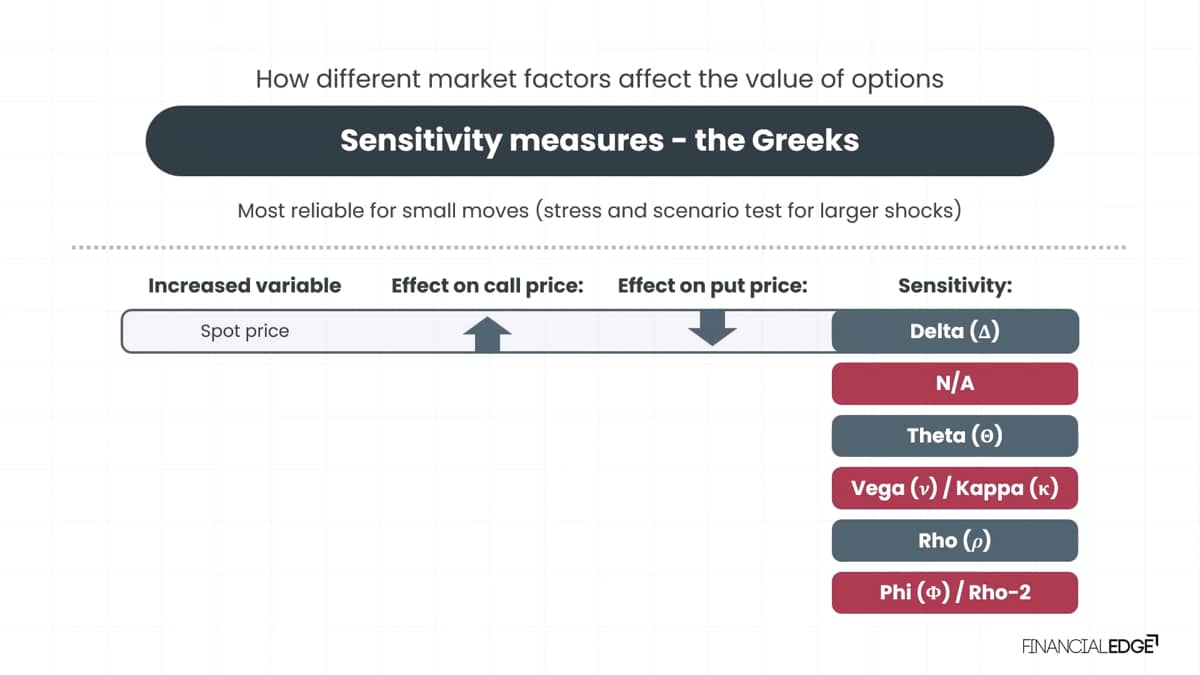
To successfully manage an options portfolio, it's essential to understand how different market factors affect the value of options, but we need more than qualitative statements.
This position loses when the underlying price rises is a start, but it's not something we can add up across a portfolio.
That's where sensitivity measures often called the Greeks come in.
These are numbers that tell us exactly how much an options premium changes for small changes in one of the key drivers.
In other words, how sensitive the option prices to changes in the spot price, in volatility, in interest rates and so on.
These measures are most reliable for small moves.
The larger shocks will also stress and scenario test.
In the option world, many of these sensitivities are assigned letters of the Greek alphabet, and that's why traders usually call them the Greeks.
For example. Instead of saying the sensitivity of the option premium to a change in the spot price, we simply say Delta theta measures the impact of time passing for long options.
This is typically a loss negative theater.
Vega, sometimes called CAPA, measures the effect of volatility.
Row captures the impact of interest rates while row two or FI relates to asset yields or dividends.
Notice that the strike price doesn't have a Greek assigned.
That's because it's fixed at the trade date and doesn't change.
And if you feel like some Greeks are missing, here you are right? This isn't the full list.
There are more often called the second order Greeks or higher order Greeks, things like Gamma Vanna and vomer.
What they have in common is that they don't measure how the option premium itself changes, but how a first order sensitivity changes when market factors move.
For example, vomer measures how vaguer itself changes when volatility changes.