Nvidia Under Pressure: Is the AI Chip Monopoly Finally Cracking (AMD, TSMC, Broadcom)

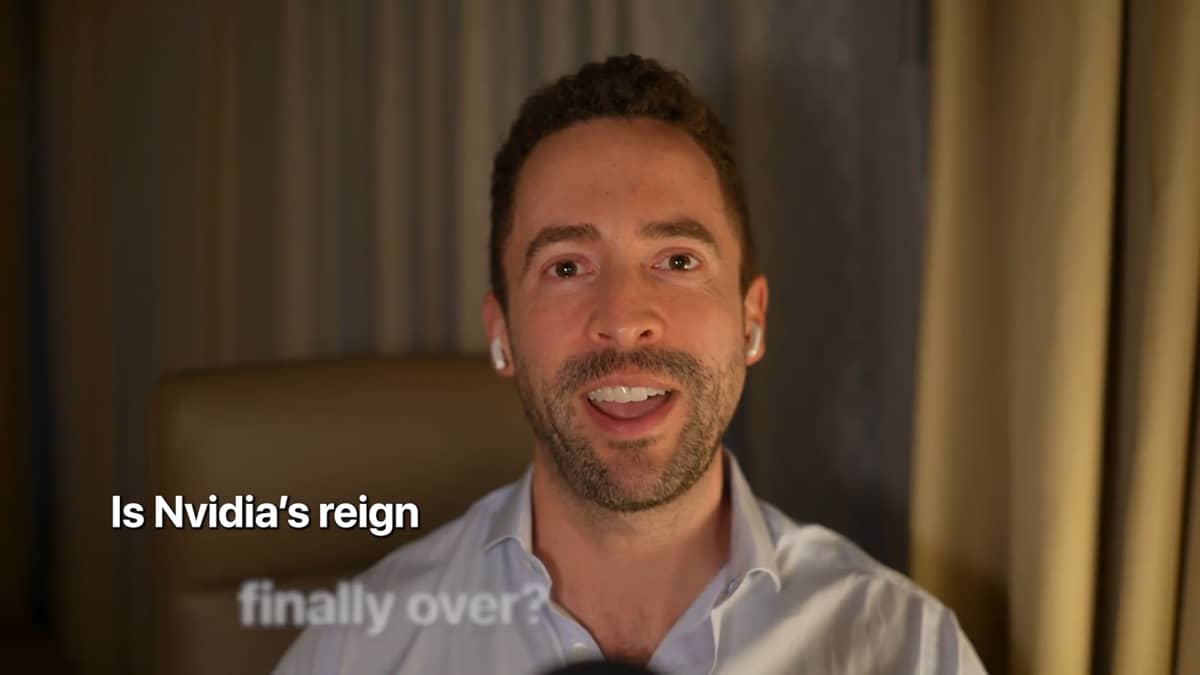
- 37:24
An in-depth look at the semiconductor industry powering the AI revolution, examining the competitive landscape, Q1 2025 earnings results, and how to value chip companies across the design and manufacturing spectrum.
DISCLAIMER: The information provided in this video is for educational and entertainment purposes only and does not constitute financial, investment, tax, or legal advice.Investing involves risk, and you may lose some or all of your capital. Past performance is not indicative of future results. Please conduct your own due diligence or consult with a certified professional before making any financial decisions.
Downloads
No associated resources to download.

Transcript
What is the big deal this week? Is NVIDIA's reign finally over? Is NVIDIA under pressure? We talk a lot about GPUs, but it's certainly not the only thing that AI requires.
TSMC basically does most of the actual manufacturing.
Then you've got companies like Broadcom. Google has their own chips.
I feel like Amazon's developing their own chips.
A lot of these companies are working with Broadcom to actually get these chips manufactured.
So what is it that Broadcom kind of brings to the party, as it were? I'm totally tied to one company. I'm locked in their software ecosystem, and what can I start to do about it? Energy costs are now a big concern, aren't they, for those running the data centers.
A ton of growth in this space, and that, I think, explains a lot of why we're seeing these multiples just so high across the board.
Yeah. Hello to all of our listeners, and welcome to this week's episode of "What's the Big Deal?" Where we take a look under the hoods of major deals in the public and private markets and explore finance industry developments. My name is Deborah Taylor, and I'm going to use my background from my career in investment banking to bring a public markets perspective.
And I'm Graham Smith. I'll use my background in private credit to bring the private market perspective here.
And Graham, what is the big deal this week? So the big deal is a big question this week, and is it, is NVIDIA's reign finally over? I feel like this is a company that just has felt unstoppable for the last, I don't know how many years, as AI has just gained more and more momentum.
But we're seeing some interesting results and some changing dynamics in the whole semiconductor space, which I think are making people question, is their unstoppable market position finally up for grabs a little bit? Absolutely. And I think it's worth remembering that every single AI product, that's ChatGPT, Claude, Copilot, Gemini, is underpinned by the semiconductor industry.
And absolutely, NVIDIA's been kind of the narrative that everyone's focused on. So we do need to explore how the industry operates and whether NVIDIA's reign is coming to an end.
We have quite a few players in the industry, which I think we need to explore.
We've got NVIDIA, obviously. They're the global leader in chip production.
We've got AMD, who are trying to compete with NVIDIA.
We've got Broadcom, previously a communications company, that are now moving into custom chips for AI.
We've got TSMC, who manufactures chips.
We've got Samsung, who produces memory and also does manufacturing.
And then we've got Intel, which is trying to reinvent itself.
So we've got a lot of companies, and we're going to try and understand how the jigsaw fits together. We'll talk about their business models, we'll talk about the Q1 results and what was surprising, and then we'll talk a little bit about their valuations.
So Graham, kick us off with a little bit of an explainer on the semiconductor industry, and also, is NVIDIA under pressure? Okay.
A short answer, I think they are. How could they not be? We've been talking about AI a lot.
This is such a hot space. There's so much CapEx being invested in this space right now.
So how could competitors not want a share of the pie from NVIDIA? So I think, I'm not necessarily saying...
We'll talk about it in a second. I'm not necessarily saying that I think they're going to be gone tomorrow. That's certainly not the case.
But there are a bunch of people saying, "Hey, I want some of that, and some of that really interesting AI growth, too." So where do we start? I guess semiconductors come in a few different flavors, and we talk a lot about GPUs now because this is the type, I guess, of chip, of semiconductor, that is so relevant for AI. But it's not the only one.
You have GPUs, you have the traditional CPUs, which are still very much a part of the market and very much required.
And then you've got, I guess, let's call it some of the other stuff, like the memory, in particular, the high bandwidth memory that AI uses.
You've got just everyone in this whole ecosystem.
So it's kind of interesting. Even when you go to buy a new iPhone, as an example.
You've got different levels of storage in that iPhone. I don't know if anyone's noticed when you've gone to buy a phone or computer, whatever the case may be, that type of memory is just insanely expensive right now, and it's actually AI that's been driving the price of all that up.
So we talk a lot about GPUs, but it's certainly not the only thing that AI requires. So let's see. Just in terms of, I guess, just high level kind of semi-technical background on why you need all this stuff.
I guess if you think about the difference between a CPU, it's kind of the chip that goes inside the server that tells everything what to do.
It orchestrates everything. The GPU is the thing that does all the AI math. Now, I am not a mathematician. Debs, we do finance math, which is barely dividing and multiplying.
I think people love to pretend finance is really complicated, and parts of it are, but the math in finance is not complicated at all. It's like high school math at the highest, I feel like. So the AI math is complicated. You need a PhD in mathematics in order to understand what's going on.
But the way I basically understand it is it's basically just a bunch of really complicated probabilities.
So if you... Everyone's used GPT, Claude, whatnot.
You kind of see how it builds its response as you go down the page or as it responds back to you.
Basically, the way it works is it's kind of on the fly.
All these models really do is basically say, okay, for any given word or letter or series of letters...
People have heard of a token in AI before.
That's kind of what this refers toWhat's the probability that something comes next? So it's building its response based on, all right, if you're asking me to explain what is AI, and it starts saying AI is, what's the next word and phrase that comes after is? So in order to do this, you need just insane amounts of what's called parallel computational power. So the GPUs, or as now a lot of them are being started called TPUs or tensor processing units, it's really just this massive chip that is designed to do the same calculation, not over and over again or in sequence like a CPU does, but at the same time.
Because you just need an insane amount of mathematical computational power to generate these responses.
And that's why these chips require so much power.
As an example, it's just the math behind this stuff is so complicated. It's also why it takes so much power and time to train all these models as well. So you have those chips that are really good at that stuff.
When you type a question into GPT or Claude, that's what's going on. But it's not just that inside this whole ecosystem. So all that happens in a data center, that all happens inside of a computer server, and in that, you need the CPU, the central processing unit, to instruct that GPU and the other stuff inside that machine, like what to do. So you've got to feed the GPU instructions, then you've got to report it back to another server to then report it back to you, the user. All this happens from your perspective almost instantaneously. So there's a lot of coordination going on between all these different components. And that's kind of what the CPUs do.
So even though I feel like we're just talking about GPUs right now, the CPU is still pretty important. And you've got different companies that focus on different parts of this ecosystem.
So you've got Nvidia, which is historically GPUs.
I mean, GPUs, it's graphics processing unit.
That's what they're designed for historically.
Like Nvidia used to make graphics cards for computer gamers.
That was kind of the main business.
And then you've got AMD, who's been in this business for quite a while as well. I think that explains a lot of-- And we'll talk about their market valuation, their movement recently.
I think it explains a lot of why they're doing so well, just because they've had their hands in both of these pies for such a long time.
And then you've got other companies like Samsung who are in the memory space. So if you buy a just little thumb drive you plug into your computer, one of those external hard drives, computer RAM, this is something that Samsung is really, really big in.
And then you've got a few other players a lot of people haven't really come across or heard of. Well, sorry, I need to stop and talk about Intel for a second because they have historically been in the CPU space.
And obviously, there's a lot of history there, right? They're kind of really the main player in that space for, what, decades, I feel like, kind of forever.
And then as these other technologies have gained so much more momentum, I feel like they kind of got pushed to the side.
They've obviously had a big investment from the US government.
There's been a push to bring more chip manufacturing capacity back in the US, and they're certainly benefiting from that.
We'll talk about the manufacturing thing in a second because that's actually kind of interesting.
Then you've got companies like Broadcom that are actually really benefiting from the AI wave right now.
They're more of a, let's call it specialist chip designer.
So Nvidia is the company we hear about all the time for GPUs.
There are a lot of new competitor products kind of coming to market.
Google has their own chips. I feel like Amazon's developing their own chips.
A lot of these companies are working with Broadcom to actually get these chips manufactured. And then you have-- Do you remember when Saudi Aramco went public, and it was kind of the biggest company that no one had ever heard of? You also have this company called TSMC, which is Taiwan Semiconductor Manufacturing Company, I think is the acronym.
And they manufacture, they make the actual chips for basically all of these guys. So you think about or you hear about Nvidia and their chips, you hear about Apple and their chips, you hear about Google, the chips they're designing. Literally, all of these guys use TSMC to do the actual manufacturing.
So it's kind of not a household name, but it's just this absolutely gigantic company that does so much of the manufacturing.
And that's really why you've got so much support for companies like Intel building chip foundries, bringing more of this back to the US just to have more chip building capacity because so much of it is done abroad by one company.
So that's the kind of whistle-stop tour anyway.
I mean, Debs, does that kind of make sense? What questions do you have? Yeah. So I guess, so to be clear, so Nvidia, AMD, and Broadcom, they're the big chip makers, but you're saying TSMC basically does most of the actual manufacturing.
Correct.
So these other companies are just really designing and actually selling the chips.
They're not actually manufacturing it themselves.
Exactly. And we can't leave Intel out of that discussion either. Because in the end, they're still big. They're still relevant. Not as relevant maybe as they were, say, 15 years ago. But they certainly haven't gone away. And when it comes to the manufacturing capacity that you talk about, they're one of the players that does both the design and some of the manufacturing of their own chips. Whereas most of these companies, yes, to your point, are manufacturing using TSMC.
Okay. And then in terms of Broadcom, you said that they're kind of working with Google and Amazon on sort of their own custom chips.What's the advantage? Because so far, NVIDIA's had a bit of a stranglehold of the GPU market.
So what is it that Broadcom brings to the party, as it were? Well, they bring some chip design experience.
They have been in the custom chip manufacturing business for quite a while, so if you're looking to develop your own chip, they're kind of a natural party to work with.
And I think this is one of the reasons why we're seeing some headwinds finally, I suppose, for NVIDIA, or at least some sign that they might not just be this unbeatable behemoth forever. They still have a lot of insane competitive advantage. There's a huge software advantage they have.
A lot of the software that is used to do all this AI calculation is really tied into NVIDIA's software and hardware ecosystem, so it's kind of hard to rip out. But you got to think, if you're literally any of these AI hyperscalers and you're like, "All right. My single biggest expense right now is GPUs.
I'm totally tied to one company. I'm locked in their software ecosystem.
And what can I start to do about it?" So I think we're finally seeing some other companies, feels like, start to catch up.
Maybe NVIDIA still has the absolute latest and greatest and best chips, but some stuff seems like it's pretty, I'm not going to say it's there yet, but it's getting close.
Hmm. And I think I'd read that actually there are energy advantages to some of Broadcom's custom chips.
Maybe they are less energy intensive.
Which, energy costs are now a big concern, aren't they, for those running the data centers.
Yeah.
So I guess if there's an energy saving as well, and you're reducing your dependency on NVIDIA, then it actually makes sense to welcome another party into the market, as it were.
Exactly.
Okay.
This is the kind of thing you literally have to save energy wherever you can- Yeah ... because your energy bill is just so insanely high.
Yeah. Okay, and then I guess my other question is on the manufacturing side.
You mentioned TSMC, that effectively has, at the moment, a monopoly on the manufacturing, but as we know, Intel's kind of moving into that market.
What are the big risks or concerns around TSMC? Because if they're doing a good job manufacturing and supplying the capacity that's needed, what's the concern there? I think there are a few. One is you have a capacity constraint in this market right now.
Again, to that point of this isn't just impacting the price of GPUs for AI.
You go to buy a new iPhone, you're like, "Why is it so much more expensive?" You buy a new computer, you want to add hard drive space to it.
Why is that so much more expensive? It is literally AI that is making that so much more expensive.
Wow. So there are supply constraints in production for really all these chips.
So I think it's just kind of good practice to have some alternative supply. And then also, let's just remember the reality of the world that we're living in. We're living in a world that is unpredictable and stuff can happen.
So when you have the basically single source of manufacturing capacity for everything that is driving so much of the overall economic growth right now that's both offshore and could be attacked by someone, then it just seems like a good idea to start to build some more production capacity.
Yeah, I think I read that the US government's actually taken a stake in Intel to help support that kind of direction change for them, that move into manufacturing.
Yeah. And it's kind of a weird move for a government to make.
I feel like government's not really supposed to do stuff like this, just fundamentally.
Hmm.
But I don't know. We're living in kind of a weird world anyway.
Yeah.
And I guess you can make the argument that actually having some alternate supply is a good thing here.
Right.
So I was just looking at the kind of high level press release. I think they invested about $9 billion for 10%. You know what's interesting to think about, though? I don't know what Intel's cash position was like, and what their production build plans were. But based on some of these crazy CapEx numbers we talked about even last week, what, like 6, 700 billion, you're like, 9 billion's chump change.
Yeah, it's pocket money, isn't it? What can you build for only $9 billion? Mm.
But there's obviously more going on than just the US government investment there.
Hmm. Yeah. Interesting. And yeah, there's so much that's been happening in the world, as you say, that's affecting demand for chips, the manufacturing process, the location, and clearly that is having an effect on the results of the companies and their valuations. So let's touch a little bit on that.
Yeah. As I say, let's talk about where the financials are here.
Yeah.
I'll just give you a kind of summary of what's been happening, because we have started to get Q1 results coming in just over the last week. I think it's the first quarter where the narrative isn't just about how amazing NVIDIA is, because as you said right at the opening- Yeah ... of this episode, it's just been such an amazing narrative so far.
But it is definitely coming under a bit of pressure, and it's the only one whose share price has actually fallen since Q1 results started. And now NVIDIA themselves haven't yet reported, but they are guiding to 77% year-on-year revenue growth. Which sounds amazing, so why on earth would- Which does sound amazing, right? ... the share price fall? Yeah, totally.
And everyone's like, "That's crap." Well, to be fair, the market reacts when there's new information. And ultimately- Yeah ... the question is what- Yeah, of course ... has been revealed in the results of others.
And I think there's been a few bits of news flow.
So first of all, AMD, they reported a huge beat. Their Q1 earnings were up 36% year-on-year, but actually a real nugget of information there was that their data center revenues were up 57% year-on-year.
So it's now viewed as- Yeah ... a much more credible rival for Nvidia.
And although it's still only generating a fraction of Nvidia's revenues, it's effectively now starting to take some market share, which, from the market's perspective, is huge.
Market share- Yeah ... is so important for share prices.
Market share gains is someone else's loss.
So there is definitely a bit of a- Yeah ... correction there. And then on top of that, we've had Broadcom's results.
Their revenues are up 29% year-on-year, and as we mentioned earlier, they produce custom AI chips, but that's stealing headlines because we've got Google and Meta spending billions on their chips, specifically not buying Nvidia's GPUs because, as we mentioned earlier, they're more energy efficient and reduces Nvidia dependency.
Meanwhile, we've had TSMC also reporting their results.
Remember, they're the manufacturing company.
Their revenues were up 41% year-on-year, and it really just provides really bullish read-across around demand for chips, so that was viewed very positively across the industry.
But Samsung also reported really strong results, up 70% year-on-year for revenues, which reinforces what we've seen for TSMC, but they did flag memory shortages running into '27.
So this is the first bit of negative we're seeing about capacity, because so far we've been concerned about capacity for GPU, but now Samsung are saying, "Well, maybe there's going to be supply chain constraints for memory." And without memory, the GPUs become effectively redundant, so you need the two- Yeah ... hand in hand to meet demand.
So a little bit of a headwind there. I'm surprised it's taken that long for them to even- Mm ... kind of come out and say that, because it's felt like that's been the case for a while, just given the crazy price increases of all this stuff. So it really does feel like we just need more capacity overall.
Absolutely. And it's funny because we were talking about prices of some of these chips. They are really expensive.
Like, when we hear the numbers- Yeah.
... about committed spend, so much of that goes on the chips, and their life- Yeah ... is so short. They're like, what, eight years' life? So yeah. I mean, this is- I know. I know ... print the license to print money here.
This whole world is a little bit crazy if you think about it sometimes, right? Yeah.
Because you have that whole dynamic, right? This just insanely expensive chip, doesn't last that long, and then you ask ChatGPT something, and then someone's lights dim if they live near a data center- Yeah ... or they run out of water in their tap, and you're just like, "What's going on?" Yeah, absolutely.
Like- Yeah ... are we living in the upside-down right now? I don't know.
Yeah. Totally. And then on top of all of that, we've got Intel.
I mean, oh my goodness, their share price has absolutely rocketed this year.
I think it's up 150% year to date.
And for them, it's really a big comeback story because as you say, they've kind of been languishing. They got that boost from the US government investment.
But I think what also gave them an extra tailwind, as it were, is that they're now reportedly in talks with Apple for using some of their processors and maybe even their manufacturing for Apple devices. So that would be a huge win- Interesting ... for them.
Yeah.
So, so much interesting news flowing in the results.
Clearly, there's strong demand for chips, but the sort of, I think, underlying story is, first of all, more pressure on Nvidia, definitely.
Yeah.
And maybe also the comeback story for Intel, the fact they're now moving into the manufacturing space, that kind of changes the dynamic of the industry slightly. So that's kind of my take on the Q1 results.
I'm not a public equity guy. I actually don't do a lot in the public stock market because I think we've had this discussion before.
You just, like, for me, how do you value something when some news comes out and things are up 50% and then they're down 30%, and especially in a space like this? How do you make money as an investor in this space right now? What are you supposed to do? Yeah, I think it's really interesting because I think part of the problem is that everybody wants to be invested in the AI theme, and everybody's trying to work out where the safe bet is. So we've kind of talked a bit about the hyperscalers, we've talked about the AI companies, and now the chips. And so I think part of the problem is trying to kind of peer through the noise and work out what is linked to fundamentals and what is just people shifting their view or kind of almost rotating between the different points at which you can invest in the theme. And I think as we've seen kind of concerns around maybe the cost of energy for the hyperscalers, then people think, "Oh, maybe we should be moving towards more focusing on semiconductors." So I think that the problem is actually the noise from all of that.
I think in terms of- Yeah ... the actual fundamentals, as I mentioned earlier, kind of the big metric that's watched is market share.
Any kind of moving of the needle there will have a massive impact on the share price because that effectively becomes a trend that you then extrapolate.
You know, "Oh, what, they gained market share?" That's likely to continue, if all else is equal. So I think that's why we've seen such positive response by the market for AMD and maybe a slight pullback for Nvidia.I think what's also interesting is that the valuation world for semiconductors has moved on.
When I was an analyst, the valuation of these companies was really closely tied to the end market, the different types of chips. So you had chips for telecoms, consumer electronics, autos, industrials, and when we had results in a particular industry, that would then feed into the valuation chip manufacturer that fed that end market. But now everything is linked to AI.
So I think that makes the analysis of valuation a little bit more tricky.
And I think it's important to understand the way the different businesses are set up.
We talked about some of them actually doing manufacturing, some doing the design, and the selling of the chips, and the different types of chips, the geopolitical risk, and how that might weigh on TSMC.
So I think those are the kind of the interesting areas to explore with the valuation. Okay, so let's talk about the valuation of some of these companies. I've got some stats in front of me in terms of multiples. We've got Nvidia actually only on an EV to EBITDA of 22 times, which I think is surprisingly low, but as we've seen, the shares have pulled back slightly in recent days. AMD on EV to EBITDA of 30 times, and Broadcom on 26 times. Meanwhile, TSMC, they've got amazing margins. Their margin's at 66%.
I mean, that's huge.
Their multiple, their EV to EBITDA, is only 18 times.
So why do you think the market favors the chip makers over the chip manufacturer? And so why do you think AMD's at such a premium at the moment? I mean, first of all, compared to-- because I always look at things through the lens of the type of investing that I've done in my finance career, and if I ever saw an EBITDA multiple of 22 times kind of purchase price on the way in, I'd say, like, "What is this?" Yeah.
So to hear, "Oh, it's only 22 times." "Oh, it's only $10 billion, only 22." You're like, "What?" This is just nuts. But yeah, actually, one thing I talk a lot about when I'm in the classroom trying to explain valuation to people, particularly EV to EBITDA valuation multiples, which is kind of like...
I feel certainly in private market investing, the multiple we look to more than anything else, I kind of think about there are two real fundamental things that drive valuation.
One is, of course, growth prospects, and we're in this insanely high growth industry, so all these multiples are high because people expect a lot of growth. And the other is cash conversion, right? So kind of makes sense to me that you've got the CapEx-light businesses in this space, like Nvidia, AMD, on a premium multiple basis compared to the foundries, because you just kind of think about what must be involved in running a foundry, and that's got to require a ton of cash, a ton of maintenance CapEx.
So, if you were to really look at these on some kind of multiple of cash flow, do you start to see a multiple that looks a little bit more similar? Probably.
I'd have to actually spread the comps and do the math.
But my guess is it has a lot to do with the CapEx requirement and cash conversion.
Yeah. I think that's true, and I think I read somewhere that the companies which provide the foundries, that kind of CapEx drag does weigh on their valuations typically.
So yeah, I completely agree. I think the only thing to flag, though, is that TSMC, we mentioned the political risk.
That probably also weighs on their multiple.
In fact, if you compare TSMC 18 times multiple to Intel's 24 times, maybe that gives you a truer comparison with Intel moving more into the foundry side of things.
Yeah.
So that almost certainly weighs down on the multiple for TSMC, doesn't it, that geopolitical risk? 100%. I'm just kind of laughing to myself.
It's still wild in the sense that a company with a high CapEx bill, geopolitical risk, is lowly valued at 18 times EV to EBITDA. Like, okay.
Yeah, but then it's got what? Year-on-year revenue growth of 40% or something.
I know. Of course, right? That's fair.
It's just kind of funny.
Yeah.
Because you compare it to any kind of other capital intensive, straight up manufacturing business where you're manufacturing just stuff.
Yeah.
It's so wildly different.
Yeah.
But yeah. Obviously, a ton of growth in this space, and that I think explains a lot of why we're seeing these multiples just so high across the board.
Yeah. Absolutely. I think the only other thing to flag, Nvidia, the fact that Nvidia's market cap is $5 trillion. It's now about 7% of the S&P 500.
So you've got all of those passive funds kind of having to hold Nvidia. I mean, I think it's the most held stock in the world.
So that is going to have an influence over the valuation as well, that kind of what we refer to as technical factors that drive a share price. It's not just about the company.
Inclusion in an index or being a very material part of an index can make the valuation a little bit more sort of buoyant, shall we say, as a result of that.
I actually think we should do a whole episode on some of this stuff at some point because this is not something that I know a ton about, and we've talked about it a little bit, and I actually just find it interesting just because it's something I don't know that much about, and I'm sure there are other people in the same kind of boat.
Yeah.
So let's pencil that in for a future episode.
Okay. DefinitelyExcellent. So I think we've kind of talked through quite a bit there. We've talked about the semiconductor industry.
We've talked a little bit about Q1 results.
We've talked about the valuation of these companies.
So I think the next question is, what are your key takeaways, Graham? All right. Key takeaway for me, personally, I don't have money invested in this market just because I don't have a view yet on if we're in just sort of hyper, almost bubble territory right now.
Feels like we have been, especially in the context of the news we talked about last week with some of these CapEx numbers being pulled back, revenue targets being missed. You're like, are we just in this world where everything is just uber frothy? I don't necessarily know if I have a view on whether we're in the '90s dot-com bubble territory here or not. Feels like there's a bit more substance going on here in the sense that you have all this infrastructure build.
There is quite a bit of demand for all these services, so it does feel different. It's not like the '90s where I was a kid, so I had no idea what was going on, but I remember friends being like, "Oh, the P multiple, a higher negative P multiple is great because it means the company is growing so fast because they're losing money." And you're in high school, you're like, "Yeah, yeah, that makes sense." And then you grow up, and you're like, "What the hell is this?" So I don't think we're there, where companies are getting valued on clicks on the site, that kind of thing.
Mm-hmm.
But I would be cautious around how to put money to work in this space just because I don't really have a view, to be honest.
Mm.
And I'm not going to say I'm bearish on Nvidia, but does feel like the music is finally slowing down for them a little bit, not necessarily stopping.
But I think everyone, again, you've got a market that's just this big, has got this much growth.
You can't just have one player supplying everything forever.
That just doesn't work. Yeah, so I'm kind of not surprised that we're finally in this phase now.
Yeah.
I'm going to be watching AMD, watching Broadcom, actually watching Intel more than I have been before, just given all the manufacturing constraints here, and see what they do in terms of building their own foundries.
I still think it's going to be a really interesting space to watch.
Yeah.
But I don't know about you. I don't know what to make of it right now.
I think we should be watching the Nvidia results.
Their results come out on the 20th of May.
That will be a huge- Yeah ... catalyst for the market if it confirms that they are losing market share to AMD, let's say.
Yeah.
So I think that, to me- Yeah ... is a really important data point.
And yeah, I think the foundry side of things, the manufacturing is becoming more interesting. What's happening with Intel, the discussions with Apple, that could be a really interesting story arc, if you like, over the next few months. So definitely one to watch there.
It's interesting because then you're talking about the dot-com boom. Guess what I was actually doing at that point in time? Oh, I'm gonna guess. You told me you were studying semiconductors, right? I was. Yes, from a very scientific perspective, I was in a clean room for about eight weeks trying to produce a new type of semiconductor.
No kidding.
Yeah.
All right.
So I was trying to produce something called semiconductor quantum dots, which is where you have nanoparticles on the surface of a silicon wafer.
And it was about the most boring eight weeks of my life because you're having to do this in complete isolation, in clinically isolated conditions, like a clean room. It literally is completely sterile.
And I was in there for long periods of time.
And actually, that was the point where I decided to move into finance.
I also thought it was a completely pointless activity.
Initially, it was quite interesting, then I thought, "This is not going to work." It didn't work. I got no results. It sounds interesting when you're like, "I was in this science lab working on quantum dots." I'm like, "That's cool.
That sounds awesome." And you're like, "No, it was boring as s**t." I got absolutely no results. I had to file a thesis that basically said, yeah, zero results. And then the worst thing was, in 2023, the Nobel Prize for chemistry was successfully doing this.
So where I failed- Wait, so is this- ... someone else succeeded and won a Nobel Prize.
Is this like an early precursor to quantum computing, this kind of thing, or something totally different? No, it's quite different. It's not a world I understand.
It's just producing quantum dots for semiconductor surfaces because they have interesting electrical properties.
Okay.
Yeah. It's slightly separate, but yeah, there we go.
All right. Well, the tides are turning.
Maybe you need to open up a quantum dot foundry.
Now's the time.
In my clean room. Yeah, which definitely would not be this house.
All right, Debs, if you're not here next week, we know where you've gone.
Yeah.
In your white lab coat with like- With my little...
Hang on. It's not just a lab coat. You literally have a whole suit.
Everything is covered. It was the summer.
I was not happy. Anyway.
Oh, amazing.
Right.
So back to our discussion on the semiconductors.
So key results coming out on the 20th of May for Nvidia.
Lots to watch in terms of the semiconductor story, I think. I'm sure we will revisit it.
So thanks very much for those of you that have tuned in, and I hope you enjoyed our deep dive into the semiconductor industry.
Don't forget to like and subscribe and leave us a comment on YouTube. And that's it from me, and over to Graham.
Thanks, everyone. It's been fun as always.
I'm sure we'll have so much more to keep talking about here, so we'll be back for more next week. But until then, take care.