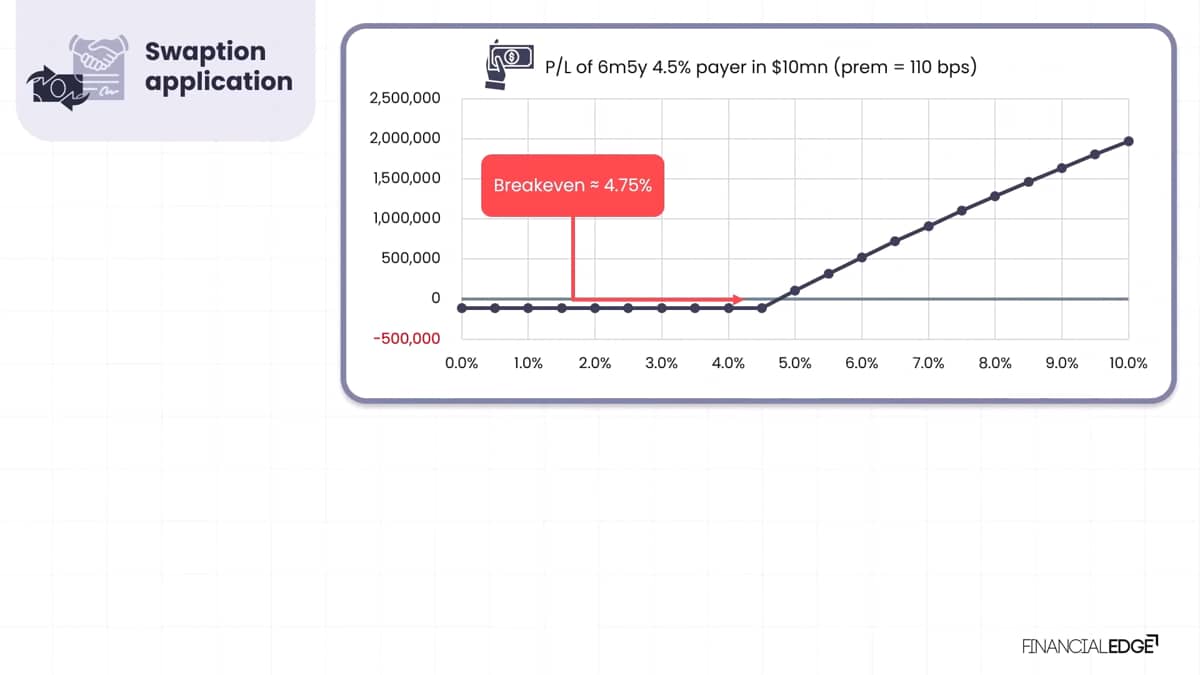
Here we see a simple speculative application of a swap option, the purchase of a payer to express the view that the underlying swap rate goes up.
The example uses a six month, five year, four and a half percent payer, which means in six months time, the buyer has the right to pay fixed at 4.5% on a five year swap.
The swap option will be in the money if five year swap rates are above 4.5%.
On expiry, we see the familiar long call payoff profile, and it's worth noting the convexity of the payoff, which is caused by the increasing effect of discounting as rates go higher.
Swaptions can be physically or cash settled in physical settlement.
The option counterparties enter into the underlying swap at the strike rate.
So using the previous example, the speculator, if they exercised their pay swap option, would pay fixed on a five year swap at 4.5%.
If a swap option is cash settled, the present value of the payoff is computed and paid by the seller to the buyer.
Like in other markets. It is generally true that financial institutions will prefer cash settlement because their motivation is related to the economic value of the payoff.
And non-financial end users will prefer physical settlement because they usually have a need to enter into the swap in question.
For example, if it is to hedge a loan, however, care needs to be taken with cash settlement as it relies on an agreement of a present value calculation on the underlying swap, which is a function of each counterparty's discount curve.
This agreement can be done in one of two ways.
In the first method, both counterparties compute the cash value using their own discount curves and compare the results.
Usually, any differences will be small enough to not be contentious and a cash amount is agreed.
The second method is where a standard pvo O one formula is used to calculate the cash value.
You may recognize the formula as the annuity formula, a standard mathematical shortcut to the calculation of present value using only the swap rate as an input.
The option counterparties need only agree where the swap rate was at expiry, often with the aid of a third party fixing rate and will by default agree the cash settlement.
The disadvantage of method two is that it is usually only an approximation, as it implicitly assumes the swap curve is flat, which it rarely is.