Skip to content
Felix
  • Topics
    • My List
    • Felix Guide
    • AI
    • Asset Management
    • Coding and Data Analysis
      • Data Analysis and Visualization
      • Financial Data Tools
      • Python
      • SQL
    • Credit
      • Credit Analysis
      • Restructuring
    • Financial Literacy Essentials
      • Financial Data Tools
      • Financial Math
      • Foundations of Accounting
    • Industry Specific
      • Banks
      • Chemicals
      • Consumer
      • ESG
      • Industrials
      • Insurance
      • Oil and Gas
      • Pharmaceuticals
      • Project Finance
      • Real Estate
      • Renewable Energy
      • Technology
      • Telecoms
    • Introductory Courses
    • Investment Banking
      • Accounting
      • Financial Modeling
      • M&A and Divestitures
      • Private Debt
      • Private Equity
      • Valuation
      • Venture Capital
    • Markets
      • Economics
      • Equity Markets and Derivatives
      • Fixed Income and Derivatives
      • Introduction to Markets
      • Options and Structured Products
      • Other Capital Markets
      • Securities Services
    • Microsoft Office
      • Excel
      • PowerPoint
      • Word & Outlook
    • Professional Skills
      • Career Development
      • Expert Interviews
      • Interview Skills
    • Risk Management
    • Transaction Banking
    • Felix Live
  • Pathways
    • Investment Banking
    • Asset Management
    • Equity Research
    • Sales and Trading
    • Commercial Banking
    • Engineering
    • Operations
    • Private Equity
    • Credit Analysis
    • Restructuring
    • Venture Capital
    • CFA Institute
  • Certified Courses
  • Ask An Instructor
  • Support
  • Log in
  • Topics
    • My List
    • Felix Guide
    • AI
    • Asset Management
    • Coding and Data Analysis
      • Data Analysis and Visualization
      • Financial Data Tools
      • Python
      • SQL
    • Credit
      • Credit Analysis
      • Restructuring
    • Financial Literacy Essentials
      • Financial Data Tools
      • Financial Math
      • Foundations of Accounting
    • Industry Specific
      • Banks
      • Chemicals
      • Consumer
      • ESG
      • Industrials
      • Insurance
      • Oil and Gas
      • Pharmaceuticals
      • Project Finance
      • Real Estate
      • Renewable Energy
      • Technology
      • Telecoms
    • Introductory Courses
    • Investment Banking
      • Accounting
      • Financial Modeling
      • M&A and Divestitures
      • Private Debt
      • Private Equity
      • Valuation
      • Venture Capital
    • Markets
      • Economics
      • Equity Markets and Derivatives
      • Fixed Income and Derivatives
      • Introduction to Markets
      • Options and Structured Products
      • Other Capital Markets
      • Securities Services
    • Microsoft Office
      • Excel
      • PowerPoint
      • Word & Outlook
    • Professional Skills
      • Career Development
      • Expert Interviews
      • Interview Skills
    • Risk Management
    • Transaction Banking
    • Felix Live
  • Pathways
    • Investment Banking
    • Asset Management
    • Equity Research
    • Sales and Trading
    • Commercial Banking
    • Engineering
    • Operations
    • Private Equity
    • Credit Analysis
    • Restructuring
    • Venture Capital
    • CFA Institute
  • Certified Courses
Felix
  • Data
    • Company Analytics
    • My Filing Annotations
    • Market & Industry Data
    • United States
    • Relative Valuation
    • Discount Rate
    • Building Forecasts
    • Capital Structure Analysis
    • Europe
    • Relative Valuation
    • Discount Rate
    • Building Forecasts
    • Capital Structure Analysis
  • Models
  • Account
    • Edit Profile
    • Manage Account
    • My List
    • Restart Homepage Tour
    • Restart Company Analytics Tour
    • Restart Filings Tour
  • Log in
  • Ask An Instructor
    • Glossary
    • Email Our Experts
    • Felix User Guide
    • Contact Support

Insurance Industry Overview

Understand how an insurance company works and the different types of insurance business.

Unlock Your Certificate   
 
0% Complete

19 Lessons (55m)

Show lesson playlist
  • Description & Objectives

  • 1. How an Insurance Company Works

    01:15
  • 2. Insurance Company Profits Workout

    02:00
  • 3. Insurance Portfolios

    01:52
  • 4. Claims Settlement Workout

    03:49
  • 5. Simple Insurance Income Statement

    02:48
  • 6. Simple Insurance Balance Sheet

    02:04
  • 7. P&C Financial Statement Workout

    05:24
  • 8. Insurance Sectors

    03:09
  • 9. Life Insurance Products

    04:38
  • 10. Risk Products Examples

    01:38
  • 11. Spread Products Examples

    05:30
  • 12. Whole Life Policies Workout

    03:07
  • 13. Fee Products Examples

    02:14
  • 14. Unit Linked Policies Workout

    03:30
  • 15. Reinsurance

    02:00
  • 16. Proportionate Reinsurance Workout

    02:31
  • 17. Stop Loss Reinsurance Workout

    03:10
  • 18. Risks in Insurance

    03:18
  • 19. Insurance Industry Overview Tryout


Next: Deconstructing Insurance Financial Statements

P&C Financial Statement Workout

  • Notes
  • Questions
  • Transcript
  • 05:24

How to build an insurance company's balance sheet and income statement after writing new policies.

Downloads

P&C Financial Statement Workout EmptyP&C Financial Statement Workout Full
Back to top
Financial Edge Training

© Financial Edge Training 2026

Topics
Introduction to Finance Accounting Financial Modeling Valuation M&A and Divestitures Private Equity
Venture Capital Project Finance Credit Analysis Transaction Banking Restructuring Capital Markets
Asset Management Risk Management Economics Data Science and System
Request New Content
System Account User Guide Privacy Policy Terms & Conditions Log in
Transcript

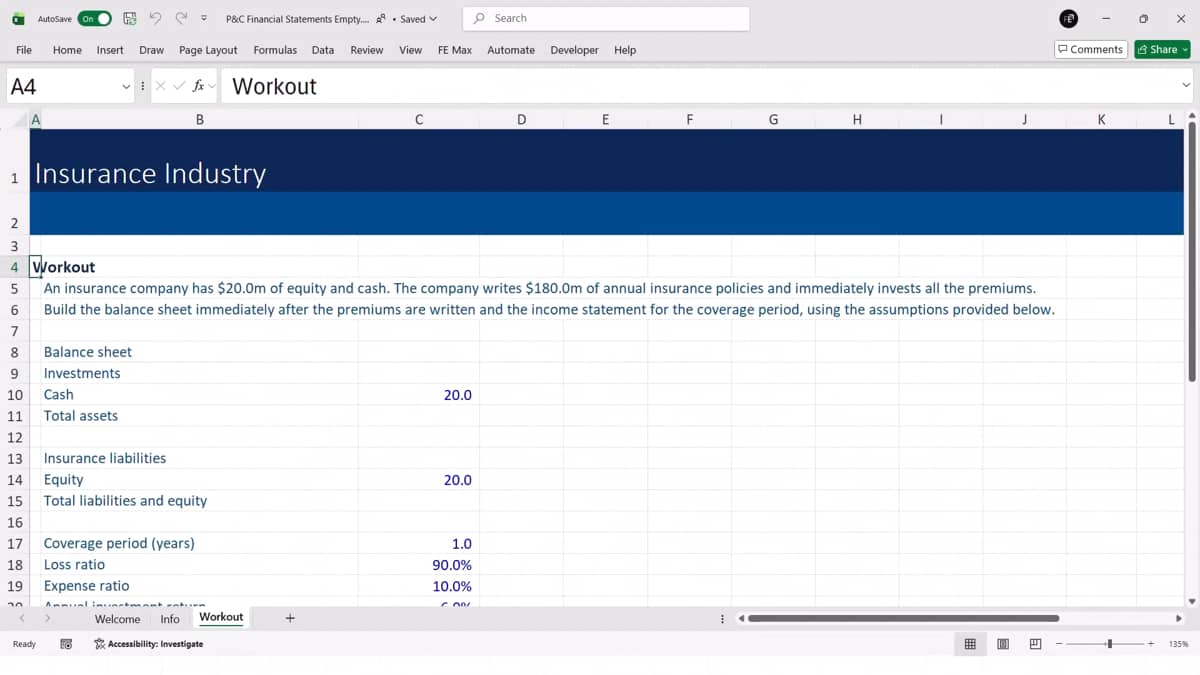
In this workout, we're told that an insurance company has $20 million of equity and cash. The company writes $180 million of annual insurance policies and immediately invests all the premiums.

We're then asked to build the balance sheet immediately after the premiums are written, and the income statement for the coverage period, using the assumptions provided below.

Now, we can see the 20 million of cash and equity already in the balance sheet, but we need to include the effect of the insurance policies which have been written.

Now, the insurance company will receive $180 million in insurance premiums, and immediately after the business is written, these are all liabilities in the balance sheet, as they reflect unearned premium.

So let's add these in now.

This means that total liabilities and equity, if I add those together, are 200 million. We're also told that the insurance company immediately invests these premiums, so we're going to reflect the premiums received in the investments balance as well. And when we add this to our cash balance, we have total assets of $200 million. So we now have a new balance sheet that reflects the business written and our balance sheet balances, as total assets equal total liabilities and equity of $200 million.

Now let's build the income statement for the coverage year.

I'm going to scroll down for this.

The assumptions provided tell us that the coverage period is one year, the loss ratio is 90%, the expense ratio is 10%, the annual investment return is 6%, and the tax rate is 25%, and all claims are paid out on the final day of the coverage period.

Let's start with the premiums earned.

If the coverage period is one year, then the 180 million of premiums are earned during the year.

If the loss ratio is 90%, then the claims expense is going to be 90% of our premiums earned.

And I'll make that a negative to show it as an expense.

If we deduct the claims expense from the premiums earned, that gives underwriting profit of $18 million.

If the annual investment return is 6%, we can apply this to the insurance premiums received to give our investment return.

Note that we're implicitly assuming that the prior cash balance is being used to cover operating expenses and taxes rather than generating an investment return.

If the expense ratio is 10%, we can apply this to our premiums earned to give our operating expenses.

And I'll multiply that by minus one to show it as a negative.

When we add the investment returns to our underwriting profit and subtract our operating expenses, this gives profits before tax of $10.8 million.

Applying the tax rate to this gives our tax expense of $2.7 million, and we deduct the tax expense from our profit for tax to give net income of $8.1 million.

Finally, the return on equity is net income divided by equity from the balance sheet, giving a return on equity of 40.5%.

Now, this is effectively a simple insurance model, and like all models, we should now spend some time understanding the main drivers.

The first key driver is the growth in business written.

That's the level of premiums. If I increase these to $250 million, let's see what happens to the return on equity.

Gosh, that goes up significantly, as we're now generating more profit, but using the same amount of equity.

Let's undo that change.

The second key driver is product pricing.

That's the premium charged relative to expected claims.

And we can demonstrate this driver in our model by keeping our premium the same, but by decreasing the loss ratio to 85%.

And when I do that, wow, our return on equity goes up, as we're generating more profit, but still using the same amount of equity.

Let's undo that change.

Our third key driver is cost efficiency.

That's the level of expenses relative to the amount of business written.

We can demonstrate this by keeping our premium the same, but decreasing our expense ratio to 8%.

Wow. Again, our return on equity goes up because we're generating more profit, but using the same amount of equity.

AI for Analysts Series - Accelerate your deal execution, financial modeling, and client deliverables. Join free via Felix Live!

Content Requests and Questions

You are trying to access premium learning content.

Discover our full catalogue and purchase a course Access all courses with our premium plans or log in to your account
Help

You need an account to contact support.

Create a free account or log in to an existing one

Sorry, you don't have access to that yet!

You are trying to access premium learning content.

Discover our full catalogue and purchase a course Access all courses with our premium plans or log in to your account

You have reached the limit of annotations (10) under our premium subscription. Upgrade to unlock unlimited annotations.

Find out more about our premium plan

You are trying to access content that requires a free account. Sign up or login in seconds!

Create a free account or log in to an existing one

You are trying to access content that requires a premium plan.

Find out more about our premium plan or log in to your account

Only US listed companies are available under our Free and Boost plans. Upgrade to Pro to access over 7,000 global companies across the US, UK, Canada, France, Italy, Germany, Hong Kong and more.

Find out more about our premium plan or log in to your account

A pro account is required for the Excel Add In

Find out more about our premium plan

Congratulations on completing

This field is hidden when viewing the form
Name(Required)
This field is hidden when viewing the form
Rate this course out of 5, where 5 is excellent and 1 is terrible.
Were the stated learning objectives met?(Required)
Were the stated prerequisite requirements appropriate and sufficient?(Required)
Were the program materials, including the qualified assessment, relevant and did they contribute to the achievement of the learning objectives?(Required)
Was the time allotted to the learning activity appropriate?(Required)
Are you happy for us to use your feedback and details in future marketing?(Required)

Thank you for already submitting feedback for this course.

CPE

What is CPE?

CPE stands for Continuing Professional Education, by completing learning activities you earn CPE credits to retain your professional credentials. CPE is required for Certified Public Accountants (CPAs). Financial Edge Training is registered with the National Association of State Boards of Accountancy (NASBA) as a sponsor of continuing professional education on the National Registry of CPE Sponsors.

What are CPE credits?

For self study programs, 1 CPE credit is awarded for every 50 minutes of elearning content, this includes videos, workouts, tryouts, and exams.

CPE Exams

You must complete the CPE exam within 1 year of accessing a related playlist or course to earn CPE credits. To see how long you have left to complete a CPE exam, hover over the locked CPE credits button.

What if I'm not collecting CPE credits?

CPE exams do not count towards your FE certification. You do not need to complete the CPE exam if you are not collecting CPE credits, but you might find it useful for your own revision.


Further Help
  • Felix How to Guide walks you through the key functions and tools of the learning platform.
  • Playlists & Tryouts: Playlists are a collection of videos that teach you a specific skill and are tested with a tryout at the end. A tryout is a quiz that tests your knowledge and understanding of what you have just learned.
  • Exam: If you are collecting CPE points you must pass the relevant CPE exam within 1 year to receive credits.
  • Glossary: A glossary can be found below each video and provides definitions and explanations for terms and concepts. They are organized alphabetically to make it easy for you to find the term you need.
  • Search function: Use the Felix search function on the homepage to find content related to what you want to learn. Find related video content, lessons, and questions people have asked on the topic.
  • Closed Captions & Transcript: Closed captions and transcripts are available on videos. The video transcript can be found next to the closed captions in the video player. The transcript feature allows you to read the transcript of the video and search for key terms within the transcript.
  • Questions: If you have questions about the course content, you will find a section called Ask a Question underneath each video where you can submit questions to our expert instructor team.