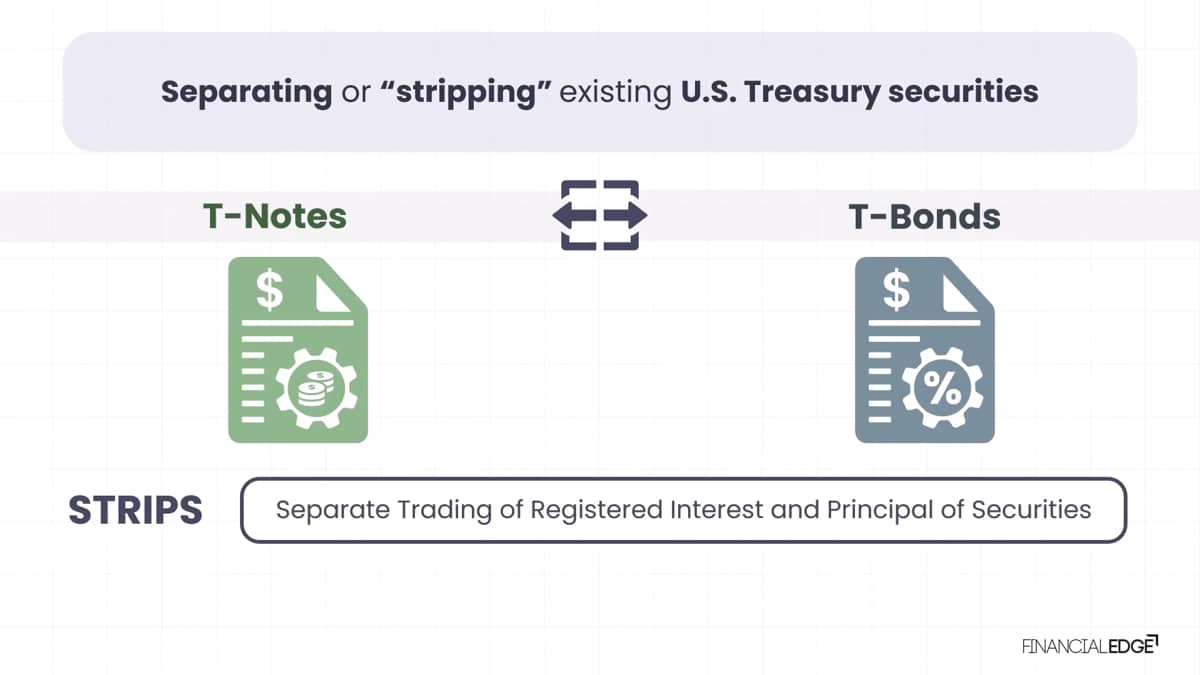
Let's have a look at STRIPS, a unique type of treasury investment that breaks down traditional bonds into the individual component cash flows. With each coupon payment and principal amount turned into its own zero coupon security, STRIPS provide investors with flexibility for precise financial planning, whether it's to manage reinvestment risk, align with a specific investment horizon, or take advantage of tax deferred accounts. Although STRIPS are not a separate type of government bond, they are unique investment products created by separating or stripping existing US treasury securities. Primarily T-notes and T-bonds, STRIPS stands for separate trading of registered interest and principle of securities, which accurately describes the process involved when a treasury note or bond is stripped, each individual coupon payment as well as the final principle payment become separate securities. For example, if a 10 year treasury note is stripped, it creates 20 individual coupon payments, one for each six month period and a single redemption payment at maturity. Each of these 21 cash flows can then be traded independently. The stripping process essentially transforms each cash cashflow into a standalone security with just one cashflow at maturity. Because of this, STRIPS behave like zero coupon bonds with their price reflecting the present value of that single future cashflow. This provides investors with longer term low credit risk, zero coupon bonds, effectively creating longer dated T-Bills, which always have less than 12 months to maturity. Now let's look at why an investor might prefer STRIPS over traditional coupon paying treasury securities. There are two main advantages which stand out.
First, reinvestment risk, investors looking to invest for a specific time period, say 10 years, might consider buying a 10 year T-note. However, with T-note, they will receive semi-annual coupon payments, which they would need to reinvest. Since future interest rates are unpredictable, there's a risk known as reinvestment risk that these coupons may need to be reinvested at lower rates. STRIPS as zero coupon securities do not have interim cash flows eliminating this reinvestment risk. The investor only receives one payment at maturity, making them more suitable for those wanting a defined return over a specific time horizon. The second main benefit is around tax deferred accounts. The structure of STRIPS can be advantageous for certain tax deferred accounts such as individual retirement accounts, IRAs, in the US. Because STRIPS do not pay periodic interest, they are well suited for tax deferred environments where the absence of regular coupon payments aligns with long-term growth strategies. In these accounts, the investor does not have to worry about paying income taxes on the coupons of a standard bond, which they were not interested in receiving anyway. Under tax deferred accounts, no taxes payable on capital gains until the maturity of the investment or when the investment is sold.