Skip to content
Felix Live
  • Topics
    • My List
    • Felix Guide
    • Asset Management
    • Coding and Data Analysis
      • AI
      • Data Analysis and Visualization
      • Financial Data Tools
      • Python
      • SQL
    • Credit
      • Credit Analysis
      • Restructuring
    • Financial Literacy Essentials
      • Financial Data Tools
      • Financial Math
      • Foundations of Accounting
    • Industry Specific
      • Banks
      • Chemicals
      • Consumer
      • ESG
      • Industrials
      • Insurance
      • Oil and Gas
      • Pharmaceuticals
      • Project Finance
      • Real Estate
      • Renewable Energy
      • Technology
      • Telecoms
    • Introductory Courses
    • Investment Banking
      • Accounting
      • Financial Modeling
      • M&A and Divestitures
      • Private Debt
      • Private Equity
      • Valuation
      • Venture Capital
    • Markets
      • Economics
      • Equity Markets and Derivatives
      • Fixed Income and Derivatives
      • Introduction to Markets
      • Options and Structured Products
      • Other Capital Markets
      • Securities Services
    • Microsoft Office
      • Excel
      • PowerPoint
      • Word & Outlook
    • Professional Skills
      • Career Development
      • Expert Interviews
      • Interview Skills
    • Risk Management
    • Transaction Banking
    • Felix Live
  • Pathways
    • Investment Banking
    • Asset Management
    • Equity Research
    • Sales and Trading
    • Commercial Banking
    • Engineering
    • Operations
    • Private Equity
    • Credit Analysis
    • Restructuring
    • Venture Capital
    • CFA Institute
  • Certified Courses
  • Ask An Instructor
  • Support
  • Log in
  • Topics
    • My List
    • Felix Guide
    • Asset Management
    • Coding and Data Analysis
      • AI
      • Data Analysis and Visualization
      • Financial Data Tools
      • Python
      • SQL
    • Credit
      • Credit Analysis
      • Restructuring
    • Financial Literacy Essentials
      • Financial Data Tools
      • Financial Math
      • Foundations of Accounting
    • Industry Specific
      • Banks
      • Chemicals
      • Consumer
      • ESG
      • Industrials
      • Insurance
      • Oil and Gas
      • Pharmaceuticals
      • Project Finance
      • Real Estate
      • Renewable Energy
      • Technology
      • Telecoms
    • Introductory Courses
    • Investment Banking
      • Accounting
      • Financial Modeling
      • M&A and Divestitures
      • Private Debt
      • Private Equity
      • Valuation
      • Venture Capital
    • Markets
      • Economics
      • Equity Markets and Derivatives
      • Fixed Income and Derivatives
      • Introduction to Markets
      • Options and Structured Products
      • Other Capital Markets
      • Securities Services
    • Microsoft Office
      • Excel
      • PowerPoint
      • Word & Outlook
    • Professional Skills
      • Career Development
      • Expert Interviews
      • Interview Skills
    • Risk Management
    • Transaction Banking
    • Felix Live
  • Pathways
    • Investment Banking
    • Asset Management
    • Equity Research
    • Sales and Trading
    • Commercial Banking
    • Engineering
    • Operations
    • Private Equity
    • Credit Analysis
    • Restructuring
    • Venture Capital
    • CFA Institute
  • Certified Courses
Felix Live
  • Data
    • Company Analytics
    • My Filing Annotations
    • Market & Industry Data
    • United States
    • Relative Valuation
    • Discount Rate
    • Building Forecasts
    • Capital Structure Analysis
    • Europe
    • Relative Valuation
    • Discount Rate
    • Building Forecasts
    • Capital Structure Analysis
  • Models
  • Account
    • Edit Profile
    • Manage Account
    • My List
    • Restart Homepage Tour
    • Restart Company Analytics Tour
    • Restart Filings Tour
  • Log in
  • Ask An Instructor
    • Email Our Experts
    • Felix User Guide
    • Contact Support

Equity Financing

An overview of the different equity financing options companies has to fund their growth and operations, with a specific focus on the IPO process.

Unlock Your Certificate   
 
0% Complete

15 Lessons (53m)

Show lesson playlist
  • Description & Objectives

  • 1. IPO Process

    03:50
  • 2. Underwriting Syndicate

    04:49
  • 3. Underwriting Fee Workout

    03:17
  • 4. The Roadshow

    02:30
  • 5. Bookbuilding

    04:53
  • 6. Setting the IPO Price Workout

    02:29
  • 7. Aftermarket and Stabilization

    05:35
  • 8. Greenshoe Option Workout

    04:37
  • 9. Other Offerings

    02:00
  • 10. Block Trades

    02:44
  • 11. Convertible Debt

    03:52
  • 12. Convertible Debt Workout

    06:07
  • 13. Rights Issues

    02:17
  • 14. Rights Issue Workout

    03:55
  • 15. Equity Financing Tryout


Prev: Securities Financing and Lending Next: Equity Investment Characteristics

IPO Process

  • Notes
  • Questions
  • Transcript
  • 03:50

An overview of the IPO process

Downloads

Equity Financing Options Slides

Glossary

Book Building Due Diligence ECM Bankers Initial Public Offering (IPO) IPO Prospectus Roadshow
Back to top
Financial Edge Training

© Financial Edge Training 2026

Topics
Introduction to Finance Accounting Financial Modeling Valuation M&A and Divestitures Private Equity
Venture Capital Project Finance Credit Analysis Transaction Banking Restructuring Capital Markets
Asset Management Risk Management Economics Data Science and System
Request New Content
System Account User Guide Privacy Policy Terms & Conditions Log in
Transcript

The process of a company embarking on an initial public offering, or IPO, where their shares will become available for public trading over an exchange for the first time is not a simple or quick process.

The company will need to appoint an investment bank to assist them with this process, and this role will typically be carried out by the equity capital markets or ECM desk within an investment bank.

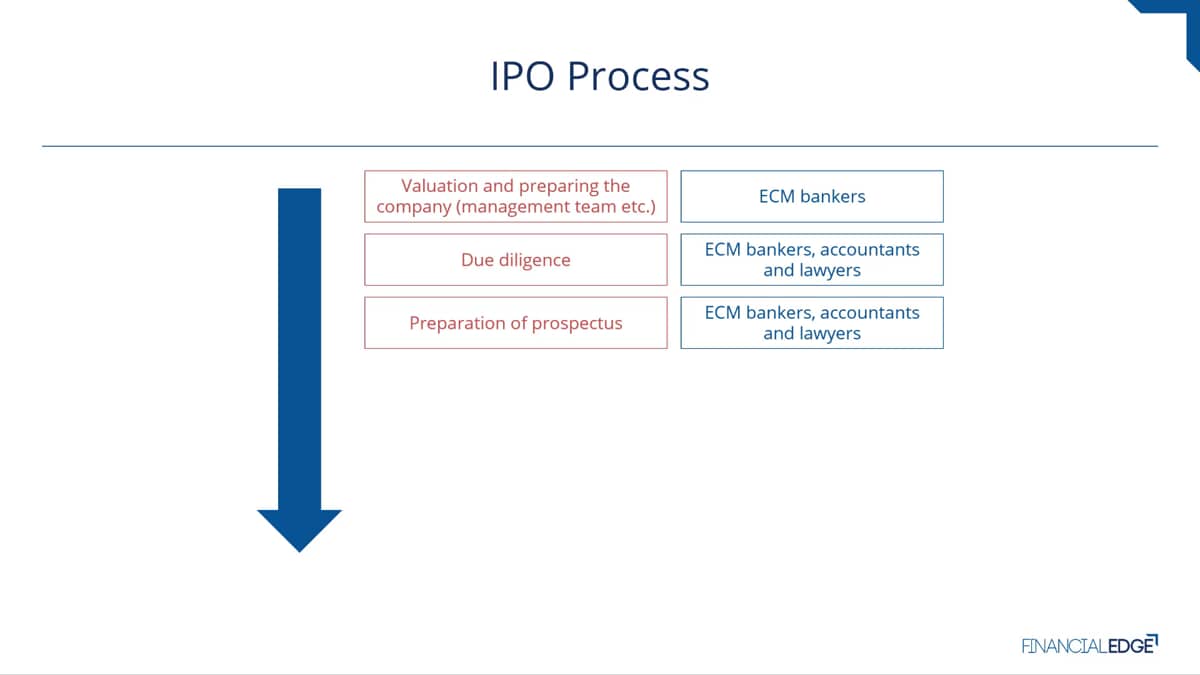
The first stage of the process is to appoint an investment bank to carry out their own valuation of the company seeking an IPO.

This valuation will typically identify a range within which the ECM bankers think that there might be sufficient demand from potential investors for the company to be able to sell all of the shares it hopes to sell through the IPO.

This does not determine the final price of the IPO, but provide some indication to the company's management about the amount of capital that they're likely to raise.

The investment bank will also provide advice on other features of the company, which may need to be addressed for a successful IPO, for example, the appropriate level of experience and expertise of the company's board of directors in relation to running a public company.

The next stage of the process is referred to as due diligence and involves the company providing all necessary information about itself to its advisors so they can adequately fulfill their own obligations to the company as well as to potential investors. In the IPO, this information would include legal, financial, commercial, HR, and IT related content, allowing the advisors who will include legal and accountancy firms to provide advice to the company on any improvements that need to be made prior to the IPO to meet any legal or regulatory requirements or to improve the likelihood of the IP O'S success.

The same group of advisors will then help the company to prepare a prospectus, which acts as a marketing document for the potential investors.

In the IPO, there are also many regulatory requirements of information that must be included within the prospectus.

Since much more information must be made publicly available by listed companies about themselves, and this document acts as part of the transition of a private company, increasing the amount of disclosure that it needs to make once it's become publicly traded.

Next, an application must be made to the relevant exchange to ensure the company has met with all of the listing requirements to the satisfaction of the exchange in which the company shares will be listed.

Once approval from the exchange is received, the company will produce a presentation to be used in speaking to potential investors who may be interested in purchasing shares through the IPO.

At the pre-marketing stage, the bank will be sounding out key institutional clients of the bank, such as asset management firms and insurance companies to gauge their level of interest in the IPO having potentially made tweaks to the number of shares or the guide price range, the investment bank will then embark on a roadshow where they will speak to many more potential institutional investors to market the company and to begin the process of book building.

This process involves gathering indicative demand levels At different potential IPO prices.

When this is compiled across a wide number of institutional investors, the investment bank will begin to build a picture of the price level at which there'll be sufficient demand to sell all the desired shares through the IPO.

This stage of the process will typically involve the sales team within the investment bank who hold the relationships with those institutional investors.

Finally, on the morning of the IPO, the investment bank and the issuing company will set the price at which they wish to sell those shares through the IPO, and investors will be invited to make offers to purchase shares at that set price.

Once trading starts, the company's shares will be listed and be available for trading between investors over the exchange.

The investment bank may be involved in providing ongoing support to the company's shares through such activities as price stabilization.

Content Requests and Questions

You are trying to access premium learning content.

Discover our full catalogue and purchase a course Access all courses with our premium plans or log in to your account
Help

You need an account to contact support.

Create a free account or log in to an existing one

Sorry, you don't have access to that yet!

You are trying to access premium learning content.

Discover our full catalogue and purchase a course Access all courses with our premium plans or log in to your account

You have reached the limit of annotations (10) under our premium subscription. Upgrade to unlock unlimited annotations.

Find out more about our premium plan

You are trying to access content that requires a free account. Sign up or login in seconds!

Create a free account or log in to an existing one

You are trying to access content that requires a premium plan.

Find out more about our premium plan or log in to your account

Only US listed companies are available under our Free and Boost plans. Upgrade to Pro to access over 7,000 global companies across the US, UK, Canada, France, Italy, Germany, Hong Kong and more.

Find out more about our premium plan or log in to your account

A pro account is required for the Excel Add In

Find out more about our premium plan

Congratulations on completing

This field is hidden when viewing the form
Name(Required)
This field is hidden when viewing the form
Rate this course out of 5, where 5 is excellent and 1 is terrible.
Were the stated learning objectives met?(Required)
Were the stated prerequisite requirements appropriate and sufficient?(Required)
Were the program materials, including the qualified assessment, relevant and did they contribute to the achievement of the learning objectives?(Required)
Was the time allotted to the learning activity appropriate?(Required)
Are you happy for us to use your feedback and details in future marketing?(Required)

Thank you for already submitting feedback for this course.

CPE

What is CPE?

CPE stands for Continuing Professional Education, by completing learning activities you earn CPE credits to retain your professional credentials. CPE is required for Certified Public Accountants (CPAs). Financial Edge Training is registered with the National Association of State Boards of Accountancy (NASBA) as a sponsor of continuing professional education on the National Registry of CPE Sponsors.

What are CPE credits?

For self study programs, 1 CPE credit is awarded for every 50 minutes of elearning content, this includes videos, workouts, tryouts, and exams.

CPE Exams

You must complete the CPE exam within 1 year of accessing a related playlist or course to earn CPE credits. To see how long you have left to complete a CPE exam, hover over the locked CPE credits button.

What if I'm not collecting CPE credits?

CPE exams do not count towards your FE certification. You do not need to complete the CPE exam if you are not collecting CPE credits, but you might find it useful for your own revision.


Further Help
  • Felix How to Guide walks you through the key functions and tools of the learning platform.
  • Playlists & Tryouts: Playlists are a collection of videos that teach you a specific skill and are tested with a tryout at the end. A tryout is a quiz that tests your knowledge and understanding of what you have just learned.
  • Exam: If you are collecting CPE points you must pass the relevant CPE exam within 1 year to receive credits.
  • Glossary: A glossary can be found below each video and provides definitions and explanations for terms and concepts. They are organized alphabetically to make it easy for you to find the term you need.
  • Search function: Use the Felix search function on the homepage to find content related to what you want to learn. Find related video content, lessons, and questions people have asked on the topic.
  • Closed Captions & Transcript: Closed captions and transcripts are available on videos. The video transcript can be found next to the closed captions in the video player. The transcript feature allows you to read the transcript of the video and search for key terms within the transcript.
  • Questions: If you have questions about the course content, you will find a section called Ask a Question underneath each video where you can submit questions to our expert instructor team.