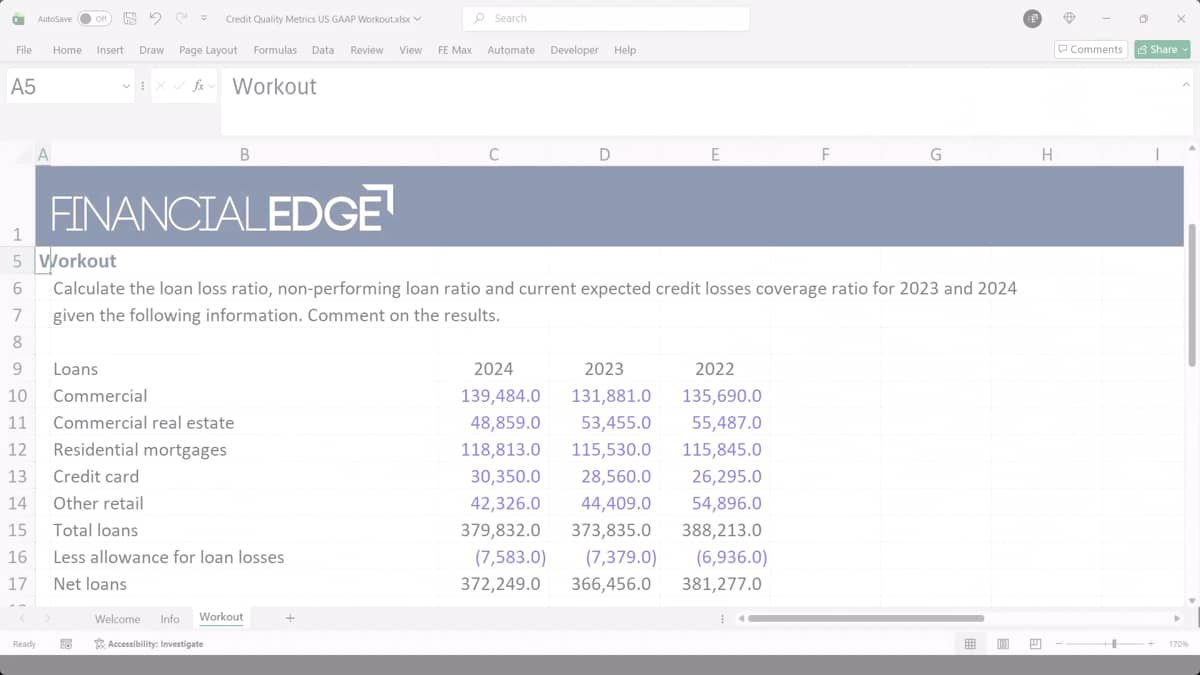
In this workout, we're going to calculate the loan loss ratio, non-performing loan ratio, and current expected credit losses coverage ratio for 2023 and 2024.
We're also going to comment on the results.
Below, we have information on the breakdown of the bank's loan portfolio, so that's split between commercial, commercial real estate, residential mortgages, credit card, and other retail.
That gives us the total loan balance.
Underneath that, we've got the allowance for loan losses, and then we arrive at the net loan balance.
So that's the total loans minus the allowance for loan losses.
Further down, we've got the gross charge-offs for each year, the recoveries, and then the net of those two, which is the net charge-offs.
And finally, we've got the non-performing loans balance for each year.
Let's get started with the loan loss ratio.
To calculate this, we're going to express the net charge-offs as a percentage of the average total loan balance during the year.
So going back up to row 15, that's the average of the ending balance from this year and the ending balance from the prior year.
And we get a ratio of 0.57% for the most recent year and 0.5% for the prior year.
Next, to calculate the non-performing loan ratio, we need to look at what proportion the non-performing loans make up of the total loan balance.
And that's 0.48% for the current year and 0.4% for the prior year.
Finally, to calculate the current expected credit losses coverage ratio or CECL coverage ratio, we're going to look at how many times the allowance for loan losses, and I'm just changing the sign on that so the ratio makes sense, how many times that covers the non-performing loans.
And we've got a 4.1 times coverage ratio for the current year and 4.9 for the prior year.
So what are these ratios indicating? We can see that there's been an increase in the loan loss ratio and an increase in the non-performing loan ratio while the CECL coverage ratio has declined.
Together, this indicates that there's been an increase in the risk profile of the loan portfolio.
The increase in the loan loss ratio, even though small, indicates that there was a greater level of losses incurred from the loan portfolio during 2024.
Like we said, the non-performing loan ratio also increased, and even though the non-performing loan ratio is pretty low, it does indicate that more loans are currently in default.
And finally, the decline in the CECL coverage ratio means that the allowance for current expected credit losses is less able to cover the non-performing loans.

 Credit Quality Metrics US GAAP Workout Empty
