Roblox Corp.
NYSE: RBLX
Share price (04/13/26): $57.66
Industry: Services-Prepackaged Software
Financials
|
Type
|
Title
|
Date
|
Extracts
|
|||
|---|---|---|---|---|---|---|
| 10-K | 02/11/26 | PR | IS | BS | CFS | |
| 10-Q | 10/30/25 | PR | IS | BS | CFS | |
| 10-Q | 07/31/25 | PR | IS | BS | CFS | |
| 10-Q | 05/01/25 | PR | IS | BS | CFS | |
| 10-K | 02/18/25 | PR | IS | BS | CFS | |
| 10-Q | 10/31/24 | PR | IS | BS | CFS | |
| 10-Q | 08/02/24 | PR | IS | BS | CFS | |
| 10-Q | 05/09/24 | PR | IS | BS | CFS | |
| 10-K | 02/21/24 | PR | IS | BS | CFS | |
| 10-Q | 11/08/23 | PR | IS | BS | CFS | |
|
|
||||||
Transcripts and slides
|
Title
|
Links
|
Date
|
|
|---|---|---|---|
| Roblox Corporation Presents at Morgan Stanley Technology, Media & Telecom Conference 2026, Mar-04-2026 07:45 AM | Transcript | 03/04/26 | |
| Earnings Call Q4 FY2025 | Transcript | Slides | 02/05/26 |
| Earnings Call Q3 FY2025 | Transcript | Slides | 10/30/25 |
| Earnings Call Q2 FY2025 | Transcript | Slides | 07/31/25 |
| Earnings Call Q1 FY2025 | Transcript | Slides | 05/01/25 |
| Earnings Call Q4 FY2024 | Transcript | 02/06/25 | |
| Earnings Call Q3 FY2024 | Transcript | Slides | 10/31/24 |
| Roblox Corporation Presents at Roblox Developers Conference, Sep-06-2024 | Transcript | 09/06/24 | |
| Earnings Call Q2 FY2024 | Transcript | 08/01/24 | |
| Roblox Corporation - Shareholder/Analyst Call | Transcript | 05/30/24 | |
|
|
|||
Ownership
|
Type
|
Title
|
Date
|
|---|---|---|
| 144 | 04/13/26 | |
| 144 | 04/13/26 | |
| 4 | 04/03/26 | |
| 4 | 04/03/26 | |
| 144 | 04/01/26 | |
| 144 | 04/01/26 | |
| SCHEDULE 13G/A | 03/27/26 | |
| 3 | 03/27/26 | |
| 3 | 03/23/26 | |
| 4 | 03/23/26 | |
|
|
Other
|
Type
|
Title
|
Date
|
|---|---|---|
| ARS | 04/17/25 | |
| UPLOAD | 05/09/24 | |
| CORRESP | 05/01/24 | |
| UPLOAD | 04/26/24 | |
| CORRESP | 04/23/24 | |
| UPLOAD | 04/12/24 | |
| ARS | 04/11/24 | |
| UPLOAD | 07/12/23 | |
| CORRESP | 07/11/23 | |
| CORRESP | 07/05/23 | |
|
|
News
|
Type
|
Title
|
Date
|
|---|---|---|
| 8-K | 03/20/26 | |
| 8-K | 03/02/26 | |
| 8-K | 02/05/26 | |
| 8-K | 10/30/25 | |
| 8-K | 09/17/25 | |
| 8-K | 07/31/25 | |
| 8-K | 07/01/25 | |
| 8-K | 06/10/25 | |
| 8-K | 06/02/25 | |
| 8-K | 05/01/25 | |
|
|
Prospectuses and Registrations
|
Type
|
Title
|
Date
|
|---|---|---|
| S-8 | 02/11/26 | |
| S-8 | 02/18/25 | |
| S-8 | 02/21/24 | |
| S-8 | 03/17/23 | |
| S-8 | 02/28/23 | |
| D/A | 04/15/22 | |
| D | 04/14/22 | |
| S-8 | 02/25/22 | |
| D | 08/31/21 | |
| D/A | 08/31/21 | |
|
|
Proxies
|
Type
|
Title
|
Date
|
|---|---|---|
| DEF 14A | 04/17/25 | |
| DEFA14A | 04/17/25 | |
| PRE 14A | 04/02/25 | |
| DEF 14A | 04/11/24 | |
| DEFA14A | 04/11/24 | |
| DEF 14A | 04/03/23 | |
| DEFA14A | 04/03/23 | |
| DEF 14A | 04/04/22 | |
| DEFA14A | 04/04/22 | |
|
|
Non-Ownership
|
Type
|
Title
|
Filed
|
|---|---|---|
| 8-K | 03/20/26 | |
| 8-K | 03/02/26 | |
| 10-K | 02/11/26 | |
| S-8 | 02/11/26 | |
| 8-K | 02/05/26 | |
| 8-K | 10/30/25 | |
| 10-Q | 10/30/25 | |
| 8-K | 09/17/25 | |
| 8-K | 07/31/25 | |
| 10-Q | 07/31/25 | |
| 8-K | 07/01/25 | |
| 8-K | 06/10/25 | |
| 8-K | 06/02/25 | |
| 8-K | 05/01/25 | |
| 10-Q | 05/01/25 | |
| DEF 14A | 04/17/25 | |
| DEFA14A | 04/17/25 | |
| ARS | 04/17/25 | |
| PRE 14A | 04/02/25 | |
| 10-K | 02/18/25 | |
|
|
Ownership
|
Type
|
Title
|
Filed
|
|---|---|---|
| 144 | 04/13/26 | |
| 144 | 04/13/26 | |
| 4 | 04/03/26 | |
| 4 | 04/03/26 | |
| 144 | 04/01/26 | |
| 144 | 04/01/26 | |
| SCHEDULE 13G/A | 03/27/26 | |
| 3 | 03/27/26 | |
| 3 | 03/23/26 | |
| 4 | 03/23/26 | |
| 4 | 03/03/26 | |
| 4 | 03/03/26 | |
| 4 | 03/03/26 | |
| 4 | 03/03/26 | |
| 4 | 03/03/26 | |
| 144 | 02/27/26 | |
| 144 | 02/27/26 | |
| 4 | 02/26/26 | |
| 4 | 02/24/26 | |
| 4 | 02/24/26 | |
|
|
|
Title
|
Links
|
Date
|
|
|---|---|---|---|
| Roblox Corporation Presents at Morgan Stanley Technology, Media & Telecom Conference 2026, Mar-04-2026 07:45 AM | Transcript | 03/04/26 | |
| Earnings Call Q4 FY2025 | Transcript | Slides | 02/05/26 |
| Earnings Call Q3 FY2025 | Transcript | Slides | 10/30/25 |
| Earnings Call Q2 FY2025 | Transcript | Slides | 07/31/25 |
| Earnings Call Q1 FY2025 | Transcript | Slides | 05/01/25 |
| Earnings Call Q4 FY2024 | Transcript | 02/06/25 | |
| Earnings Call Q3 FY2024 | Transcript | Slides | 10/31/24 |
| Roblox Corporation Presents at Roblox Developers Conference, Sep-06-2024 | Transcript | 09/06/24 | |
| Earnings Call Q2 FY2024 | Transcript | 08/01/24 | |
| Roblox Corporation - Shareholder/Analyst Call | Transcript | 05/30/24 | |
|
|
|||
BUSINESS
Overview
Roblox is an immersive gaming and creation platform (the “Roblox Platform” or “Platform”) that offers people millions of ways to be together, inviting its community to explore, create, and share endless unique experiences. Our vision is to reimagine the way people come together– in a world that’s safe, civil, and optimistic. To achieve this vision, we are building an innovative company that, together with the Roblox community, has the ability to strengthen our social fabric and support economic growth for people around the world.
Our Platform consists of the Roblox Client, the Roblox Studio, and the Roblox Cloud. Roblox Client is the application that allows users to seamlessly explore immersive experiences. Roblox Studio is the free toolset that allows creators to build, publish, and operate immersive experiences and other content accessed with the Roblox Client. Roblox Cloud includes the services and infrastructure that power our Platform.
Our mission is to connect a billion users with optimism and civility. We are constantly improving the ways in which our Platform supports shared experiences, ranging from how these experiences are built by an engaged community of creators to how they are enjoyed and safely accessed by users across the globe. We also believe there is a strong potential to capture a greater percentage of the global gaming market within the Roblox ecosystem. Our goal is to make it as easy as possible for creators to build better and safer experiences, including games, and ultimately reach more users. We continue to invest in creating tools for our creators designed to promote key experience genres and deepen engagement on our Platform.
Growth at Roblox has been driven primarily by a significant investment in technology and two mutually reinforcing network effects: content and connections.
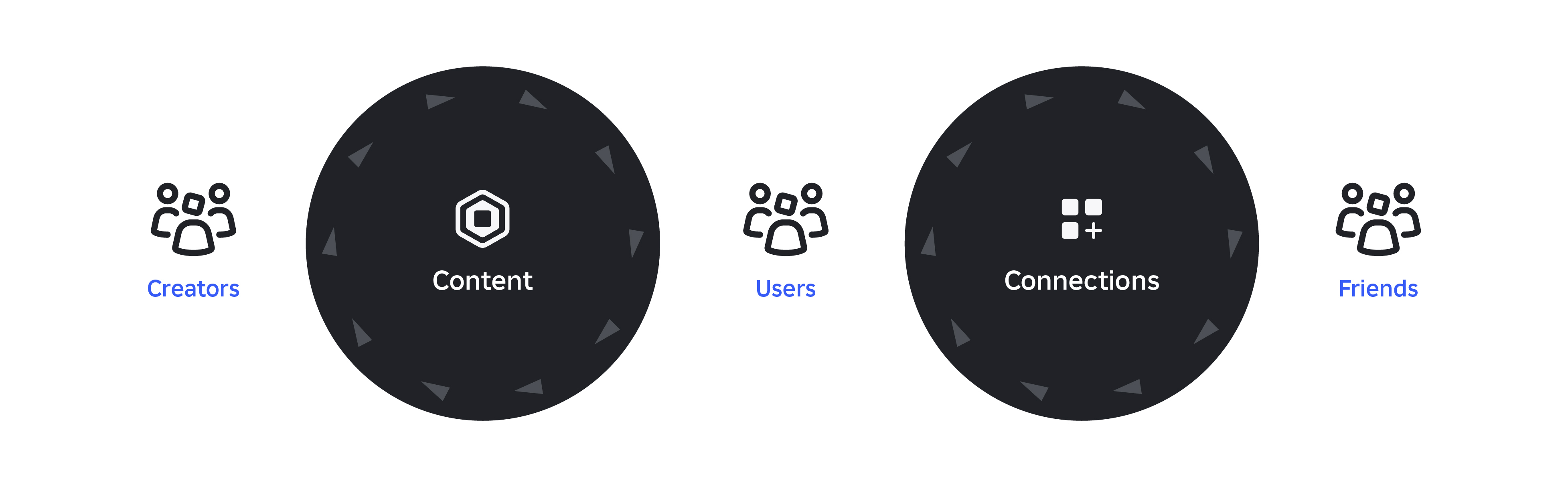
First, user-generated content built by our community of creators powers our Platform. As creators build increasingly high-quality and diverse content, more users are attracted to our Platform. With more users on our Platform, greater engagement and monetization opportunities exist, which in turn, makes Roblox more attractive to creators, incentivizing them to design increasingly engaging content and encouraging new creators to start building on our Platform.
Second, our Platform encourages connections. When users join, they typically interact with friends, which inspires them to invite more friends, who in turn, invite their friends, driving organic growth. The more friends that each of our users have interacting on the Platform, the more valuable and engaging the Platform becomes. This drives more users to our Platform through word of mouth from their existing friends on the Platform.
Our User and Creator Community
Roblox is powered by content from our community of creators who build immersive and engaging experiences on Roblox, as well as the vast majority of the items for customizing avatars. This content attracts our users to immerse themselves in the millions of experiences found on the Platform. Many of our users may also eventually become creators.
Our Users
In the year ended December 31, 2025, 127 million average DAUs across over 180 countries enjoyed experiences on Roblox across mobile, desktop, and console platforms, of which on average, approximately 1.8 million were daily unique paying users. Our users are diversified across multiple dimensions, including age, geography, platform, and gender. Each day, users express themselves through their avatars, explore different worlds, and engage with others in the Roblox community. During the year ended December 31, 2025, users spent 123.9 billion hours engaged on our Platform, or an average of 2.7 hours per DAU each day. Over the same period, our users explored an average of over 24 different experiences on our Platform per month.
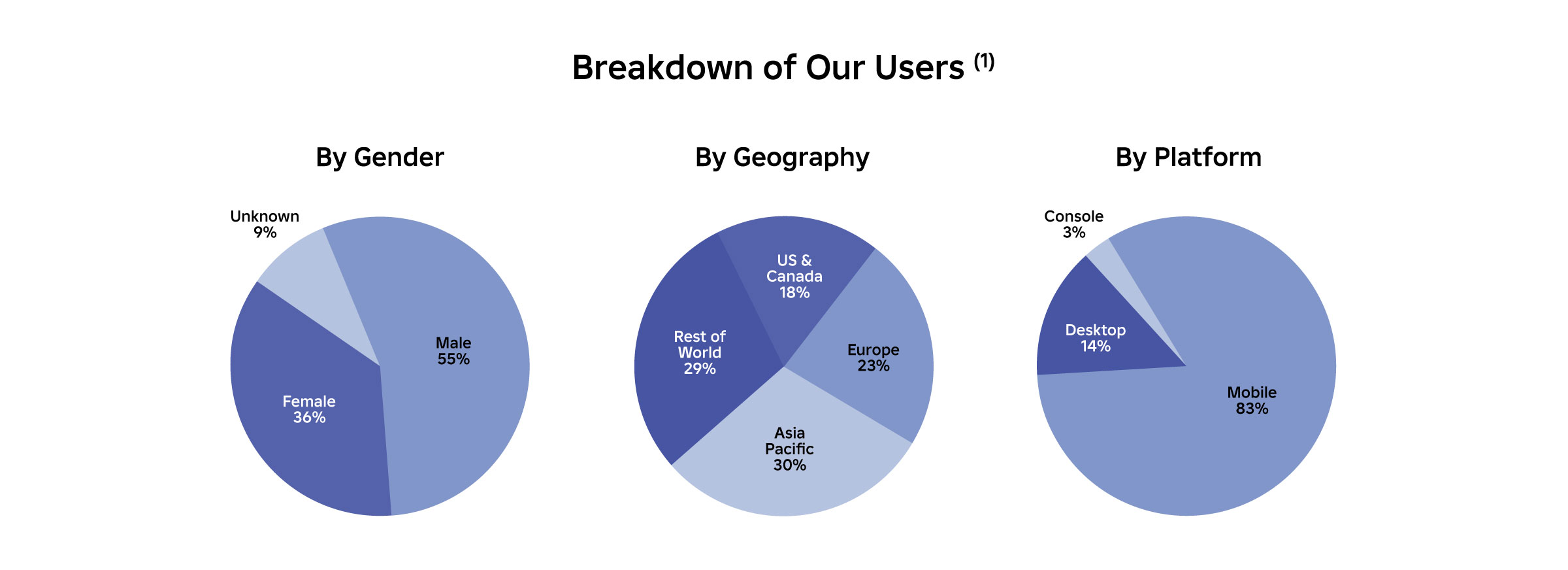
DAUs = 127 million(1)
(1)Represents the average during the year ended December 31, 2025. Percentages presented are calculated from the underlying numbers in thousands and may not add to their respective totals due to rounding.
Our Creators
We believe that everyone can become a creator. We offer creators the ability to build engaging, immersive experiences, and avatar related items in our Marketplace and custom models, plugins, audio, fonts, images, meshes, and video in our Creator Store that they can easily share with the Roblox community. Our creators enable us to offer a wide variety of content on our Platform and cost-effectively crowd-source the experiences available on our Platform, Marketplace items, and creator tool ecosystem. In the year ended December 31, 2025, we had millions of creators across more than 170 countries building on our Platform. Our creator community includes individuals with a wide spectrum of professional capabilities and team sizes, ranging from young students and independent hobbyists, all the way to full-time studios.
We measure the health and success of our creator community based on our economy and user engagement. As our Platform has scaled, our monetizing creators have enjoyed meaningful growth over time, reflecting the increasing popularity and opportunities for monetization of our Platform and driving a growing incentive for our creators to continue building high-quality content.
We offer our creator community several models to help support their goals. Specifically, creators can accumulate Robux (which we refer to as “earned Robux”), or, in some circumstances, be paid directly in money (referred to herein as “fiat currency”, to differentiate from Robux, which is an in-game currency), through the following methods:
1.Monetizing a developed experience: Creators can accumulate earned Robux through:
a.In-experience purchases, which consist of microtransactions generated from the sale of in-experience virtual items, subscription-based offerings (including access to private servers), access to certain experiences (referred to as paid access), and/or passes granting special in-experience privileges.
b.The Creator Rewards Program, which launched in July 2025 and replaced our legacy Engagement-Based Payouts Program. This program allows creators who publish experiences to accumulate earned Robux based on the achievement of various metrics that we believe drive user engagement and monetization supporting the long-term health of our Platform. Prior to the launch of the Creator Rewards Program, our Engagement-Based Payouts Program allowed creators to accumulate earned Robux based solely on the share of time that Roblox Premium subscribers engage in their experience.
c.Advertisements (“ads”), which include a range of high-quality, programmatically served ad units through which creators can accumulate earned Robux from impressions and/or teleports generated.
2.IP licensing: Powered by our self-serve License Manager (launched in late 2025), which enables rights holders to partner with our creator community to accumulate earned Robux from their intellectual property.
3.Creating and selling or reselling avatar items: Creators can create and sell entire avatars, accessories, clothes, bodies, and heads for avatars in the Marketplace or inside experiences.
4.Creating and selling Roblox Studio plugins: Through the Creator Store, creators can sell Roblox Studio plugins which are extensions that add additional features or functionality to Roblox Studio and help improve creator workflows.
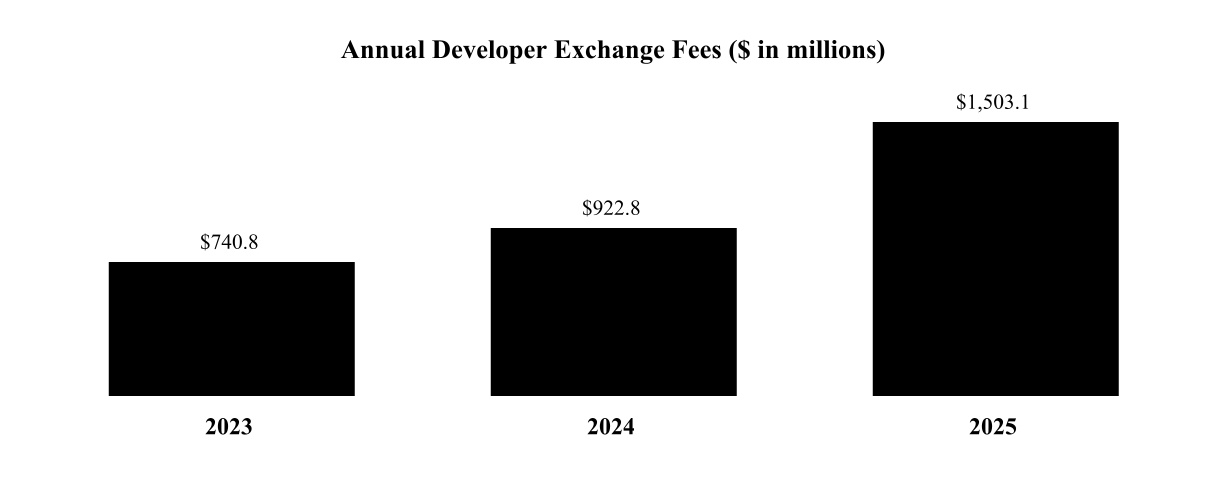
As of December 31, 2025, over 35,500 creators qualified for and were registered in our Developer Exchange Program, of which over 10,500 were newly qualified and registered during 2025. Creators that qualify for our Developer Exchange Program are eligible to be paid fiat currency by Roblox, based on the amount of earned Robux the creator has accumulated through the Platform. Creators must meet certain conditions, such as having accumulated the minimum amount of earned Robux required to qualify for the program, and having a verified creator account in good standing. On January 31, 2022, we reduced the minimum amount of accumulated earned Robux required to qualify for the program from 100,000 Robux to 50,000 Robux and subsequently on January 31, 2023, we further reduced the minimum requirement from 50,000 Robux to 30,000 Robux. We believe these reductions in the minimum amounts required incentivize our creator community, while promoting its long-term growth and health. For the year ended December 31, 2025, over 23,500 creators participated in our Developer Exchange Program and were paid fiat currency by Roblox based on their earned Robux. Beginning September 5, 2025 and applying prospectively, we also increased the amount creators can receive in fiat currency based on earned Robux by 8.5%.
We invest in our creator community by providing a comprehensive set of free tools and services through Roblox Studio, the Roblox Open Cloud, and a range of other creator resources that enable them to easily build, publish, analyze, grow, and monetize experiences. We empower creators to get started with minimal upfront costs by providing a comprehensive suite of services to creators including hosting, storage, distribution, discovery, customer support, localization, certain regulatory support, and managing certain third-party payment processing fees. Roblox retains a portion of every Robux transaction for the Platform and support services we provide to creators and distributes the rest to creators. We support our creators to promote engagement and growth in our creator community. This includes managing and moderating our online Developer Forum and operating special programs for aspiring and top creators such as our annual Roblox Developers Conference. With Roblox Open Cloud, creators can leverage a suite of backend APIs to seamlessly build and scale their experiences.
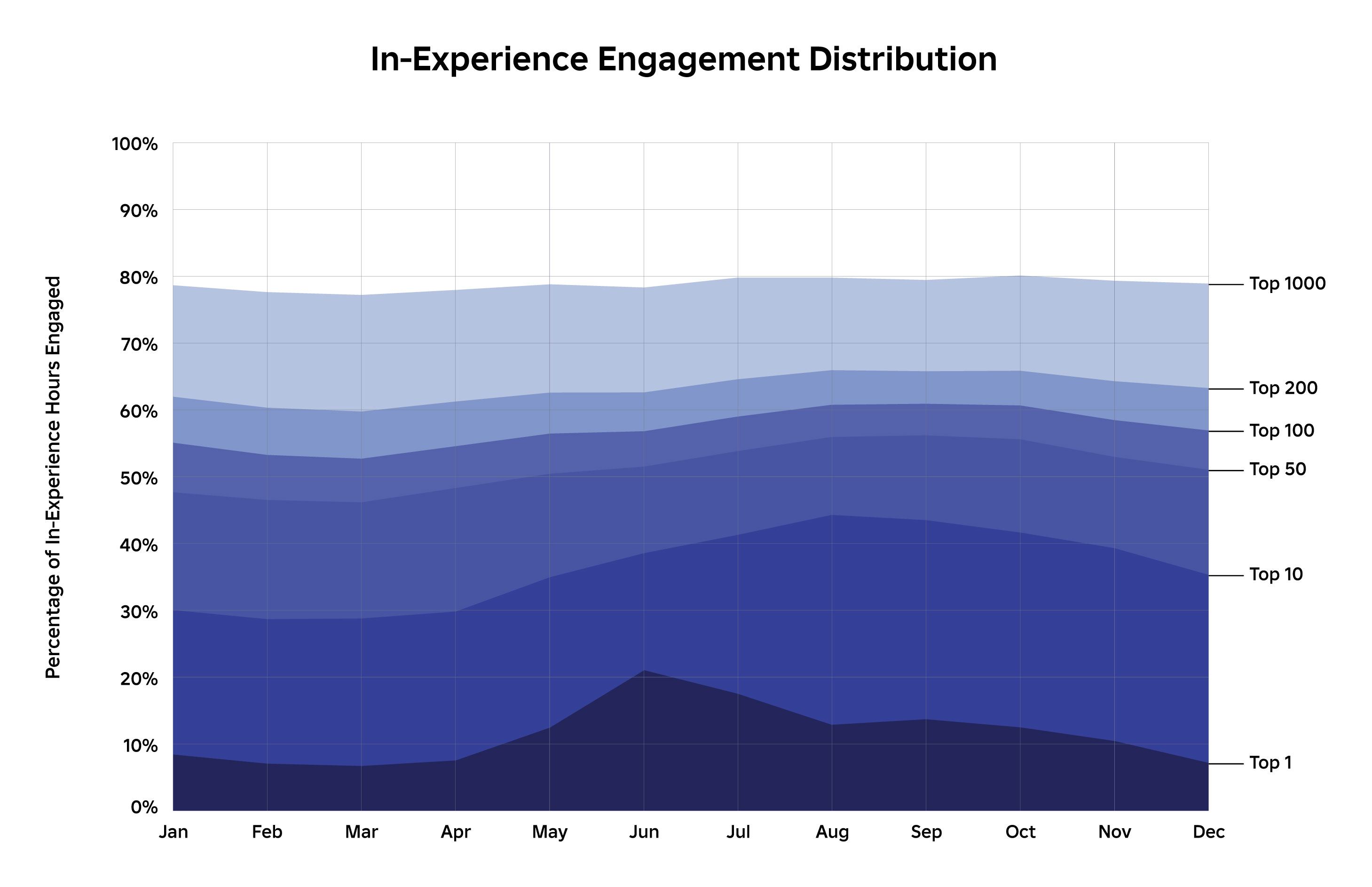
The investment in our creator community has resulted in an ever-changing offering of diverse content for our users to explore and engage in. The chart below provides detail on the diversity of content our users engage in within experiences. Specifically, this chart reflects the distribution of in-experience hours engaged within the top 1,000 experiences by month from January to December 2025.
Our Products and Technology
The Roblox Platform is the underlying technology and infrastructure that supports shared experiences and is composed of three elements:
•Roblox Client—The free application that allows users to explore immersive experiences.
•Roblox Studio—The free toolset that allows creators to build, publish, and operate immersive experiences and other content accessed with the Roblox Client.
•Roblox Cloud—The services and infrastructure that power the Roblox Client and Roblox Studio.
Since our founding, we have invested heavily in building the Roblox Platform, and as of December 31, 2025, 75% of our employees were dedicated to maintaining, improving, and expanding it. Our technology supports the following key characteristics of the Roblox Platform: Safety, Self-Expression, Connection and Communication, Immersive, Low Friction, Variety of Content, Economy, and Anywhere.
Safety
Safety is core to everything we do. Our Community Standards govern what is acceptable content and behavior, including communications, on the Platform, and we have multi-layered moderation systems, including both automated and human review, that are designed to assess content uploaded to Roblox and communications on Platform for potential violations of our policies. Because a large number of our users are children, our Community Standards and moderation enforcement are purpose-built to be strict and we strive to quickly remove violative content and bad actors from our community.
Moderation Systems
We leverage text-filtering, voice moderation, content moderation, and other automated systems powered by artificial intelligence (“AI”) such as Roblox Sentinel that are designed to proactively identify content and behaviors, including communications, that may violate our policies. We have open-sourced multiple models, including our Voice Safety, PII Classifier, Roblox Guard, and Child Safety models, to the entire industry to allow other companies to benefit from our technological advancements in these areas. All images, audio files, and video files that creators upload to the Roblox Platform to include in their experiences and in the Marketplace are subject to review by humans or by AI trained on our Community Standards. During the year ended December 31, 2025, including automated reviews, we evaluated millions of such files. Images and videos are evaluated for Child Sexual Abuse Material using tools such as PhotoDNA, with flagged content promptly reported to the National Center for Missing and Exploited Children upon review. When experiences are published or updated on the Roblox Platform, they are evaluated by a suite of AI driven tools that identify problematic language, potential bypasses to our safety systems, and content that falls outside our policies, and a human review team is continuously operating to evaluate flagged content.
In the fourth quarter of 2025, we began introducing age-checks to the Platform. Our methodologies, policies, and procedures for age-checking our users continue to evolve, but as of the date of this filing include facial age estimation, identity verification, and parent or caregiver provided age data. Beginning in January 2026, we implemented mandatory age-check systems in all chat-enabled regions designed to check a user’s age prior to accessing chat on our Platform. The age-check system is designed to enable chat only between users in similar age groups or Trusted Connections.
We also operate a customer service portal that provides self-help information along with direct reporting channels via email, a chat-bot, or from within the Roblox Client. In the year ended December 31, 2025, we responded to millions of user inquiries. Our safety systems prioritize high-severity reports, enabling human teams to respond to actionable safety issues rapidly after submission.
User Reporting & Parental Controls
We provide our users with the ability to report activity that they find objectionable. Users can also block other users with whom they do not want to interact. We also provide parents and caregivers with customizable controls, which allow them to limit access to features like chat, control screen time and spending, and view their child’s friends list. In addition, parents and caregivers can restrict access to experiences based on Content Maturity Labels designed for users to make informed decisions about the content they interact with. In 2025, we continued to innovate and expand our safety initiatives, including increased transparency tools for parents and caregivers and beginning the rollout of our age-check systems designed to promote safer communications on our Platform.
Safety Partnerships
We work closely with regulators, authorities, and safety groups in many countries. We endeavor to promptly report any suspected child exploitation or sexual abuse material to the National Center for Missing and Exploited Children and cooperate in all related investigations with relevant authorities. Our Platform is designed to comply with the Children’s Online Privacy Protection Act (“COPPA”) and we regularly monitor and evaluate compliance with other U.S. federal and state and foreign laws and regulations regarding privacy and data protection, including the European Union’s General Data Protection Regulation (“GDPR”) and Network Information Systems Directive 2 (“NIS2”).
We partner with leading global organizations focused on child and internet safety, including the WeProtect Global Alliance, Digital Wellness Lab, Family Online Safety Institute, UK Safer Internet Centre, Internet Matters, the Internet Watch Foundation, and kidSAFE, among others. We are also a member of various organizations, such as the Association for United Kingdom Interactive Entertainment and the Technology Coalition, with a goal of cross-industry collaboration, knowledge, and technology exchange in areas of user safety and child safety. As a member of the Technology Coalition and a founding member of its cross-platform signal sharing Lantern program, we are committed to providing transparency and promoting child safety online. We also nominate the board chair position of the Family Online Safety Institute where we educate and provide balanced perspectives to policy makers to help draft thoughtful online safety legislation. We also have a Safety Advisory Board (“SAB”) made up of global industry experts that advise on the best practices to protect our community. In addition to the SAB, we also have a Teen Council, a Parent & Caregiver Council, and a Community Safety Council (composed of Roblox creators). Each of those groups is made up of members of our community who provide valuable input regarding safety features on the Platform, and provide a diversity of viewpoints on safety matters.
Self-Expression
The Roblox avatar system allows users to create and personalize their unique identities. Our avatar technology supports a wide variety of character styles, ranging from classic avatars with blocky body shapes, to ones with more human proportions, from anime characters, to fantasy avatars, and more. Avatars can also be animated and mirror a user’s movements and facial expressions on the avatar in real time, allowing more interactive and authentic communication. Creators can also build avatar creation tools in their experiences, allowing users to create more personalized avatars.
The Roblox Client features the Avatar Editor, which enables users to manipulate the size and body shape of their avatars as well as equip their avatar with clothing, gear, animations, simulated gestures, or emotes, and other accessories from the Marketplace. Our avatar system allows users to attach practically any accessory to any avatar maximizing the combinatorial variety of avatar configurations supported by the Platform. Users manipulate their avatar through a consistent set of controls for emotes, basic movement, and tap-to-move functionality which adapts to dynamically changing virtual environments. The Roblox Client normalizes camera and avatar control inputs from different device form factors, including mobile, tablet, desktop, and game console, to simplify the process of building multi-user, multi-platform, and avatar-based experiences.
Within most experiences, avatars appear exactly how they were configured in the Avatar Editor, creating a sense of persistent identity. However, creators, when designing experiences, have the freedom to dynamically reconfigure all or part of the participating avatars to meet the specific needs of the creator’s experience.
Connection and Communication
The Roblox Client allows users to easily connect with people they know and trust (through features such as contact importer) and make new connections (by matching users with similar characteristics, such as country location, for example). The social graph created by these connections is stored in the Roblox Cloud and requires mutual opt-in to form a connection.
Our social graph is the engine of human connection and communication on the Platform, driving organic growth and retention. When a user chooses to join an experience, the Roblox Cloud is designed to automatically place that user into the same virtual environment as others connected through the social graph. In addition, with Party, up to six friends can easily join the same instance of an experience and even move together from one experience to another. Further, most creators allow users to purchase private servers that allow groups of friends to share an exclusive, invite-only instance of an immersive experience. Finally, in September 2025, we launched Moments, which allows users to capture, edit, and share gameplay moments, which in turn helps other users find new, diverse experiences.
Additionally, the Roblox Platform facilitates communication with in-experience text-based chat amongst users. The system is designed to enable chat based on a user’s Trusted Connections or similar age groups after a user age checks. For safety, every text message passes through filters that are designed to block content which violates applicable Roblox Community Standards. Using advanced pattern matching and machine learning, our chat filters are constantly evolving and process billions of messages per day.
Our communication features also include voice chat, available in over 50 countries around the world and in several supported languages, to users aged 13 and over who have age-checked. This proximity-based feature simulates realistic communication through lip sync and is based on how close users are in an experience to other users who are speaking in that experience. In addition, avatar animation allows all users to use their camera to animate their avatar with their movement, allowing them to communicate and express themselves in more natural, real-time, and immersive ways.
Immersive
The Roblox Platform allows creators to build deeply immersive 3D and 4D environments where users can share synchronous experiences with others, independent of where they may be physically. The Roblox Client provides users with intuitive camera and input controls that are tuned for each device’s form factor. By abstracting these controls from creators, the process of building cross-platform immersive experiences is greatly simplified.
Creators use Roblox Studio to easily build immersive experiences that are then rendered and simulated on the Roblox Platform. The Roblox Client leverages efficient low-level hardware-specific device APIs, such as Vulkan for Android devices and Metal for Apple devices, to efficiently render those experiences. Each experience combines thousands of meshes, textures, 3D and 4D models, and animations. Using Roblox Studio, creators can also insert immersive ads, such as Rewarded Video, Billboards, and Portals, into their experiences with relatively low effort. Each immersive experience is simulated in the Roblox Cloud with a custom physics engine built for rigid body and constraint-based physics. Using a combination of novel mathematical formulations and aggressive optimization, the engine can simulate a large number of complex mechanisms at high levels of fidelity. To achieve an optimal balance between latency, scale, and consistency, computations for the simulation are distributed across Roblox Clients and the Roblox Cloud.
Assets that make up the immersive experience are stored in a persistent tree hierarchy that is the foundation for collaborative editing and interactive multi-user experiences. The hierarchy can be modified through APIs which serve as a powerful abstraction layer making it easy to create experiences that are consistent across all Roblox Clients, regardless of device type. During simulation, this data is dynamically replicated within the Roblox Cloud and selectively transmitted to Roblox Clients. The Roblox Client then constructs and renders its own view of the immersive experience.
Low Friction
The Roblox Platform gives users the ability to interact with experiences almost instantly, on most popular client devices, and from anywhere in the world over existing broadband and cellular networks. As of December 31, 2025, the Roblox Client operates on iOS, Android, Windows, Mac, Xbox, PlayStation, Chromebook, and select virtual reality (“VR”) hardware. With the Roblox Platform, creators can build an experience once and then expect that experience to operate consistently on all supported devices to both take advantage of the capabilities of high end systems and also scale down the experience to work on lower end devices. We continually focus on improving frame rates, increasing stability, and enhancing graphics quality.
The Roblox Client is designed for the rapid movement of users between experiences. Almost immediately upon launching a new experience, the Roblox Client will begin simulating and rendering the virtual world using a partial representation of the environment at a low level of detail. As more and higher fidelity assets are received by the Roblox Client, the fidelity of the experience automatically improves.
Assets are delivered to the Roblox Client through geographically distributed content delivery networks. The Roblox Cloud determines the format, level of detail, and priority of each asset sent in order to optimize for the capabilities and bandwidth available to the client device. The Roblox Client can dynamically load and unload instances and assets as the player moves throughout the experience without waiting for long content preloads, in a process otherwise referred to as streaming. All else being equal, streaming enables faster join times and larger, more complex experiences that can be joined synchronously on different devices regardless of device memory capacity.
The Roblox Cloud enables low-latency, responsive interactivity between millions of concurrent users within 3D and 4D environments. When a user joins an immersive experience, the Roblox Cloud assigns that user to a particular game instance based on, among other considerations, the user’s social graph, geographic location, spoken language, and age group. Roblox Cloud is designed to automatically scale up and down the number and size of server instances to effectively serve the current user demand for an experience, thereby allowing the Platform to scale up to handle the most popular experiences while also scaling down when demand reduces. Creators can choose to allow up to 200 users within an instance, but may choose fewer to optimize their experience.
Creators have access to persistent data stores in the Roblox Cloud where information about users and each simulated environment can be stored across play sessions. This, along with other services hosted in the Roblox Cloud, make it possible for creators to build, launch, scale, and monetize an immersive experience without any additional tools or services.
The majority of services operated by the Roblox Cloud are hosted in Roblox managed data centers. For some of our databases, object storage, message queuing services, and bursting during large user peaks, we primarily leverage Amazon Web Services to augment our owned and operated infrastructure. The virtual environments and assets used by Roblox Clients are simulated on servers running in 25 regional data centers distributed across North America, South America, Asia-Pacific, and Europe. As of December 31, 2025, the Roblox Cloud uses over 150,000 servers. The Roblox Cloud is designed to be fault tolerant, prepared for disaster recovery, and resistant to malicious attacks and we continue to expand into multiple data centers within and across geographic regions to improve reliability and fault tolerance. Further, as we increasingly leverage AI across our Platform, we continue to expand our graphics processing units (“GPU”) infrastructure both in our owned and operated data centers and in the public cloud.
Data centers in the Roblox Cloud are linked through a high-performance dedicated backbone network bypassing the public internet for traffic within and between our data centers and we operate under an open peering policy where we have direct interconnection with internet providers globally. Operating our own network maximizes performance, security, and increases the immersiveness experienced by our users.
Variety of Content
Creators build nearly all of the content for the Roblox Platform, including a variety of experiences from gaming, to education, to entertainment, and beyond. Their efforts contribute to an expanding content library that included over 14 million active experiences and millions of available Marketplace items during the year ended December 31, 2025.
Creators build, publish, and operate immersive experiences with Roblox Studio, a free suite of tools accessible to all skill levels. Teams can work together using built-in access control management and collaborative editing. Once content is built, it can be replicated and shared across multiple experiences, giving creators the ability to scale their efforts and make rapid updates.
In addition to constructing 3D and 4D objects and environments, creators can script complex behaviors into their experience with Roblox Luau. Based on Lua, an interpreted light-weight programming language popular in the gaming industry, Roblox Luau adds an optional static type system and a highly optimized interpreter that maximizes performance on Roblox Clients and in the Roblox Cloud. Using scripts, creators can modify the environment, control object behavior, and create new ways for users to interact with the virtual environment. Within Roblox Studio, creators have access to a powerful script editor which supports autocomplete, debugging, and the ability to emulate the Roblox Client running on supported devices.
Roblox Studio also leverages AI to help reduce friction for creators, making it easier to build content on the Platform. These AI tools help creators with varying levels of experience. For example, AI tools such as Assistant help beginner creators by answering common questions, Code Assist or Material Generator help creators with some coding experience learn how to write and improve code and easily create more complex materials, and Avatar Auto-Setup saves creators time by turning avatar models into animated avatar technology. In 2025, we released Roblox Cube, a generative AI system for 3D and 4D content creation, allowing creators to include 3D and 4D generative features as part of any immersive experience.
Creators can share their work with other creators through the Creator Store. The Creator Store drives collaboration within our creator community, accelerates creation of new experiences, and provides additional ways for creators to monetize their work. As of December 31, 2025, the Creator Store contained millions of models, meshes, textures, scripts, audio clips, creator tools, and packaged combinations of these items.
We provide creators with reference material, tutorials, community forums, and analytics to build their creations. Creator Hub includes reference material, API documentation, and tutorials for creators. Developer Forum is a private forum for qualified creators which provides insight on new features, community initiatives, recruitment opportunities, bug reporting, and direct engagement with our employees. Learning Hub provides content for educators, students, and parents who are using Roblox as a tool to learn coding, design, and digital civility. All creators on the Roblox Platform have access to dashboards that show daily visits to their experience, as well as earned Robux accumulated from their experience and Marketplace items.
Within the Roblox Client, users find experiences through personalized content recommendations, curated homepage sorts, and search. Personalized AI-driven content recommendations are based on past user behavior, the social graph, and demographic information. An emphasis is always placed on experiences where someone you are connected with is present. Additionally, we utilize our homepage to highlight experiences from up-and-coming creators, recently updated experiences, platform-wide events curated by Roblox, and key genres helping our users to try more experiences and increasing the diversity of the content with which they engage. The search engine automatically learns user intent, accounting for misspellings, slang, and multilingual queries.
Economy
Roblox has a vibrant economy built on an in-Platform virtual currency called Robux, which can be purchased through the Roblox Client and Roblox website or through prepaid cards purchased online and at physical retailers. Roblox relies on payment processor partners to process payments and store user’s payment information, if applicable.
Users can also acquire Robux through a monthly subscription to Roblox Premium. With a subscription, users receive Robux at a discount compared to one-off purchases. Creators may also choose to offer additional benefits to active Roblox Premium subscribers in the form of discounted virtual merchandise or access to exclusive in-experience features.
Creators accumulate earned Robux by selling virtual content or access to virtual content (including through subscriptions), as well as through the incorporation of immersive ads into their experiences, which are ad units that creators can insert into their experience for Roblox to programmatically serve ad content from advertisers. This native integration allows for monetization that respects the user experience, maintaining immersion while providing value to advertisers. Roblox also allows creators to enable regional pricing, which in turn offers users region-specific prices based on economic location, allowing creators to build a more inclusive and accessible global economy.
Creators can also accumulate earned Robux through the Creator Rewards Program, which launched in July 2025 and replaced our legacy Engagement-Based Payouts Program. The Creator Rewards Program allows creators who publish experiences to accumulate earned Robux based on the achievement of various metrics that we believe drive user engagement and monetization supporting the long-term health of our Platform. Creators are compensated for producing enjoyable, replayable gameplay loops through daily engagement rewards and for helping grow the Platform by bringing new and returning users through audience expansion rewards. Members of the Roblox Video Stars program, which is a program for Roblox video and livestream content creators, are also eligible to earn daily engagement and audience expansion rewards.
Roblox allows creators to be paid out through our Developer Exchange Program based on the amount of earned Robux the creator has accumulated through access to experiences and virtual items they have created. Roblox uses a risk-based approach to review requests to be paid through the Developer Exchange Program to mitigate fraud and money laundering. Creators participating in the program are required to create an account with our third-party vendor which collects tax information, conducts customer due diligence, and executes the payouts.
Anywhere
The Roblox Platform serves a global audience. In the year ended December 31, 2025, creators from over 170 countries and users spanning over 180 countries accessed our Platform.
Localization systems embedded within the Roblox Client and Roblox Cloud help to lower cultural barriers. Creators can build experiences in their native language and then, using machine translation and advanced pattern recognition, the Roblox Cloud automatically translates those experiences into 17 languages including Arabic, simplified Chinese, traditional Chinese, English, French, German, Indonesian, Italian, Japanese, Korean, Polish, Portuguese, Russian, Spanish, Thai, Turkish, and Vietnamese. Creators also have the ability to customize all or part of their translations if needed.
The Roblox Client can adjust a user’s experience and available content based on their age, location, and where the client application was obtained. This allows Roblox to dynamically apply relevant content filters, payment limits, and parental consent requirements.
The Roblox Economy
We support our creator community by providing the tools to build, publish, operate, drive discovery, and ultimately monetize content. As of December 31, 2025, over 35,500 creators qualified for and were registered in our Developer Exchange Program and therefore met certain conditions, such as having accumulated the minimum amount of earned Robux required to qualify and having a verified creator account in good standing. These creators were therefore eligible to be paid fiat currency by Roblox, based on the amount of earned Robux the creator accumulated through the Platform. For the year ended December 31, 2025, over 23,500 creators participated in our Developer Exchange Program and were paid in fiat currency by Roblox based on their earned Robux.
Business Model
When users sign up for Roblox, they can create an avatar and explore the vast majority of our experiences for free, although the business model for any given experience is ultimately up to its creator. Most free experiences allow users to use Robux to purchase experience-specific enhancements. Users can also use Robux to obtain items such as clothing, accessories, and emotes from our Marketplace or within an experience. Roblox retains a portion of every Robux transaction for the Platform and support services we provide to creators and distributes the rest to creators. Robux can only be purchased from us at prices set by us, and can only be used within our Platform. Robux have no monetary value and no authorized market or application outside of our Platform. Creators that participate in our Developer Exchange Program can only be paid fiat currency based on the amount of earned Robux they have accumulated, subject to eligibility. We are aware that some users seek to use unauthorized third-party websites to exchange Robux for fiat currency which is not permitted under our terms of use. We regularly monitor and screen usage of our Platform with the aim of identifying and preventing these activities, as well as regularly seek to identify operators of third-party websites offering fraudulent Robux or digital goods offers and send cease-and-desist letters when we identify such websites.
Consistent with our free to use business model, a small portion of our users have historically been payers. For example, in the year ended December 31, 2025, of our 127 million average DAUs, only approximately 1.8 million represented our average daily unique paying users. Similarly, in the year ended December 31, 2025, our average daily bookings per DAU was $0.15, whereas our average daily bookings per daily unique paying user was $10.36. We believe that maintaining and growing our overall number of users, including the number of users who may not purchase and spend Robux, is important to the success of our business. As a result, we believe that the number of users who choose to purchase and spend Robux will continue to constitute a small portion of our overall users.
Roblox also allows creators and third-party brands to reach their audiences by purchasing ads. Further, Roblox offers sponsored experiences and sponsored items, whereby creators can pay to purchase ads to increase discoverability of their creations, which appear where experiences and items are discovered, including through search.
How Users Purchase Robux
Users can generally purchase Robux in two ways: as one-time purchases or via Roblox Premium, a subscription service that is billed monthly and includes Robux at a discount compared to one-time purchases, access to exclusive in-experience benefits, and the ability to buy, sell, and trade certain avatar items. Roblox accepts payments through app stores and directly through payment methods such as credit cards, debit cards, and prepaid cards. Through differential Robux pricing, Roblox also offers more Robux for users purchasing Robux through payment processing channels with lower transaction processing fees. The average selling price for a Robux for the year ended December 31, 2025 was $0.01.
How Creators Accumulate Earned Robux
A creator can accumulate earned Robux when users spend Robux for a bona fide third-party transaction with the creator through the Roblox Platform. We offer creators the following mechanisms to accumulate earned Robux:
•sale to users of access to their experiences and enhancements in their experiences, which may be one-time or recurring;
•through the Creator Rewards Program, which launched in July 2025 and replaced our legacy Engagement-Based Payouts Program, and allows creators who publish experiences to accumulate earned Robux based on the achievement of various metrics that we believe drive user engagement and monetization supporting the long-term health of our Platform;
•generating impressions for ad units within their experiences and teleporting users to other experiences through ad portals;
•sale of avatar items to users (through the Marketplace or directly within experiences); and
•IP licensing, which enables rights holders to partner with our creator community to accumulate earned Robux from their intellectual property.
Generally, as users purchase and subsequently use Robux on Roblox, creators of the virtual item receive 30% of the Robux, the distributor of the virtual item receives 40% of the Robux, and the Platform receives 30% of the Robux. Oftentimes, the creator of the virtual item is also the seller of that item. Creators that sell their own creations within their experiences receive 70% of the Robux spent, as they are acting both as the creator and the seller. Creators that make their virtual items available through the Marketplace receive a minimum of 30% of the Robux spent, as Roblox serves as both the seller and the Platform for these transactions. As it relates to generating impressions for ad units and portals, creators accumulate earned Robux based on the number of impressions and teleports that occur within their experience.
Earned Robux that creators accumulate as consideration for their virtual content are allocated to their respective accounts with Roblox on the Platform. As noted, creators that qualify for our Developer Exchange Program are eligible to be paid fiat currency by Roblox, based on the amount of earned Robux the creator has received through the Platform. The amount creators can receive in fiat currency is based on the amount of earned Robux they have accumulated and is determined by Roblox in its sole discretion. Beginning September 5, 2025, Roblox pays eligible creators $0.0038 per earned Robux, an increase from $0.0035 prior to that, if they qualify for and are registered in our Developer Exchange Program. In order to be qualified for our Developer Exchange Program, creators must meet certain conditions, such as having accumulated the minimum amount of earned Robux required to qualify for the program and having a verified creator account in good standing. On January 31, 2022, we reduced the minimum amount of earned Robux required to qualify for the program from 100,000 Robux to 50,000 Robux and subsequently on January 31, 2023, we further reduced the minimum requirement from 50,000 Robux to 30,000 Robux. We believe these reductions in the minimum amounts required incentivize our creator community, while promoting its long-term growth and health. As of December 31, 2025 and 2024, over 35,500 and 24,500 creators were qualified and registered in our Developer Exchange Program, respectively. For the years ended December 31, 2025 and 2024, creators earned $1,503.1 million and $922.8 million, respectively.
Our creators do not always seek to receive fiat currency payouts from Roblox based on the earned Robux they have accumulated. Some choose to purchase ad credits to promote their experiences on the Platform or use the Robux on the Platform as any other user would.
Our Growth Strategies
Our long-term vision is to connect one billion users with optimism and civility. We are working towards an ambitious target of capturing 10% of the global gaming content market and winning an even greater share of the U.S. market. We continue to invest in creating a safe and civil Platform for users across geographies and devices, while creating a vibrant economy for our creators. As we continue to scale, we believe we will be able to further expand our capabilities in communication, entertainment, commerce, and advertising.
In order to achieve this goal, we are focused on the following levers:
•Novel Game Expansion to Serve All Audiences: We see a large opportunity to expand our footprint among older audiences by optimizing our Platform to facilitate the creation of “novel” games that expand into new genres, use different gameplay mechanics, and have a different look and feel than classic Roblox games.
•Harnessing the Power of AI: We are innovating aggressively in AI to accelerate the creation of content, improve the safety of our Platform, and fuel ongoing user engagement, discovery, and monetization improvements.
•Safety & Civility as a Strategic Advantage: We seek to make Roblox a safe place for children on the internet and believe there is significant value to be captured by serving this audience.
•Accelerating our Flywheel: We expect to continue enhancing monetization, while investing in our creators and our Platform to drive growth that unlocks further capacity for investment and long-term margin expansion.
Brand and Marketing
Our go-to-market approach is driven by the strength and continued enhancement of our brand, organic adoption across our user, creator communities, and an influencer-based marketing strategy, with a goal to demonstrate the Platform’s wide-ranging appeal across demographics, geographies, and interests.
Users build a direct relationship with the Roblox brand by establishing an identity and creating their social graph. Users are able to navigate across an integrated universe of experiences on our Platform and engage on the Platform with other users in their social graph. We believe this approach helps to create a flywheel that brings new users to the Platform, and promotes loyalty and engagement.
We have millions of experiences to choose from on Roblox, and creators continue to build new experiences on the Platform and publish them daily. As experiences on the Platform grow in popularity, this success accrues to the Roblox brand and serves to draw in new audiences. Our approach is to amplify these experiences on both earned and owned channels which builds awareness and affinity for Roblox. This approach includes educating our creators, users, and brands on the Platform’s capabilities and innovations, all of which elevates each stakeholder’s experience.
We operate a highly efficient marketing model. Our approach is highly organic, with our user and creator adoption driven by mutually reinforcing content and social network effects. We also leverage our influencer community to increase brand awareness and our reach across all age demographics.
We believe safety and civility is an integral and differentiating part of our brand. We have invested heavily in creating a safe and civil platform, which has allowed us to both grow and retain our user base. To further this commitment, we plan to increase our outbound messaging regarding Roblox’s safety ecosystem in the near term to better inform our community and partners. This includes providing timely, transparent information to our social media ecosystem alongside more targeted paid media strategies designed to reach the right audiences with precision.
Competition
We compete for both users and creators. We compete to attract and retain our users’ attention on the basis of our content and user experiences. We compete for users and their engagement hours with global technology leaders such as Amazon, Apple, Meta Platforms, Google, Microsoft, and Tencent, global entertainment companies such as Comcast, Disney, Paramount Global, and Warner Bros Discovery, global gaming companies such as Activision Blizzard (now owned by Microsoft), Electronic Arts, Take-Two, Epic Games, Krafton, NetEase, and Valve, online content platforms such as Netflix, Spotify, and YouTube, as well as platforms such as Facebook, TikTok, Instagram, WhatsApp, Pinterest, X, Reddit, Discord, and Snap. We are able to compete for these users based on our variety of content, personalized user experience, and various engagement features.
We rely on creators to create the content that leads to and maintains user engagement (including maintaining the quality of experiences). We compete to attract and retain creators by providing them with the free tools to easily build, publish, operate, and monetize content. We compete for creators and engineering talent with gaming and metaverse platforms such as Epic Games, Unity, Meta Platforms, and Valve, who also provide creators the ability to create or distribute interactive content. We are able to compete for these creators because of our comprehensive offering to build, publish, and operate experiences on our Platform, our free and easy-to-use technology, our broad user reach, our economic rewards system, our brand, our reputation for innovation, our creator-centric culture, and our mission.
Seasonality
We have historically experienced seasonality in monetization on our Platform and tend to generate higher levels of bookings in the fourth quarter of the year primarily due to the end-of-year holiday season. We also typically see higher levels of engagement in the months of June, July, and August, which are summer periods in the northern hemisphere, and lower levels of engagement in the post-summer months of September, October, and November. Other periods of seasonality include holidays such as Lunar New Year, Easter, and Ramadan, as well as school holidays around the world, each of which may differ in timing year-over-year. Consolidated Financial Statements and Supplementary Data, Note 1, “Overview and Summary of Significant Accounting Policies”, for further discussion on our revenue recognition policy). These seasonal impacts may be more or less pronounced in the future or different altogether.
Government Regulation
We operate in a complex, rapidly evolving, and increasingly fragmented regulatory environment. We are subject to a wide array of domestic and international laws and regulations concerning matters central to our business, including but not limited to, privacy, data protection, security, rights of publicity, content regulation, intellectual property, use of AI, online safety, gambling, loot boxes, ratings, competition, protection of minors, consumer protection, communication, payment processing, taxation, anti-bribery, anti-money laundering and corruption, economic or other trade prohibitions or sanctions, and securities law compliance. These laws and regulations often differ significantly by jurisdiction and are subject to frequent changes, uncertain or novel interpretations, conflicting compliance requirements, and shifting regulatory enforcement priorities, any of which could subject our established business practices to new or enhanced scrutiny. For example, there has been increased regulatory focus on areas that impact our business including the protection of minors online and online safety overall in recent periods.
The costs of complying with these laws and regulations are high and likely to increase in the future, particularly as the degree of regulation increases, our business grows, and our geographic scope expands. To comply with these regulations, in certain jurisdictions and for subsets of our users, we have been required to and could in the future be required to modify or remove certain content on our Platform, change the default settings of our Platform, modify, restrict access to, or disable certain features or tools on our Platform, including communication features, change our business model for specific jurisdictions or subsets of our users, and take on more onerous obligations. In addition, certain government authorities have restricted access to or blocked our Platform entirely. Further, the impact of these regulations may place a disproportionate compliance burden on us relative to larger technology peers with more extensive resources. Any failure on our part to comply with these laws and regulations may subject us to significant liabilities or penalties, or otherwise adversely affect our business, financial condition, or operating results.
We rely on a variety of statutory and common-law frameworks and defenses relevant to the content available on our Platform, including the Digital Millennium Copyright Act (“DMCA”), the Communications Decency Act of 1996 (“CDA”), the fair-use doctrine in the U.S., and the Digital Services Act (“DSA”) in the European Union (“EU”). However, each of these statutes and regulations is subject to uncertain or evolving judicial interpretation, regulatory guidance, and legislative amendments. For example, there have been various congressional, executive and state efforts to eliminate or modify Section 230 of the Communications Act of 1934, enacted as part of the CDA. If existing legal frameworks or safe harbor defenses are eroded, international jurisdictions decline to adopt or enforce similar protections, or a court or regulator were to disagree with our application of those rules to our business, we could be required to expend significant resources to try to comply with the new rules or incur liability, and our business, revenue, and financial results could be harmed. Further, pending or recently adopted legislation globally imposes additional obligations on us associated with user behavior and content on our Platform, including obligations to publish transparency reports, implement product changes, and to carry out risk assessments and mitigate identified risks.
We are subject to U.S. federal and state laws and regulations regarding privacy and data protection, including with respect to the collection, storage, sharing, use, processing, transfer, disclosure, and protection of personal data. For example, the California Consumer Privacy Act (“CCPA”) as amended by the California Privacy Rights Act (“CPRA”) requires covered companies to, among other things, provide new disclosures to California consumers, afford consumers opt-out rights for the sale of personal information, and requires companies to obtain the consent of children in California under the age of 16 (or parental consent for children under the age of 13) before selling their personal information. Additionally, the latest CPPA regulation requires companies to conduct risk assessments, complete annual cybersecurity audits, and implement consumers’ rights to access and opt-out of businesses’ use of automated decision making technology. Similar legislation has been proposed or adopted in other states. We continue to monitor the status of the California Age-Appropriate Design Code Act (“CA ADCA”). Although currently enjoined by federal court, if the injunction is lifted or if similar legislation such as the proposed federal Kids Online Safety Act is enacted, we may be required to alter our Platform design, age estimation methods, and content recommendation algorithms. We are subject to the Children’s Online Privacy Protection Act (“COPPA”), which governs the collection of personal information from children under the age of 13. On April 22, 2025, the Federal Trade Commission (“FTC”) published final amendments to COPPA that expand the definition of personal information (to include biometric data), require separate parental consents for third-party data disclosures, and impose stricter data retention limits. Operators have until April 22, 2026 to bring their operations into compliance.
In addition, foreign data protection, privacy, online safety, children’s privacy, consumer protection, communication, content regulation, cybersecurity, and other laws and regulations are constantly evolving and subject our business to product requirements and potential liability that could adversely affect our business, financial condition, or operating results. For example, GDPR imposes stringent operational requirements for entities processing personal information, particularly of children under the age of 13 or 16 (depending on the country) without parental consent, and significant penalties for non-compliance. Under GDPR, fines up to 20 million Euros or up to 4% of the annual global revenues of the infringer, whichever is greater, can be imposed for violations. NIS2 sets an enhanced standard for security, including cybersecurity risk management measures and rigorous, multi-stage incident reporting obligations. Similar to GDPR, NIS2 introduces significant monetary penalties, such as fines up to 2% of global annual turnover, and non-monetary penalties, including personal executive liability. The DSA imposes content moderation obligations, notice and transparency obligations, advertising restrictions, children’s privacy and safety requirements, and other product requirements on digital platforms to protect consumers and their rights online. Allegations of noncompliance with the DSA can and have led to investigations and other proceedings, such as the Roblox investigation announced in January 2026 by the Netherlands. The DSA imposes significant penalties for non-compliance including fines of up to 6% of annual global revenues, in addition to the ability of civil society organizations and non-governmental organizations to lodge class action lawsuits. The United Kingdom’s Online Safety Act (“UK OSA”) imposes, among other things, duties to protect children online, complete risk assessments, and remove illegal content. Noncompliance with the UK OSA could lead to investigations and other proceedings, substantial fines of up to 10% of global revenues of the previous year and the imposition of business disruption measures such as access restriction orders. Australia’s Online Safety Act also imposes similar duties, and Brazil and Indonesia have introduced a series of requirements on digital services, with a particular emphasis on children’s online safety and illegal content. In addition to online safety requirements, Australia has also adopted its Social Media Minimum Age Act (“SMMA”) that imposes a ban on certain social media platforms for users under 16 years old. There are similar discussions and legislative efforts ongoing in several jurisdictions, including the U.S. and EU, related to restricting minors’ access to social media platforms, with a particular emphasis on restricting access to features that may be considered addictive or harmful to minors, with certain legislation and regulation addressing these matters having been enacted. Should Roblox be considered or asserted to be in scope of the SMMA or any similar laws or regulations in the future, it could have a substantial impact on usage of our Platform in those markets.
Additionally, there are ongoing discussions in the U.S. and abroad regarding whether certain mechanisms that may be included in experiences on our Platform, such as features referred to as “loot boxes,” and certain genres of experiences, such as social casino, that may reward gambling-like behavior, should be limited and/or restricted to protect consumers, and particularly minors and persons susceptible to addiction. For example, in Belgium and the Netherlands, “loot box” mechanics may be considered gambling and are restricted as a result and in Australia, gaming content containing “loot boxes” requires a mature age rating (15 years of age and older). We also are subject to regulations with respect to advertising, in particular, advertising to minors, and advertising regulations could differ based on the jurisdiction of a user. For example, in the U.S., the FTC and other regulators restrict deceptive or unfair commercial activities, including in relation to targeted advertising and advertising to minors.
Also, actual or perceived noncompliance with the U.K. Age Appropriate Design Code (“AADC”) may result in audits or other proceedings by the U.K.’s Information Commissioner Office and other regulators in the European Economic Area or Switzerland, as noncompliance with the AADC may indicate noncompliance with applicable data protection law. Additionally, in the EU, the Artificial Intelligence Act (“EU AI Act”) establishes a comprehensive risk-based regulatory framework for AI systems. The EU AI Act imposes tiered obligations based on the potential risk of the AI technology, ranging from transparency requirements for limited-risk systems (such as chatbots) to strict compliance mandates for ‘high-risk’ systems and ‘general-purpose AI’ models. These mandates include extensive data governance, risk management, and fundamental rights impact assessments. Violations of the EU AI Act could result in fines of up to 35 million Euros or 7% of total worldwide annual turnover, whichever is higher.
The evolving regulatory landscape internationally results in uncertainty. As our user base in key jurisdictions continues to grow, we expect to be subject to more stringent compliance obligations and increased costs, including annual independent audits, mandatory risk assessments of online safety risks (such as illegal content and negative effects on minors), increased transparency requirements, and potentially additional supervisory fees.
We have policies and procedures designed to promote compliance with applicable laws and regulations, but we cannot assure you that authorities will not assert or determine that our practices violate such laws and regulations. There are also a number of legislative proposals pending before the U.S. Congress, various state legislative bodies, and foreign governments concerning content regulation, online safety, privacy, and data protection that could affect us if enacted and we may not be able to comply with certain of these laws and regulations in a timely fashion. Non-compliance with any applicable laws and regulations could result in penalties or significant legal liability, including platform blocking or throttling. Although we take reasonable efforts to comply with applicable laws and regulations, there can be no assurance that we will not be subject to regulatory action, including fines, in the event of an incident or as the result of a regulatory investigation. We or our third-party service providers could be adversely affected if legislation or regulations are expanded to require changes in our or our third-party service providers’ business practices or if governing jurisdictions interpret or implement their legislation or regulations in ways that negatively affect our or our third-party service providers’ business, results of operations, or financial condition.
We are and expect to continue to be, the subject of inquiries, investigations, audits, and other actions and proceedings by domestic and international government authorities and regulators, particularly in the areas of privacy, data use, data protection, consumer protection, online safety, children’s safety, and content moderation. The occurrence of any of these can and could continue to cause us to incur substantial costs, expose us to civil and criminal liability (including liability for our personnel) or penalties (including substantial monetary remedies), interrupt or require us to change our business practices in a manner materially adverse to our business (including changes to our products or user data practices), result in negative publicity and reputational harm, divert resources and the time and attention of management from our business, or subject us to other structural or behavioral remedies that adversely affect our business.
For additional information on government regulation applicable to our business, please see the section titled “Risk Factors” elsewhere in this Annual Report on Form 10-K.
Intellectual Property
Our intellectual property is an important aspect of our business, and our success depends in part on our ability to enforce and defend our intellectual property rights. We rely on a combination of patents, copyrights, trademarks, trade secrets, know-how, license agreements, contractual provisions, non-disclosure agreements, and confidentiality procedures to establish and protect our intellectual property rights. In addition to the protection provided by our intellectual property rights, we maintain a policy requiring our employees, consultants, and other third parties to enter into confidentiality and proprietary rights agreements to control access to our intellectual property.
As of December 31, 2025, we owned more than 200 U.S. patents relating to aspects of our actual or contemplated operations and technologies. Our issued patents are scheduled to expire between 2027 and 2044. We also had more than 350 pending patent applications in the U.S. and abroad. There can be no assurance that each of our patent applications will result in the issuance of a patent. In addition, any resulting issued patents may have claims narrower than those in our patent applications. We seek to protect our proprietary inventions relevant to our business through patent protection; however, we are not dependent on any particular patent or application for the operation of our business.
We have registered “Roblox,” “Robux,” and our corporate logo as trademarks in the U.S. and other jurisdictions. In total (including our subsidiary entities), we are the owner of over 530 trademark filings, including over 50 trademark applications in the U.S. and foreign countries as of December 31, 2025. There can be no assurance that each of our trademark applications will result in the issuance of a trademark or that each resulting trademark registration will be able to be maintained. As of December 31, 2025, we were the registered holder of over 850 domestic and international domain names. We continually monitor the registration of our domain names, trademarks, and service marks in the U.S. and in certain locations outside the U.S.
Despite our efforts, we may not be able to obtain or maintain sufficient protection for or successfully enforce our intellectual property. Any current and future patents, trademarks, and other intellectual property or other proprietary rights we own or license, or otherwise have a right to use, may be contested, circumvented, or found unenforceable or invalid. Our existing and future patents, copyrights, trademarks, trade secrets, domain names, and other intellectual property rights may not provide us with competitive advantages, distinguish our products from those of our competitors, or prevent competitors from launching comparable products. We may also be dependent on third-party content, technology, and intellectual property in connection with our business. Further, we may not be able to prevent third parties from infringing, diluting, or otherwise misappropriating or violating our intellectual property rights, and we may face challenges to the validity or enforceability of our intellectual property rights. We cannot guarantee that our business does not and will not infringe or misappropriate the rights of third parties. We expect to continue to face allegations from third parties, including our competitors and “non-practicing entities,” that we have infringed or otherwise violated their intellectual property rights. While we do not anticipate that these allegations, if they were to result in litigation against us, would have a materially adverse impact on our business, financial condition, or operating results, there can be no guarantee that such lawsuits would not have a materially adverse impact on us. Further, certain federal statutes in the U.S. may apply to us with respect to various activities of our users, including the DMCA, provide immunity from monetary damages for online service providers such as us from, among other things, infringing content uploaded to our Platform by our users provided we comply with certain statutory requirements. The immunity is part of a statutory safe harbor. To enjoy the benefits of the safe harbor and be immune from monetary damages for infringing content uploaded by our users, we have to register a designated agent with the U.S. Copyright Office and maintain that filing on a periodic basis with the U.S. Copyright Office. We must also expeditiously remove any infringing content upon acquiring actual knowledge of such infringement or, in the absence of actual knowledge, if we become aware of facts or circumstances from which infringing activity is apparent. We must also adopt, reasonably implement, and inform users of our Platform about a policy that provides for the termination in appropriate circumstances of users who are repeat infringers of the copyrights of third parties. If we fail to comply with the conditions for qualifying for safe harbor protection, we may be subject to monetary damages for infringing content on our Platform. The damages for copyright infringement can range from $750 to $30,000 per work infringed and, in the case of willful infringement, up to $150,000 per work infringed. Alternatively, copyright owners could seek to recover their actual damages and our profits. As we host millions of user uploaded works, we could be subject to significant damages claims if we are determined not to comply with the DMCA safe harbors. Intellectual property disputes are common in our sector, and, as we face increasing competition or grow our business, there is an ongoing risk that we may become involved in legal disputes involving intellectual property claims.
For additional information on risks relating to intellectual property, please see the section titled “Risk Factors” elsewhere in this Annual Report on Form 10-K.
Human Capital
As of December 31, 2025, we employed 3,065 full time employees, the majority of whom work from our San Mateo, California headquarters. In addition, we had thousands of trust & safety agents across the globe. In order to continue to evolve the Roblox Platform, we plan to continue to invest in attracting and retaining key talent, especially those focused on product and engineering. We monitor our progress with human capital metrics such as turnover, time to fill open roles, ratio of internally developed talent to external hires, ratio of technical talent to overall employees, and employee engagement. Our brand, market position, reputation for innovation, and creator-centric culture support our ability to recruit best-in-class engineering talent. As of December 31, 2025, we had over 2,300 employees in product and engineering functions, accounting for approximately 75% of our total full time employees, and over 200 of our full time employees were located outside of the U.S.
We have embraced four core values since we founded Roblox and focus on incorporating them into our daily actions:
•Respect the Community. We consider our impact on the world, strive to make decisions with everyone’s best interests in mind, and communicate authentically. We prioritize our community before company, company before team, and team before individual.
•We are Responsible. We are empowered and responsible for both the intended and unintended consequences of our actions.
•Take the Long View. We drive innovation by setting a long-term vision first, even when making short term decisions and making incremental advancements.
•Get Stuff Done. We drive execution every day by taking initiative and relentlessly iterating towards long-term goals.
Corporate Information
We were incorporated in 2004 in Delaware, and reincorporated to Nevada in May 2025. Our principal executive offices are located at 3150 South Delaware Street, San Mateo, California 94403, and our telephone number is (888) 858-2569. Our website address is www.corp.roblox.com. Information contained on, or that can be accessed through, our website is not incorporated by reference into this Annual Report on Form 10-K. “Roblox,” “Robux,” our logo, and our other registered or common law trademarks, service marks, or trade names appearing in this Annual Report on Form 10-K are the property of Roblox Corporation. Other trademarks and trade names referred to in this Annual Report on Form 10-K are the property of their respective owners. Solely for convenience, trademarks and trade names referred to in this Annual Report on Form 10-K, including logos, artwork, and other visual displays, may appear without a trademark symbol, but such references are not intended to indicate in any way that we will not assert, to the fullest extent under applicable law, our rights or the rights of the applicable licensor to these trademarks and trade names. We do not intend our use or display of other entities’ trade names, trademarks, or service marks to imply a relationship with, or endorsement or sponsorship of us by, any other entity.
Available Information
We file electronically with the U.S. Securities and Exchange Commission (“SEC”), our annual reports on Form 10-K, quarterly reports on Form 10-Q, current reports on Form 8-K, and amendments to those reports filed or furnished pursuant to Section 13(a) or 15(d) of the Exchange Act. We make available on our website at ir.roblox.com, free of charge, copies of these reports and other information as soon as reasonably practicable after we electronically file such material with, or furnish it to, the SEC.
Investors, the media, and others should note that we intend to announce material information to the public through filings with the SEC, the investor relations page on our website, at www.ir.roblox.com, press releases, public conference calls, and webcasts. We use these channels, as well as social media, our blog at https://blog.roblox.com/, our Creator Hub page at https://create.roblox.com/docs, and our Developer Forum at https://devforum.roblox.com/, to communicate with our creators, users, and the public about our company, our Platform, and other issues, and the information disclosed by the foregoing channels could be deemed to be material information. As such, we encourage investors, the media, and others to follow the channels listed above and to review the information disclosed through such channels. However, information contained on, or that can be accessed through, these channels does not constitute a part of this Annual Report on Form 10-K and is not incorporated by reference herein. Any updates to the list of disclosure channels through which we will announce information will be posted on the investor relations page on our website.
| No annotations |
A subscription is required for the below company data including historic share prices, economic, EV bridge, WACC, customizable comparables and earnings forecasts.
Sign up today or log in to your account| 52 week | high $150.59 | low $51.23 |
| Download 5-year share price history | ||
| Economic Data | |
| Historic real GDP growth rate | ?? |
|---|---|
| Forecast real GDP growth rate | ?? |
| Historic inflation rate | ?? |
| Forecast inflation rate | ?? |
| SOFR | ?? |
| US 3 month Treasury Yield | ?? |
| Calculating WACC | ||
| Govt. bond yield* | ?? | |
|---|---|---|
| Eq. risk premium* | ?? | |
| Adj. beta | ?? | |
| Est. cost of equity | ||
| Unlevered beta | ?? | |
| Credit spread* | ?? | |
| Cost of debt | ||
| Credit rating (Moodys/S&P) | ?? | |
| Total debt / capitalization | ?? | |
| Total debt / mkt. cap. | ?? | |
| WACC | ||
| Earnings | |||||
|---|---|---|---|---|---|
| Date | ?? | ?? | ?? | ||
| Revenue ($M) | ?? | ?? | ?? | ||
| Growth | ?? | ?? | ?? | ||
| EBITDA ($m) | ?? | ?? | ?? | ||
| Margin | ?? | ?? | ?? | ||
| EPS ($) | ?? | ?? | ?? | ||
Market data by Finnhub | Earnings forecasts by Factset | Economic data from FRED |
Fundamental data by Financial Edge
Please notify us of any data inaccuracies. All critical data usage must be externally validated.
Please notify us of any data inaccuracies. All critical data usage must be externally validated.