General Dynamics Corporation
NYSE: GD
Share price (09/18/26): $353.05
Industry: Ship & Boat Building & Repairing
Financials
|
Type
|
Title
|
Date
|
Extracts
|
|||
|---|---|---|---|---|---|---|
| 10-Q | 07/29/26 | PR | IS | BS | CFS | |
| 10-Q | 04/29/26 | PR | IS | BS | CFS | |
| 10-K | 01/30/26 | PR | IS | BS | CFS | |
| 10-Q | 10/24/25 | PR | IS | BS | CFS | |
| 10-Q | 07/23/25 | PR | IS | BS | CFS | |
| 10-Q | 04/23/25 | PR | IS | BS | CFS | |
| 10-K | 02/07/25 | PR | IS | BS | CFS | |
| 10-Q | 10/23/24 | PR | IS | BS | CFS | |
| 10-Q | 07/24/24 | PR | IS | BS | CFS | |
| 10-Q | 04/24/24 | PR | IS | BS | CFS | |
|
|
||||||
Transcripts and slides
|
Title
|
Links
|
Date
|
|
|---|---|---|---|
| Earnings Call Q2 FY2026 | Transcript | Slides | 07/29/26 |
| Earnings Call Q1 FY2026 | Transcript | Slides | 04/29/26 |
| Earnings Call Q4 FY2025 | Transcript | Slides | 01/28/26 |
| GD Q3 FY2025 | Slides | 10/24/25 | |
| Earnings Call Q2 FY2025 | Transcript | Slides | 07/23/25 |
| Earnings Call Q1 FY2025 | Transcript | Slides | 04/23/25 |
| Earnings Call Q4 FY2024 | Transcript | Slides | 01/29/25 |
| Earnings Call Q3 FY2024 | Transcript | Slides | 10/23/24 |
| Earnings Call Q2 FY2024 | Transcript | 07/24/24 | |
| Earnings Call Q1 FY2024 | Transcript | Slides | 04/24/24 |
|
|
|||
Ownership
|
Type
|
Title
|
Date
|
|---|---|---|
| 4 | 09/18/26 | |
| 4 | 09/18/26 | |
| 4 | 09/18/26 | |
| 4 | 09/18/26 | |
| 4 | 09/18/26 | |
| 4 | 09/18/26 | |
| 4 | 09/18/26 | |
| 4 | 09/10/26 | |
| 4 | 09/04/26 | |
| 144 | 08/28/26 | |
|
|
Other
|
Type
|
Title
|
Date
|
|---|---|---|
| SD | 05/27/26 | |
| ARS | 03/27/26 | |
| SD | 05/27/25 | |
| ARS | 03/28/25 | |
| SD | 05/29/24 | |
| ARS | 03/22/24 | |
| SD | 05/30/23 | |
| ARS | 03/24/23 | |
| UPLOAD | 10/25/22 | |
| CORRESP | 09/20/22 | |
|
|
News
|
Type
|
Title
|
Date
|
|---|---|---|
| 8-K | 08/07/26 | |
| 8-K | 08/04/26 | |
| 8-K | 07/29/26 | |
| 8-K | 05/11/26 | |
| 8-K | 04/29/26 | |
| 8-K | 01/28/26 | |
| 8-K | 12/05/25 | |
| 8-K | 12/05/25 | |
| 8-K | 10/24/25 | |
| 8-K | 07/23/25 | |
|
|
Prospectuses and Registrations
|
Type
|
Title
|
Date
|
|---|---|---|
| 424B5 | 08/04/26 | |
| S-3ASR | 07/30/26 | |
| S-8 | 07/01/26 | |
| 424B5 | 04/30/25 | |
| 424B5 | 04/28/25 | |
| FWP | 04/28/25 | |
| S-3ASR | 04/18/24 | |
| 424B5 | 05/05/21 | |
| 424B5 | 05/03/21 | |
| FWP | 05/03/21 | |
|
|
Proxies
|
Type
|
Title
|
Date
|
|---|---|---|
| DEFA14A | 03/27/26 | |
| DEF 14A | 03/27/26 | |
| PX14A6G | 04/04/25 | |
| DEF 14A | 03/28/25 | |
| DEFA14A | 03/28/25 | |
| DEFA14A | 03/22/24 | |
| DEF 14A | 03/22/24 | |
| DEF 14A | 03/24/23 | |
| DEFA14A | 03/24/23 | |
| PRE 14A | 03/14/23 | |
|
|
Non-Ownership
|
Type
|
Title
|
Filed
|
|---|---|---|
| 8-K | 08/07/26 | |
| 8-K | 08/04/26 | |
| 424B5 | 08/04/26 | |
| S-3ASR | 07/30/26 | |
| 8-K | 07/29/26 | |
| 10-Q | 07/29/26 | |
| S-8 | 07/01/26 | |
| SD | 05/27/26 | |
| 8-K | 05/11/26 | |
| 10-Q | 04/29/26 | |
| 8-K | 04/29/26 | |
| ARS | 03/27/26 | |
| DEFA14A | 03/27/26 | |
| DEF 14A | 03/27/26 | |
| 10-K | 01/30/26 | |
| 8-K | 01/28/26 | |
| 8-K | 12/05/25 | |
| 8-K | 12/05/25 | |
| 8-K | 10/24/25 | |
| 10-Q | 10/24/25 | |
|
|
Ownership
|
Type
|
Title
|
Filed
|
|---|---|---|
| 4 | 09/18/26 | |
| 4 | 09/18/26 | |
| 4 | 09/18/26 | |
| 4 | 09/18/26 | |
| 4 | 09/18/26 | |
| 4 | 09/18/26 | |
| 4 | 09/18/26 | |
| 4 | 09/10/26 | |
| 4 | 09/04/26 | |
| 144 | 08/28/26 | |
| SCHEDULE 13D/A | 08/28/26 | |
| 4 | 08/17/26 | |
| 4 | 08/17/26 | |
| 4 | 08/13/26 | |
| 4 | 08/12/26 | |
| 4 | 08/12/26 | |
| 4 | 08/11/26 | |
| 144 | 08/10/26 | |
| 4 | 08/06/26 | |
| 4 | 08/06/26 | |
|
|
|
Title
|
Links
|
Date
|
|
|---|---|---|---|
| Earnings Call Q2 FY2026 | Transcript | Slides | 07/29/26 |
| Earnings Call Q1 FY2026 | Transcript | Slides | 04/29/26 |
| Earnings Call Q4 FY2025 | Transcript | Slides | 01/28/26 |
| GD Q3 FY2025 | Slides | 10/24/25 | |
| Earnings Call Q2 FY2025 | Transcript | Slides | 07/23/25 |
| Earnings Call Q1 FY2025 | Transcript | Slides | 04/23/25 |
| Earnings Call Q4 FY2024 | Transcript | Slides | 01/29/25 |
| Earnings Call Q3 FY2024 | Transcript | Slides | 10/23/24 |
| Earnings Call Q2 FY2024 | Transcript | 07/24/24 | |
| Earnings Call Q1 FY2024 | Transcript | Slides | 04/24/24 |
|
|
|||
BUSINESS
(Dollars in millions, unless otherwise noted)
BUSINESS OVERVIEW
General Dynamics is a global aerospace and defense company that specializes in high-end design, engineering and manufacturing to deliver state-of-the-art solutions to our customers. We offer a broad portfolio of products and services in business aviation; ship construction and repair; land combat vehicles, weapon systems and munitions; and technology products and services. Our leadership positions in attractive business aviation and defense markets enable us to deliver superior and enduring capabilities to our customers and returns to our shareholders.
Our company consists of 10 business units, which are organized into four operating segments: Aerospace, Marine Systems, Combat Systems and Technologies. We refer to the latter three collectively as our defense segments. To ensure market focus, customer intimacy, agility and operating expertise, each business unit is responsible for the development and execution of its strategy and operating results. This structure allows for a lean corporate function, which sets the overall strategy and governance for the company and is responsible for allocating and deploying capital.
Our business units seek to deliver superior operating results by building industry-leading franchises. To achieve this goal, we invest in advanced technologies, focus on execution, pursue a culture of continuous improvement, and strive to be the low-cost, high-quality provider in each of our markets. The result is long-term value creation measured by delivering on our commitments to our customers coupled with strong earnings and cash flow and an attractive return on capital.
Over the past decade, we have invested to create, renew or expand our portfolio of products and services across our businesses. This includes product development investments in Aerospace to bring to market an all-new lineup of business jet aircraft, capital investments in Marine Systems to support significant growth in U.S. Navy ship and submarine construction over the next two decades, development of next-generation platforms and technologies to meet customers’ emerging requirements in Combat Systems, and both organic development and strategic acquisitions to ensure we can provide a complete spectrum of solutions for our Technologies customers. We expect to realize an attractive return from these investments in each of our segments, and we will continue to ensure our capital deployment delivers long-term growth and enduring value to our shareholders and our customers.
Following is additional information on each of our operating segments.
AEROSPACE
Our Aerospace segment is recognized as a leading producer of business jets and the standard bearer in new technology aircraft, aircraft repair, customer support and custom completion services. The segment consists of our Gulfstream and Jet Aviation business units. We have earned our reputation through:
•superior aircraft design, manufacturing excellence, quality, performance, safety and reliability;
•technologically advanced flight deck and cabin systems; and
•industry-leading customer support.
We believe the key to long-term value creation in the business jet industry is steady development and release of new aircraft models and technologies and in customer service capabilities. Since acquiring Gulfstream more than 25 years ago, we have made significant investments in research and development (R&D), state-of-the-art manufacturing facilities, and our global maintenance and support network.
We are committed to continual investment in R&D to create new aircraft that consistently broaden customer offerings while raising the bar for safety and performance. The result is the unprecedented development of an all-new lineup of the most technologically advanced business jet aircraft in the world. The Gulfstream family of aircraft offers industry-leading cabin, cockpit and safety technologies and the longest ranges at the fastest speeds in their respective classes.
The following represents Gulfstream’s current product line, along with the maximum range, maximum speed, cabin length (excluding baggage), and total number of city-pair speed records held for each aircraft:
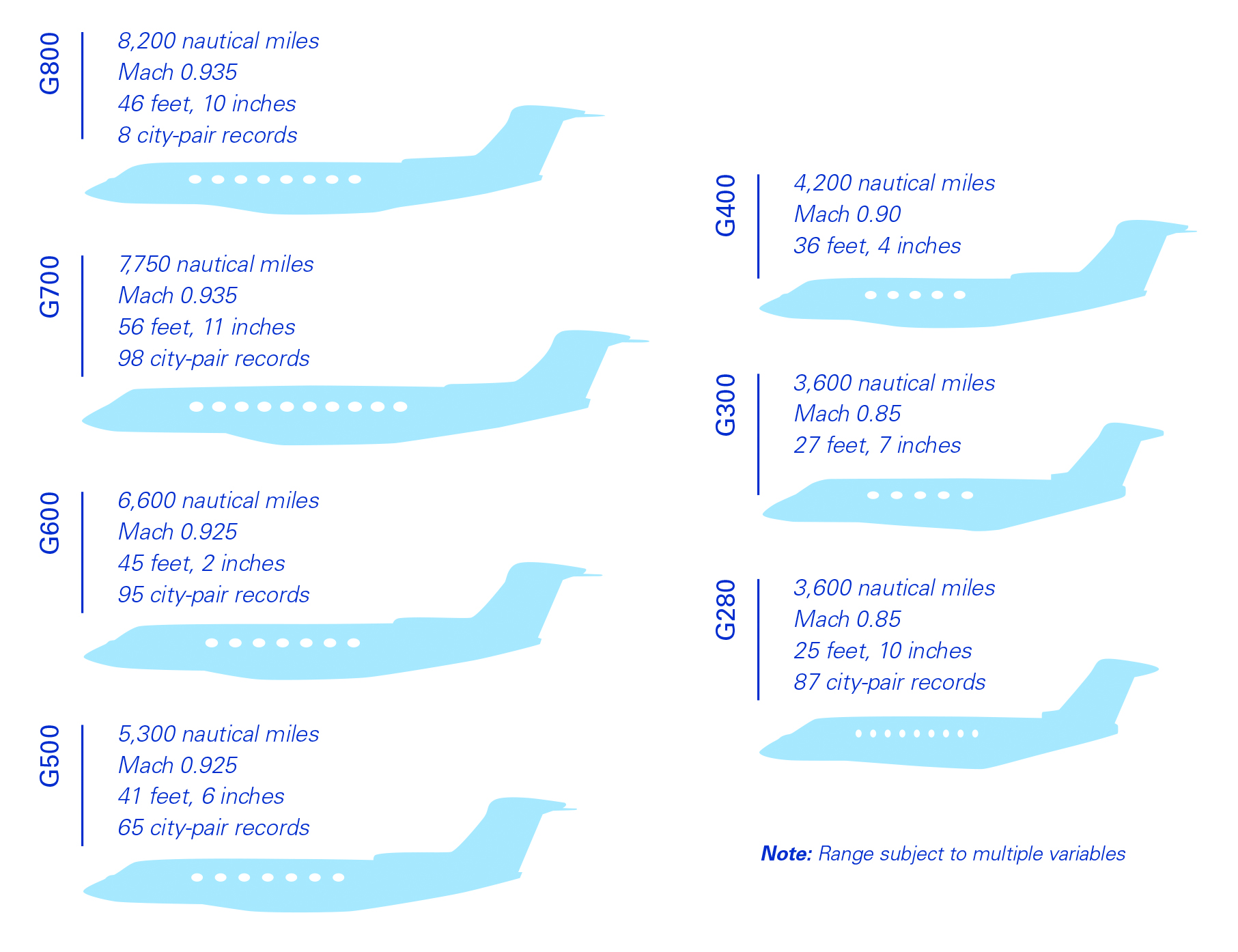
Gulfstream’s in-service aircraft hold more than 350 city-pair speed records, more than any other business jet manufacturer, including the National Aeronautic Association’s polar and westbound around-the-world speed records.
The most recent addition to the in-service Gulfstream fleet is the ultra-long-range, ultra-large-cabin G800, which entered service in 2025 following U.S. Federal Aviation Administration (FAA) certification in April 2025. The G800 is Gulfstream’s longest-range aircraft, offering an 8,200-nautical-
mile range at Mach 0.85. It replaces the G650 and G650ER, which currently operate in 55 countries with more than 595 aircraft of this family in service. The G800 features Gulfstream’s Symmetry Flight Deck—the industry’s most technologically advanced flight deck—industry-leading high-speed efficiency, and enhanced safety capabilities.
The ultra-long-range, ultra-large-cabin G700 entered service in 2024. It combines Gulfstream’s most spacious cabin with the advanced Symmetry Flight Deck, and the superior high-speed performance of all-new engines to deliver best-in-class capabilities.
The G500 and G600 entered service in 2018 and 2019, respectively. These clean-sheet aircraft replaced the G450 and G550 models, whose combined family has an installed base of more than 1,650 aircraft around the world. Our investment in the development of these aircraft included a new wing, new avionics, new fuselage and new ergonomically designed larger interiors, as well as systems and technologies to improve the manufacturing process and quality of the aircraft. As a result, the G500 and G600 are best in class in terms of speed, fuel efficiency, cabin volume, emissions, range and flight controls.
Gulfstream is currently developing the large-cabin G400 from a clean-sheet design developed in concert with the G500 and G600, expanding commonality across the Gulfstream family. The G400 will join a market segment in which Gulfstream has not participated for several decades, and completes a nearly two-decade effort to develop an all-new family of Gulfstream aircraft.
In the second half of 2025, we announced the all new, super midsize G300 as the latest aircraft to join our next-generation fleet. The aircraft will replace the G280 and feature signature Gulfstream Panoramic Windows as well as an all-new Harmony Flight Deck, which includes next-generation avionics to enhance safety and operational efficiency.
Our disciplined and consistent approach to new product development has allowed us to repeatedly introduce first-to-market capabilities that set industry standards for safety, performance, quality, speed and comfort. Product enhancement and development efforts include initiatives in advanced avionics, composites, flight-control and vision systems, acoustics, and cabin technologies.
Gulfstream designs, develops and manufactures aircraft in Savannah, Georgia, including all large-cabin models. The midsize aircraft are assembled by a non-U.S. partner. All models are outfitted in Gulfstream’s and Jet Aviation’s facilities. As Gulfstream’s aircraft portfolio and customer base have grown and become increasingly global in reach over the years, we have invested in our facilities and operations around the world. At our Savannah campus, we added new purpose-built manufacturing facilities, increased aircraft service capacity, opened a customer-support distribution center and expanded our R&D capabilities.
We offer comprehensive support for the more than 3,000 Gulfstream aircraft in service around the world and operate an extensive network of service centers. We continue to invest in maintenance, repair and overhaul (MRO) facilities, technologies to enhance service, and inventory to accommodate fleet growth. We also operate a 24/7 year-round customer support center and offer on-call Gulfstream aircraft technicians ready to deploy around the world for customer service requirements under our Field and Airborne Support Team (FAST) rapid-response unit.
In addition to expanding the reach of Gulfstream’s aircraft maintenance network outside the United States, Jet Aviation provides a comprehensive suite of innovative aircraft services for aircraft owners and operators around the world. Jet Aviation manages over 300 business aircraft globally on behalf of individuals and corporate owners. We operate a leading global fixed-base operator (FBO) network of
approximately 30 facilities on four continents and support all aircraft types with a full range of maintenance services, including 24/7 global aircraft-on-ground support. We also operate one of the world’s largest custom completion and refurbishment centers for both narrow- and wide-body aircraft and perform modifications, upgrades and lifecycle sustainment support for various government fleets. We continue to grow our global footprint through acquisitions, expansions and significant renovations in strategic business aviation markets most frequented by these customers. In 2025, Jet Aviation acquired an FBO at Paris - Le Bourget Airport, the busiest business aviation airport in Europe. This acquisition expands our global FBO network and our capabilities to meet customer needs. We also launched initial operations at our new FBO at Miami Opa Locka Executive Airport in Florida. The facility is expected to be fully operational in mid-2026.
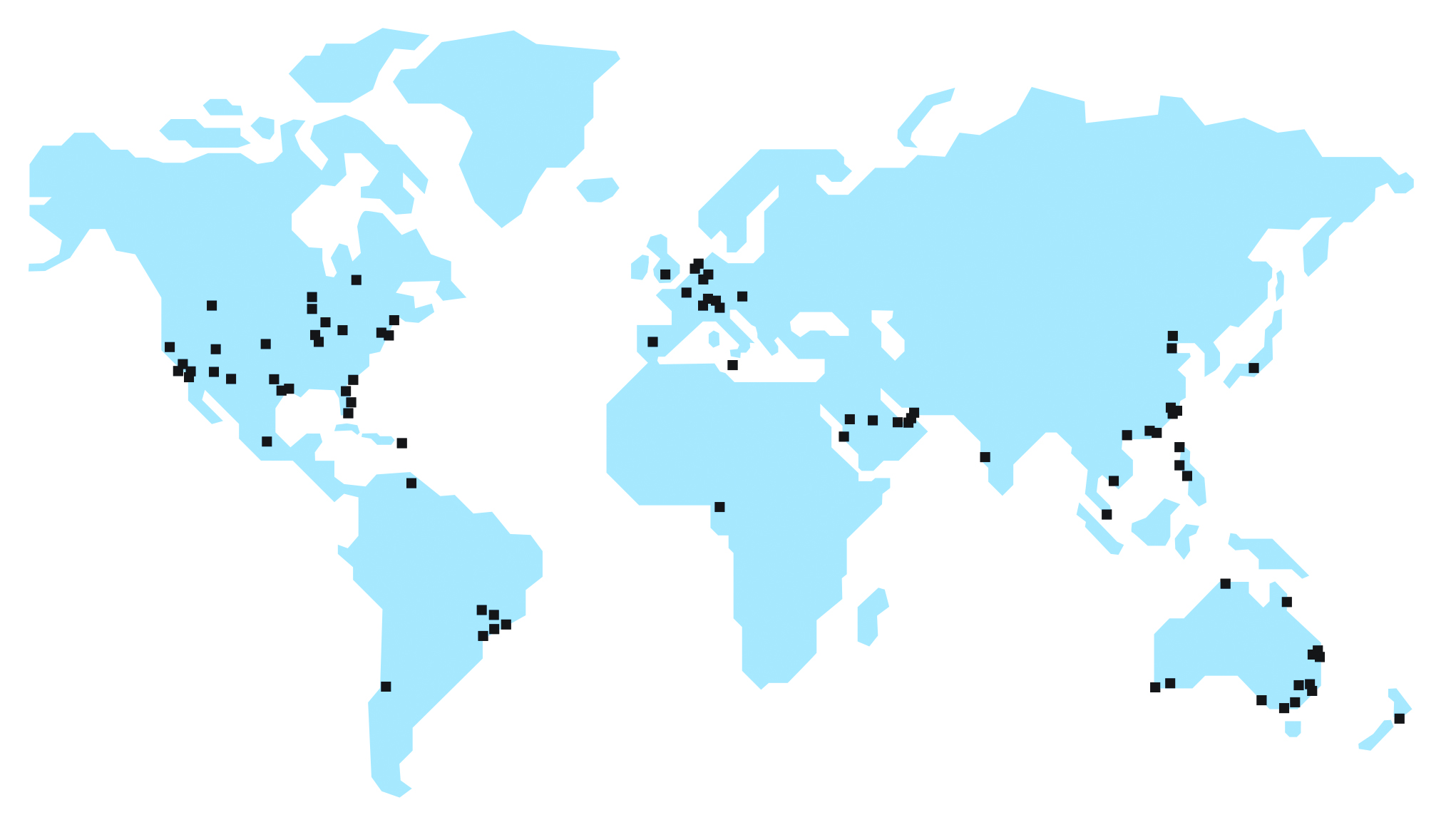
The following map displays the broad reach of our combined Gulfstream and Jet Aviation services network, including authorized service centers:
The Aerospace segment places a priority on sustainability throughout its manufacturing and service operations, producing aircraft that maximize fuel efficiency while offering customers options to reduce or eliminate their carbon footprints. Gulfstream and Jet Aviation have been at the forefront of the industry by adopting and expanding the availability of sustainable aviation fuel (SAF), which achieves as much as an 80% reduction in carbon dioxide emissions per gallon over its lifecycle compared to petroleum-based jet fuel. Gulfstream also offers operators the ability to achieve carbon-neutral travel by facilitating the purchase of carbon-offset credits. In addition to actively expanding the availability of SAF at its FBO locations, Jet Aviation allows customers to purchase SAF at locations where it is not available through a book-and-claim system. Since 2019, Jet Aviation has uploaded more than 12 million gallons of blended SAF to its customers.
Revenue for the Aerospace segment was 25% of our consolidated revenue in 2025, 24% in 2024 and 20% in 2023. Revenue by major products and services was as follows:
| Year Ended December 31 | 2025 | 2024 | 2023 | ||||||||||||||
| Aircraft manufacturing | $ | 9,413 | $ | 7,811 | $ | 5,710 | |||||||||||
| Aircraft services | 3,697 | 3,438 | 2,911 | ||||||||||||||
| Total Aerospace | $ | 13,110 | $ | 11,249 | $ | 8,621 | |||||||||||
MARINE SYSTEMS
Our Marine Systems segment is the leading designer and builder of nuclear-powered submarines and a leader in surface combatant and auxiliary ship design and construction for the U.S. Navy. We also provide maintenance, modernization and lifecycle support services for Navy ships and maintain the most sophisticated marine engineering expertise in the world to support future capabilities. Our ability to design, build and maintain our nation’s most technologically sophisticated warships is a critical element of the U.S. defense industrial base. In addition to Navy ships, we have designed and built ocean-going Jones Act ships for commercial customers. Marine Systems consists of three business units — Electric Boat, Bath Iron Works and NASSCO.
In support of our Navy customer’s significant increase in demand for submarines and surface ships, we have made substantial investments to expand our facilities, grow and train our workforce, and expand our supply chain. The resulting increase in capacity and capabilities will support the significant demand expected in our shipbuilding business, particularly submarines, over the next two decades.
Electric Boat is the prime contractor and lead shipyard on all Navy nuclear-powered submarine programs. The business is responsible for all aspects of design and engineering and leads the construction of both Columbia-class ballistic-missile submarines and Virginia-class attack submarines.
The Columbia-class ballistic-missile submarine is a 12-boat program considered one of the nation’s top acquisition priorities. Accordingly, the program has received the highest possible rating from the government’s Defense Priorities and Allocations System. These submarines will provide strategic deterrent capabilities for decades, with the first boat expected to deliver in 2028 to begin replacement of the current Ohio-class ballistic-missile submarine fleet as it reaches the end of its service life. Construction is scheduled to span two decades, and the value of the Navy’s program of record is in excess of $125 billion.
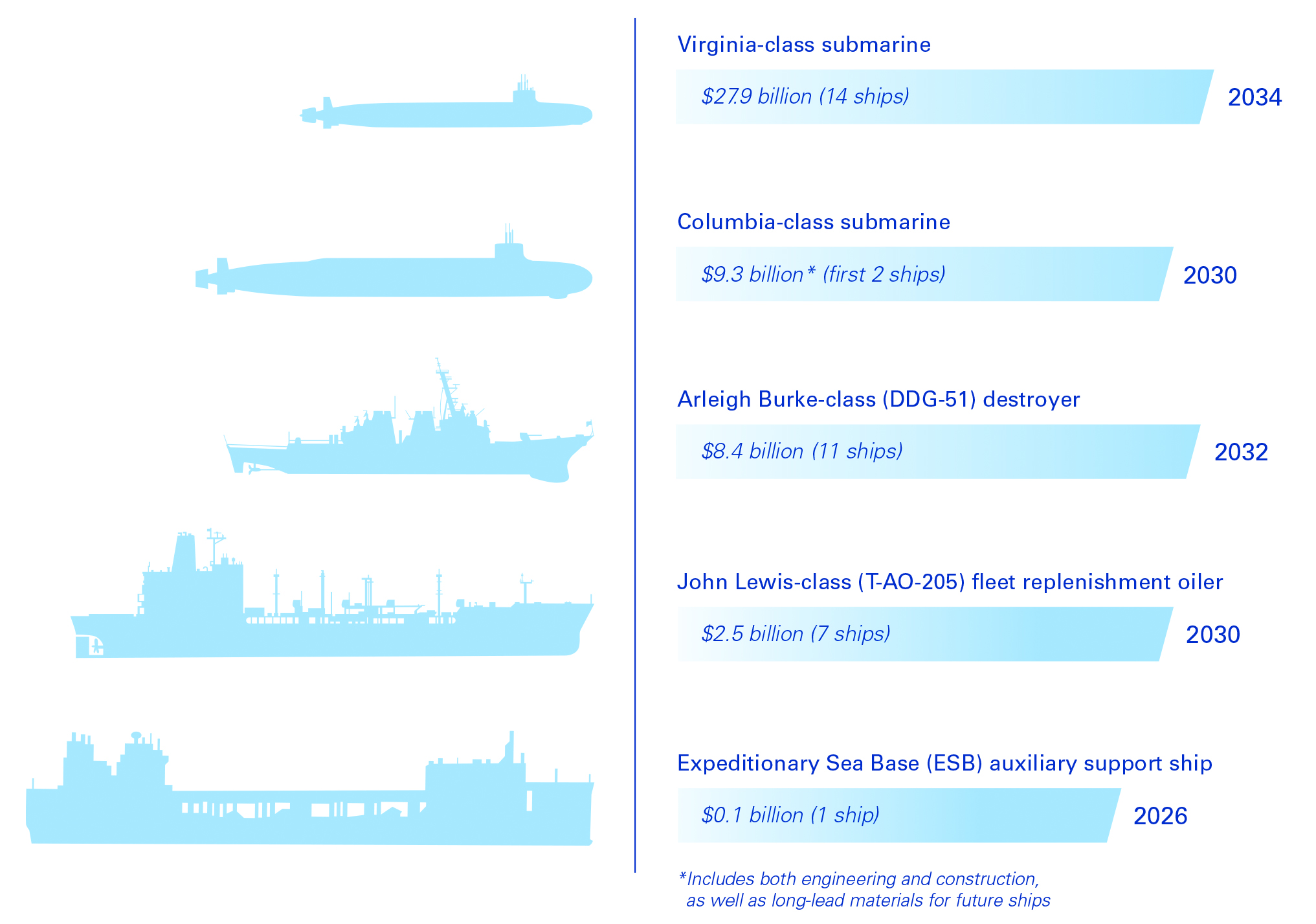
The Navy procures Virginia-class submarines in multi-boat blocks. Along with an industry partner, we are currently working on Blocks IV and V in the program, with 14 Virginia-class submarines in our backlog scheduled for delivery through 2034. Ten of the boats in Block V will include the Virginia Payload Module, an 84-foot Electric Boat-designed-and-built hull section that adds four additional payload tubes, more than tripling the strike capacity of these submarines and providing unique capabilities to support special missions.
We have invested significant capital over the past several years in expanded and modernized facilities at Electric Boat to support the growth in submarine construction and are working with our Navy customer on additional capacity to meet the increased demand for submarines. Consistent with our commitment to invest capital is our commitment to developing our Electric Boat workforce. We expect the Electric Boat workforce to continue to grow to enable sustained production of one Columbia-class submarine plus up to two Virginia-class submarines per year as the submarine industrial base expands to support that pace. Along with strong contributions from the states of Connecticut and Rhode Island, we invest in the training and tools necessary for our skilled employees to deliver these next-generation submarines to the Navy. We continue to develop and work with our growing network of approximately 3,000 suppliers to support the growth related to concurrent production of the two submarine programs.
Bath Iron Works (BIW) is one of two companies that builds the Arleigh Burke-class (DDG-51) guided-missile destroyer. The DDG-51 class of destroyer is a critical component of the Navy’s surface combatant fleet and represents the longest-running shipbuilding program in Navy history with the first ship procured in 1985. The DDG-51 class has maintained relevance with a series of upgrades and enhanced capabilities up to the current “Flight III” configuration. In 2025, we were competitively awarded construction of an additional DDG-51 destroyer (DDG-148), bringing our total backlog to 11 ships with scheduled deliveries through 2032. BIW is also a part of the core team working with the Navy to design the surface combatant of the future.
BIW also manages modernization and lifecycle support for both Arleigh Burke-class and Zumwalt-class (DDG-1000) destroyers. Within these programs, BIW provides engineering and logistics solutions to upgrade earlier versions of the DDG-51 to Flight III configuration, and to add Conventional Prompt Strike hypersonic missile strike capability to the DDG-1000.
NASSCO specializes in Navy auxiliary and support ships and is currently building the Expeditionary Sea Base (ESB), which serves as an afloat forward-staging base for U.S. Marines and special operations forces, and the John Lewis-class (T-AO-205) fleet replenishment oiler. Work on the final ESB in backlog will complete in 2026, while the seven T-AO-205 ships currently in backlog have deliveries planned into 2030. In 2025, NASSCO received an award for the eleventh and twelfth T-AO-205 ships. In addition to these projects, NASSCO has been awarded a contract to provide a preliminary design for the Navy’s Submarine Tender replacement program (AS(X)). Over the last two decades, NASSCO has partnered with a leading South Korean ship design and equipment procurement company, DSEC Co., Ltd, (DSEC), to design and build many large ocean-going commercial vessels including tankers and cargo ships to support U.S. Jones Act customers based on proven DSEC designs. In 2025, NASSCO, along with DSEC, signed a tri-party memorandum of agreement with Samsung Heavy Industries, one of the world’s leading shipbuilders, to explore future commercial and government opportunities.
On December 31, 2025, backlog for our major ship construction programs and the scheduled final delivery date of ships currently in backlog were as follows:
In addition to design and construction activities, our Marine Systems segment provides comprehensive post-delivery services to modernize and extend the service life of these and other Navy ships. NASSCO conducts full-service maintenance and surface-ship repair operations in Navy fleet concentration areas in San Diego, California; Norfolk, Virginia; Bremerton, Washington; and Mayport, Florida. Electric Boat provides submarine maintenance and modernization services in a variety of U.S. locations, and Bath Iron Works provides lifecycle support services for Navy surface ships in U.S. and overseas ports. In support of allied navies, we offer program management, planning, engineering and design support for submarine construction programs.
Revenue for the Marine Systems segment was 32% of our consolidated revenue in 2025, 30% in 2024 and 29% in 2023. Revenue by major products and services was as follows:
| Year Ended December 31 | 2025 | 2024 | 2023 | ||||||||||||||
| Nuclear-powered submarines | $ | 12,608 | $ | 10,392 | $ | 8,631 | |||||||||||
| Surface ships | 2,932 | 2,819 | 2,698 | ||||||||||||||
| Repair and other services | 1,183 | 1,132 | 1,132 | ||||||||||||||
| Total Marine Systems | $ | 16,723 | $ | 14,343 | $ | 12,461 | |||||||||||
COMBAT SYSTEMS
Our Combat Systems segment is a premier manufacturer and integrator of land combat solutions worldwide, including wheeled and tracked combat vehicles, weapon systems, energetics and munitions. The segment consists of three business units — Land Systems, European Land Systems (ELS), and Ordnance and Tactical Systems (OTS).
Combat Systems creates long-term value through operational excellence — high-quality, on-schedule and on-budget performance — combined with investments in innovative technologies that modernize existing platforms and develop next-generation capabilities to meet our customers’ rapidly evolving requirements. We maintain our market-leading position by focusing on innovation, affordability and speed to market to deliver increased survivability, mobility and lethality on the battlefield. Our large installed base of wheeled and tracked vehicles around the world and expertise gained from research, engineering and production programs position us well for modernization programs, support and sustainment services, and future development programs.
Across our portfolio we are investing in innovative new technologies to modernize legacy platforms and introduce all-new capabilities to ensure the ground forces of the United States and its allies maintain their superiority on the battlefield of the future. This includes partnering with commercial technology companies, developing future platforms with digital open-architecture frameworks, and modernizing our manufacturing capabilities to enable rapid, agile upgrading of systems to address emerging threats.
Land Systems is the sole-source producer of two foundational products central to the U.S. Army’s warfighting capabilities — the Abrams main battle tank and Stryker wheeled combat vehicle. Both platforms are core components of the multi-domain, joint war fight in practice today and envisioned on the battlefield of the future.
We continue to maximize the capability, effectiveness and lethality of the Abrams tank. We are currently working with the Army to develop the next generation M1E3 Abrams tank to significantly overmatch current and potential threats on the modern battlefield. The demand by NATO members and other allies and partners for procurement and upgrades of Abrams tanks remains strong, reflected by a growing installed base in Europe, the Middle East, North Africa and Indo-Pacific theaters of operation.
The Stryker is an eight-wheeled, medium-weight combat vehicle that combines lethality, mobility and survivability. Our most recently delivered innovations to this highly versatile platform include enhanced survivability, increased power, improved cross-country mobility and an advanced digital, in-vehicle network. With Stryker’s enabling capabilities, we continue to explore disruptive technologies with the Army for new uses of the vehicle. These include an air defense mission package, as found on the Sergeant Stout, a state-of-the-art electronic warfare suite, a high-energy laser, a high-power microwave and several Army command post options.
Our work on new ground combat vehicles is ongoing with two additional transformational vehicles in development. The XM30 program is a mechanized infantry combat vehicle program for the Army that will replace the M2 Bradley Infantry Fighting Vehicle. This optionally manned platform maneuvers soldiers to a point of positional advantage in close combat and delivers decisive lethality during combined arms engagements. The program is currently a Middle Tier Acquisition Rapid Prototyping with eight initial prototypes being delivered in 2026.
The Advanced Reconnaissance Vehicle (ARV) for the U.S. Marine Corps will provide sensors, communications systems and lethality options to overmatch threats that have historically been addressed by more heavily armored systems. The initial program includes three prototype variants: the Command, Control, Communications and Computers/Unmanned Aircraft Systems (C4/UAS), the ARV-30 with a 30mm auto cannon, and a Logistics variant. Three additional variants are planned over the program life. This program is expected to move to the engineering and manufacturing development phase in 2026 and reflects the evolution of the Marine Corps light armored vehicle (LAV) platform.
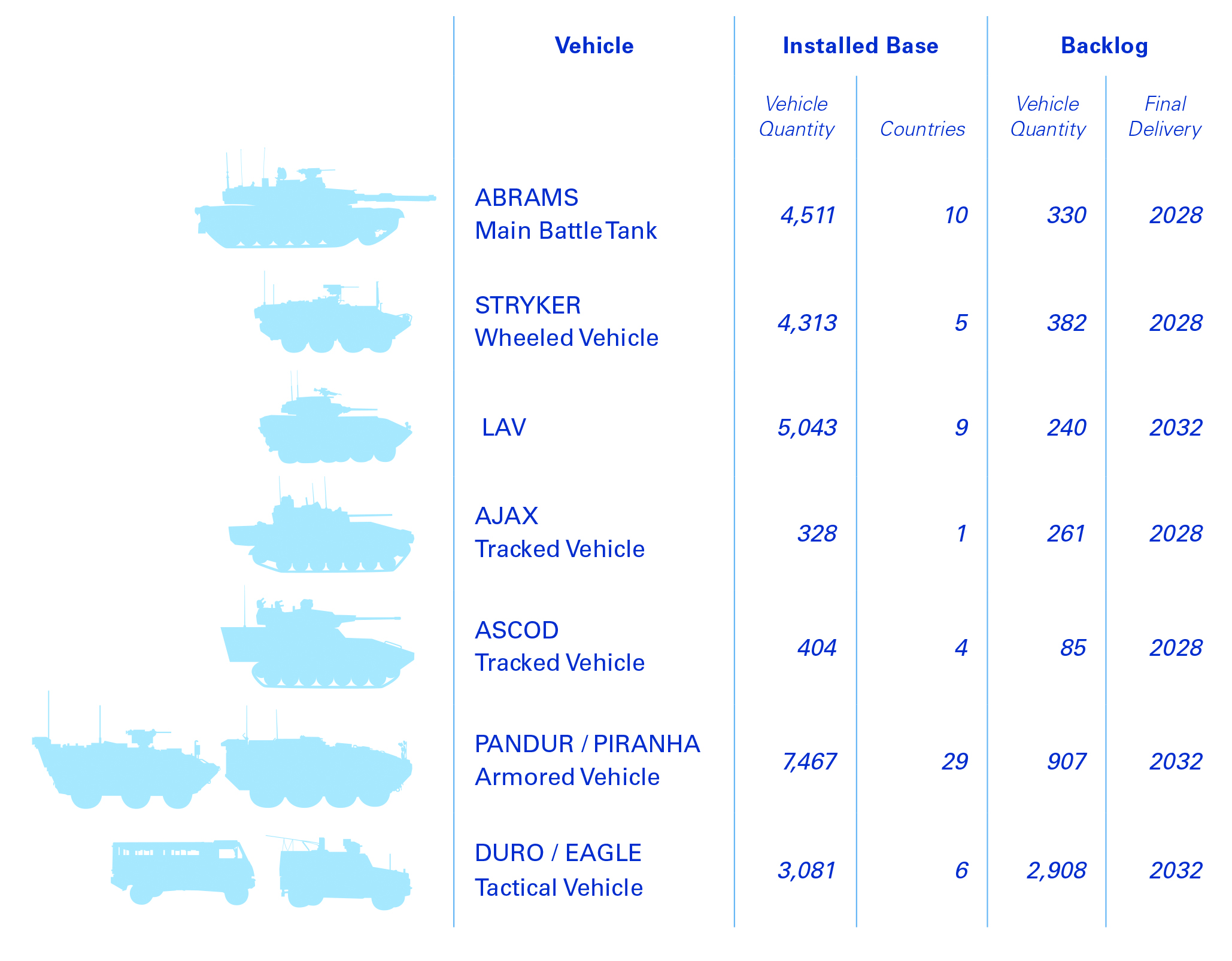
Combat Systems provides similar capabilities for U.S. allies and partners through export opportunities and through our longstanding operations in several countries around the world, including Canada, the United Kingdom, Spain, Switzerland, Austria, Germany and Romania. As a result, we have a market-leading position in LAVs with more than 12,000 of the high-mobility, versatile Pandur, Piranha and other LAVs in service worldwide.
Land Systems is producing 515 new LAVs for the Canadian army in nine variants, including ambulances, command posts, maintenance and recovery vehicles, and troop-carrying vehicles, as well as upgrading Canada’s existing fleet. Land Systems is also producing the British Army’s Ajax armored fighting vehicle, a next-generation, medium-weight tracked combat vehicle, the first fully digitized ground combat vehicle in the U.K. Armed Forces. With 589 vehicles comprising six variants, including a reconnaissance vehicle, an armored personnel carrier and various support platforms, the Ajax family of vehicles offers advanced electronic architecture and proven technology for a balance of survivability, lethality and mobility, along with high reliability for a vehicle in its weight class.
ELS is producing and upgrading Piranha vehicles, a premier 8x8 armored combat vehicle, around the world. We are currently providing the Piranha 5 family of vehicles for several countries, including Germany, Romania, Spain and Denmark. The Piranha family of vehicles is expanding through the addition of new versions including the Piranha 6x6 and Piranha 10x10. ELS is producing Luchs 2 reconnaissance vehicles for Germany based on the Piranha 6x6 platform and the Heavy Mission Carrier (HMC) self-propelled howitzer based on the 10x10 variant for Switzerland.
Additionally, we provide mobile bridge systems with payloads ranging from 100 kilograms to 100 tons to customers worldwide. We offer the ASCOD, a highly versatile tracked combat vehicle with multiple versions, including the Spanish Pizarro, Austrian Ulan and Latvian ASCOD Hunter. ELS also offers Duro and Eagle tactical vehicles in a range of options and weight classes and is currently producing these vehicles for Germany, Switzerland and Luxembourg, while providing a full range of product support for the German and Swiss Armed Forces.
On December 31, 2025, the installed base for our major vehicle programs, as well as the quantity and scheduled final delivery date of vehicles and vehicle upgrades in backlog were as follows:
Complementing our military-vehicle portfolio, OTS is a leading provider of capabilities across munitions, weapon systems, artillery, and energetics, with over 25 locations across the United States and Canada. Backed by decades of technical expertise and operational excellence, our broad footprint enables us to deliver capabilities at scale with efficiency and reliability. The breadth and depth of our portfolio allow us to support air, land, and sea domains with solutions that enhance lethality, readiness, and operational advantage for U.S. and allied forces.
We hold a global leadership position in large-caliber tank ammunition, medium-caliber ammunition, and high-speed Gatling guns, providing combat-proven performance and precision firepower. As an artillery systems integrator, OTS produces mission-critical components, including projectiles, artillery propelling charges, and next-generation artillery. We deliver world-class propellants for both direct- and indirect-fire munitions, and as the global leader in extruded propellant manufacturing and the world’s largest producer of the trusted Ball Powder propellant, we power a wide array of U.S. and allied military platforms. As a major component supplier for both tactical and strategic missile platforms, OTS offers concept-to-hardware capability to enhance precision lethality. We design, develop, and manufacture advanced subsystems including control actuators, high-performance warheads, rocket motor cases, solid rocket motors, and launch pod containers, ensuring superior performance across missile platforms.
To meet growing demand, OTS across multiple locations is expanding production capacity and capabilities, including artillery-projectile and propelling-charge load, assemble and pack lines; extruded propellant production; increased Ball Powder propellant capacity; and continued advancement in solid rocket motor production. These initiatives will strengthen supply chain resiliency and support the full lifecycle of critical defense systems.
Revenue for the Combat Systems segment was 17% of our consolidated revenue in 2025, 19% in 2024 and 20% in 2023. Revenue by major products and services was as follows:
| Year Ended December 31 | 2025 | 2024 | 2023 | ||||||||||||||
| Military vehicles | $ | 4,970 | $ | 5,101 | $ | 5,036 | |||||||||||
| Weapon systems and munitions | 3,104 | 2,932 | 2,442 | ||||||||||||||
| Engineering and other services | 1,172 | 964 | 790 | ||||||||||||||
| Total Combat Systems | $ | 9,246 | $ | 8,997 | $ | 8,268 | |||||||||||
TECHNOLOGIES
Our Technologies segment provides a full spectrum of services, technologies and products to a wide range of military, intelligence, federal civilian and state customers. The segment is organized into two business units — Information Technology (GDIT) and Mission Systems — with a diverse portfolio that includes:
•technology solutions and mission-support services and solutions;
•mobile communication, computers, command-and-control and cyber (C5) mission systems; and
•intelligence, surveillance and reconnaissance (ISR) solutions.
Over the past decade, the U.S. Department of War (DoW), the intelligence community and federal civilian agencies have increasingly prioritized technology solutions to drive operational efficiencies, advance security and accelerate mission-decision making in real time. Expanded geopolitical and cyber threats and the demand for advanced warfighter connectivity have accelerated these trends, adding urgency to required technology investments. The result is an increase in federal information technology (IT) modernization and technology spending in recent years and a shift to the rapid development of solutions to meet the ever-changing information-systems and mission-support needs of these customers.
GDIT and Mission Systems share a common defense, intelligence and federal civilian customer base and, when appropriate, go to market together. We make strategic investments in new and emerging technologies and partner with commercial companies to bring solutions to our customers that combine leading-edge technologies with an intimate knowledge of customers’ mission needs. The segment’s highly skilled workforce comprises approximately 40,000 employees, including technologists, engineers, mission experts and cleared personnel critical to solving the toughest security and technology challenges facing the United States and its allies.
GDIT provides technology solutions and expertise that underpin our national security systems, modernize government operations, and secure networks, data and information from sophisticated cyber attacks. Operating thousands of complex digital modernization programs across the federal government, GDIT’s expansive portfolio includes cloud services, cybersecurity, network modernization, artificial intelligence/machine learning (AI/ML), application development, high-performance computing, and 5G and advanced communications. At the center of these efforts is GDIT’s development of secure, tailorable and scalable digital solutions, known as our Digital Accelerators. These Digital Accelerators are at the forefront of technological trends and are designed to accelerate customers’ adoption and
integration of advanced technologies to meet unique mission needs. With technology evolving at an unprecedented pace, GDIT operates a national network of technology innovation labs that enable rapid development, testing and fielding of prototypes alongside commercial technology partners.
Mission Systems is a defense electronics manufacturer and integrator for Command, Control, Communications, Computers, Cyber, Intelligence, Surveillance and Reconnaissance (C5ISR) applications in all domains. Our products and solutions are built into platforms and integrated systems critical to our national security. The business’s portfolio includes both prime contract programs with government customers as well as subcontract positions with large platform providers to develop and integrate technologies to make their systems smarter and more secure.
The Technologies segment leverages its scale, partnerships and deep knowledge of its customers’ missions and challenges to bring innovation to those customers across a portfolio of thousands of contracts. While no individual contract is material to the segment’s results, the following highlights provide a sampling of the capabilities this business delivers.
In the defense market, GDIT is modernizing the U.S. Central Command’s (CENTCOM) enterprise IT infrastructure. CENTCOM’s area of responsibility covers 21 nations in Northeast Africa, Central and South Asia and the Middle East. We are utilizing AI/ML technologies to improve decision making, transition CENTCOM to a new cloud environment, and enhance the efficiency and effectiveness of its networks. GDIT is also leveraging its zero trust capabilities to bolster CENTCOM’s cyber defenses and protect against future cyber threats.
In the federal civilian market, GDIT is operating and modernizing the Healthcare Integrated General Ledger Accounting System (HIGLAS) for the Centers for Medicare and Medicaid Services (CMS). HIGLAS is a single, integrated accounting system that standardizes and centralizes federal financial accounting for all of CMS’s programs. The HIGLAS system processes approximately 4.5 million Medicare transactions daily and over $1.7 trillion in annual payments. In modernizing the HIGLAS system, GDIT is leveraging its AI/ML capabilities to analyze trends and patterns to determine potential anomalies in the data and detect fraud, waste and abuse.
Under the User Facing and Data Center Services (UDS) contract for the National Geospatial-Intelligence Agency (NGA), GDIT is providing hybrid cloud services, and innovative IT design, engineering, implementation and operations support services. We supported NGA in the development of their new headquarters in St. Louis, Missouri, which opened in late 2025, and are committed to supporting the St. Louis area as a strategic hub for the geospatial intelligence community through our innovation center, community partnerships and talent pipeline programs.
Mission Systems develops and manufactures high-assurance encryption products that are widely deployed to protect national security systems, data and networks against persistent threats. These Type 1 National Security Agency (NSA)-certified products and capabilities provide needed protection for classified voice, video and data in-transit or at-rest in all domains. Capabilities range from enterprise systems to embedded applications required for terrestrial, airborne or space environments.
We are working with our U.S. Army customer to adapt elements of advanced resilient radio frequency (RF) to address battlefield realities such as jamming, spoofing, cyberattacks and lack of ground connectivity. Given our deep product innovation experience, we were selected to build the Next Generation Survival radio for the U.S. Joint Forces. For the Canadian Army, we provide the Land Command, Control, Communications, Computers, Intelligence, Surveillance and Reconnaissance (C4ISR) system.
Mission Systems continues to advance our nation’s position in the space domain. The U.S. Space Development Agency (SDA) selected Mission Systems to establish the ground operations and integration segment for Tranches 1 and 2 of the National Defense Space Architecture by building ground entry points and operations centers, as well as providing network operations and systems integration services for the SDA’s proliferated Low Earth Orbit satellites. In addition, we provide critical subsystems for data processing and security of space assets across multiple space vehicle platforms.
In the maritime domain, we have a more than 60-year legacy of providing critical systems to the Navy’s submarine programs. These include advanced fire-control and weapon-launch systems; tactical control systems; specialized hardware and software solutions for acoustics, cybersecurity and torpedo guidance; and other core capabilities that are essential for submarine modernization for U.S. and allied forces.
Mission Systems also continues to invest in autonomous capabilities both undersea and in the air. Our Unmanned Undersea Vehicle (UUV) Manufacturing and Assembly Center of Excellence provides manufacturing, assembly, integration and testing capabilities for Mission Systems’ Bluefin Robotics UUVs, as well as the Hammerhead and MEDUSA programs for the Navy. In addition, we support a variety of manned aircraft and unmanned aerial vehicle (UAV) platforms with mission-critical processing and security subsystems on both modern combat and ISR aircraft as well as emerging capabilities like the Collaborative Combat Aircraft.
Revenue for the Technologies segment was 26% of our consolidated revenue in 2025, 27% in 2024 and 31% in 2023. Revenue by major products and services was as follows:
| Year Ended December 31 | 2025 | 2024 | 2023 | ||||||||||||||
| IT services | $ | 9,057 | $ | 8,761 | $ | 8,459 | |||||||||||
| C5ISR solutions | 4,414 | 4,366 | 4,463 | ||||||||||||||
| Total Technologies | $ | 13,471 | $ | 13,127 | $ | 12,922 | |||||||||||
CUSTOMERS
In 2025, 68% of our consolidated revenue was from the U.S. government, 15% was from U.S. commercial customers, 8% was from non-U.S. government customers and the remaining 9% was from non-U.S. commercial customers.
U.S. GOVERNMENT
Our primary customer is the DoW. We also contract with other U.S. government customers, including the intelligence community and other departments and agencies. Our revenue from the U.S. government was as follows:
| Year Ended December 31 | 2025 | 2024 | 2023 | ||||||||||||||
| DoW | $ | 29,788 | $ | 27,191 | $ | 24,720 | |||||||||||
| Non-DoW | 4,954 | 4,810 | 4,711 | ||||||||||||||
| Foreign military sales (FMS)* | 1,015 | 1,063 | 896 | ||||||||||||||
| Total U.S. government | $ | 35,757 | $ | 33,064 | $ | 30,327 | |||||||||||
| % of total revenue | 68 | % | 69 | % | 72 | % | |||||||||||
*In addition to our direct non-U.S. sales, we sell to non-U.S. governments through the FMS program. Under the FMS program, we contract with and are paid by the U.S. government, and the U.S. government assumes the risk of collection from the non-U.S. government customer.
Our U.S. government revenue is derived from fixed-price, cost-reimbursement and time-and-materials contracts. Our production contracts are primarily fixed-price. Under these contracts, we agree to perform a specific scope of work for a fixed amount. Contracts for research, engineering, repair and maintenance, and other services are typically cost-reimbursement or time-and-materials. Under cost-reimbursement contracts, the customer reimburses contract costs incurred and pays a fixed, incentive or award-based fee. The amount for an incentive or award fee is determined by our ability to achieve targets set in the contract, such as cost, quality, schedule and performance. Under time-and-materials contracts, the customer pays a fixed hourly rate for direct labor and generally reimburses us for the cost of materials.
Of our U.S. government revenue, fixed-price contracts accounted for 51% in 2025, 51% in 2024 and 53% in 2023; cost-reimbursement contracts accounted for 44% in 2025, 43% in 2024 and 41% in 2023; and time-and-materials contracts accounted for 5% in 2025, and 6% in 2024 and 2023.
U.S. COMMERCIAL
Our U.S. commercial revenue was $7.6 billion in 2025, $6.7 billion in 2024 and $5.8 billion in 2023, which represented 15% of our consolidated revenue in 2025, and 14% in 2024 and 2023. The majority of this revenue was for business jet aircraft and related services where our customer base consists of individuals and public and privately held companies across a wide range of industries.
NON-U.S.
Our revenue from non-U.S. government and commercial customers was $9.2 billion in 2025, $8 billion in 2024 and $6.1 billion in 2023, which represented 17% of our consolidated revenue in 2025, 17% in 2024 and 14% in 2023.
We conduct business with customers around the world. Our non-U.S. defense subsidiaries maintain long-term relationships with their customers and have established themselves as principal regional suppliers and employers, providing a broad portfolio of products and services.
Our non-U.S. commercial revenue consists primarily of business jet aircraft exports and worldwide aircraft services. While the installed base of aircraft is concentrated in North America, orders from
customers outside North America represent a significant portion of our aircraft business with approximately 38% of the Aerospace segment’s aircraft backlog on December 31, 2025.
COMPETITION
Several factors determine our ability to compete successfully in the defense and business aviation markets. While customers’ evaluation criteria vary, the principal competitive elements include:
•the technical excellence, reliability, safety and cost competitiveness of our products and services;
•our ability to innovate and develop new products and technologies that improve mission performance and adapt to dynamic threats;
•successful program execution and on-time delivery of complex, integrated systems;
•our global footprint and accessibility to customers;
•the reputation and customer confidence derived from past performance; and
•the successful management of customer relationships.
DEFENSE MARKET COMPETITION
The U.S. government contracts with numerous domestic and non-U.S. companies for products and services. We compete against other contractors as well as smaller companies that specialize in a particular technology or capability. Outside the United States, we compete with global defense contractors’ exports and the offerings of local, private and state-owned defense manufacturers. Our Marine Systems segment has one primary competitor with which it also partners on the Virginia-class submarine program, and to which it subcontracts on the Columbia-class submarine program. For commercial and repair work, the Marine Systems segment competes with several additional U.S. shipyards. Our Combat Systems segment competes with a large number of U.S. and non-U.S. businesses. Our Technologies segment competes with many companies, from large government contracting and commercial technology companies to small niche competitors with specialized technologies or expertise. The operating cycle of many of our major programs can result in sustained periods of program continuity when we perform successfully.
We are involved in teaming and subcontracting relationships with some of our competitors. Competitions for major defense and other government contracting programs often require companies to form teams to bring together a spectrum of capabilities to meet the customer’s requirements. Opportunities associated with these programs include roles overseeing and coordinating the efforts of all participants on a team, or as a provider of a specific component or subsystem.
BUSINESS JET AIRCRAFT MARKET COMPETITION
The Aerospace segment has several competitors for each of its Gulfstream products. Key competitive factors include aircraft safety, reliability and performance; comfort and in-flight productivity; service quality, global footprint and responsiveness; technological and new-product innovation; and price. We believe that Gulfstream competes effectively in all of these areas.
The Aerospace segment competes worldwide in the business jet aircraft services market primarily on the basis of quality, price and timeliness. While competition for each type of service varies somewhat, the segment faces a number of competitors of varying sizes for each of its offerings.
INTELLECTUAL PROPERTY
We develop specific technology, manufacturing processes and systems-integration intellectual property. In addition to owning a large portfolio of proprietary intellectual property, we license some intellectual property rights to and from others. The U.S. government holds licenses to many of our patents developed in the performance of U.S. government contracts, and it may use or authorize others to use the inventions covered by these patents. Although these intellectual property rights are important to the operation of our business, no existing patent, license or other intellectual property right is of such importance that its loss or termination would have a material impact on our business.
HUMAN CAPITAL MANAGEMENT
Our company is a global community of approximately 117,000 employees dedicated to our Ethos of transparency, trust, honesty and alignment. These four core values drive how we operate our business; govern how we interact with each other, our customers, partners and suppliers; guide the way that we treat our workforce; and determine how we connect with our communities. Our commitment to ethical business practices is outlined in our Standards of Business Ethics and Conduct, which states our expectation that all employees conduct business in accordance with our Ethos, applicable laws and our policies. Each employee is asked to acknowledge receipt, understanding of and compliance with our standards.
Due to the highly specialized nature of our business, we must hire and train skilled and qualified people to design and build the products and perform the services required by our customers. This includes upskilling employees to advance within the workplace. The health, welfare and safety of our employees is paramount throughout our workplaces. This effort starts with treating all employees with dignity and respect and providing them with fair, market-based, competitive and equitable compensation. We recognize and reward the performance of our employees in line with our pay-for-performance philosophy and provide a comprehensive suite of benefit options that aim to enable our employees and their dependents to live healthy and productive lives.
Across our businesses, we take measures to prevent workplace hazards, encourage healthy and safe behaviors and enforce a culture of continuous improvement to ensure that our processes help reduce safety incidents and illnesses and comply with applicable health and safety laws.
We recognize that our success as a company depends on our ability to attract, develop and retain qualified people. General Dynamics works hard to promote an environment where employees feel respected and empowered to contribute effectively. We are dedicated to workplaces that foster and support a principled, fair and productive environment. We stand for basic universal human rights, including that employment must be voluntary. We track, measure and analyze our workforce trends to establish accountability for putting people first across our businesses and at every level of our company.
Our values motivate us to promote strong workplace practices with opportunities for development and training. Our training and development efforts focus on ensuring that our people are appropriately trained on critical job skills as well as on leadership behaviors that are consistent with our Ethos. We conduct rigorous succession planning exercises to ensure that key positions have the appropriate level of bench strength to provide for future key positions and leadership transitions. We listen to our people to assess areas of concern and levels of engagement.
2025 WORKFORCE STATISTICS
•Approximately 84% of our employees are based in the United States, of which roughly 69% are white, 31% are people of color, 20% are veterans of the U.S. Armed Forces and 9% have self-reported having a disability. The remaining 16% of our workforce is based internationally in over 65 countries with the primary concentrations being in North America and Europe. Approximately 23% of our workforce is represented by collective bargaining agreements.
•Our global workforce is 77% male and 23% female, and our senior leadership teams across the business are represented by 76% males and 24% females. During 2025, we hired more than 18,700 individuals.
RAW MATERIALS AND SUPPLIERS
We depend on suppliers and subcontractors for raw materials, components and subsystems. Our U.S. government customer is a supplier for some of our programs. These supply networks can experience price fluctuations and capacity constraints, which can put pressure on our costs. Effective management and oversight of suppliers and subcontractors is an important element of our successful performance. If our sources of supply are disrupted, particularly in instances where we rely on only one or two sources of supply, or in the event that international conflicts result in the disruption of manufacturing or trade relations for some supply components, our ability to meet our customer commitments could be adversely impacted. We attempt to mitigate risks with our suppliers by entering into long-term agreements and leveraging company-wide agreements to achieve economies of scale and by negotiating flexible pricing terms in our customer contracts.
REGULATORY MATTERS
U.S. GOVERNMENT CONTRACTS
U.S. government contracts are subject to procurement laws and regulations. The Federal Acquisition Regulation (FAR) and the Cost Accounting Standards (CAS) govern the majority of our contracts. The FAR mandates uniform policies and procedures for U.S. government acquisitions and purchased services. Also, individual agencies can have acquisition regulations that provide implementing language for the FAR or that supplement the FAR. For example, the DoW implements the FAR through the Defense Federal Acquisition Regulation Supplement (DFARS). For all federal government entities, the FAR regulates the phases of any product or service acquisition, including:
•acquisition planning;
•competition requirements;
•contractor qualifications;
•protection of source selection and supplier information; and
•acquisition procedures.
In addition, the FAR addresses the allowability of our costs, while the CAS addresses the allocation of those costs to contracts. The FAR and CAS subject us to audits and other government reviews covering issues such as cost, performance, internal controls and accounting practices relating to our contracts.
NON-U.S. REGULATORY
Our non-U.S. operations are subject to the applicable government regulations and procurement policies and practices, as well as U.S. policies and regulations. We are also subject to regulations governing investments, exchange controls, repatriation of earnings and import-export control.
BUSINESS JET AIRCRAFT
The Aerospace segment is subject to FAA regulation in the United States and other similar aviation regulatory authorities internationally, including the Civil Aviation Administration of Israel (CAAI), the European Aviation Safety Agency (EASA) and the Civil Aviation Administration of China (CAAC). For an aircraft to be manufactured and sold, the model must receive a type certificate from the appropriate aviation authority, and each aircraft must receive a certificate of airworthiness. Aircraft outfitting and completions also require approval by the appropriate aviation authority, which is often accomplished through a supplemental type certificate. Aviation authorities can require changes to a specific aircraft or model type before granting approval. Maintenance facilities and charter operations must be licensed by aviation authorities as well.
ENVIRONMENTAL
We are subject to a variety of federal, state, local and foreign environmental laws and regulations. These laws and regulations cover the discharge, treatment, storage, disposal, investigation and remediation of materials, substances and wastes identified in the laws and regulations. We are directly or indirectly involved in environmental investigations or remediation at some of our current and former facilities and at third-party sites that we do not own but where we have been designated a potentially responsible party (PRP) by the U.S. Environmental Protection Agency or a state environmental agency. As a PRP, we are potentially liable to the government or third parties for the cost of remediating contamination. In cases where we have been designated a PRP, we generally seek to mitigate these environmental liabilities through available insurance coverage and by pursuing appropriate cost-recovery actions. In the unlikely event that we are required to fully fund the remediation of a site, the current statutory framework would allow us to pursue contributions from other PRPs. We regularly assess our compliance status and management of environmental matters.
Operating and maintenance costs associated with environmental compliance and management of contaminated sites are a normal, recurring part of our operations. Historically, these costs have not been material. In addition, we could be affected by future laws or regulations imposed in response to concerns over climate change, the timing and effect of which are difficult to assess.
Changes in environmental and climate change laws or regulations, including laws relating to greenhouse gas emissions, could lead to new or additional investment in product designs or facilities and could increase environmental compliance expenditures, including increased energy and raw materials costs. Environmental costs are often recoverable under our contracts with the U.S. government. Based on information currently available and current U.S. government policies relating to cost recovery, we do not expect continued compliance with environmental regulations, including costs associated with changes in environmental and climate change laws or regulations, to have a material impact on our results of operations, financial condition or cash flows.
AVAILABLE INFORMATION
We file reports and other information with the Securities and Exchange Commission (SEC) pursuant to Section 13(a) or 15(d) of the Securities Exchange Act of 1934, as amended (the Exchange Act). These reports and information include annual reports on Form 10-K, quarterly reports on Form 10-Q, current reports on Form 8-K and proxy statements. Free copies of these items, and any amendments to those items filed or furnished pursuant to Section 13(a) or 15(d) of the Exchange Act, are made available on our website (gd.com) as soon as practicable after we electronically file such items with, or furnish them to, the SEC. The SEC maintains a website (sec.gov) that contains reports, proxy and information statements, and other information.
In addition to the information contained in this Form 10-K, information about the company can be found on our website and our Investor Relations website (investorrelations.gd.com). Our Investor Relations website contains a significant amount of information about the company, including financial information, our corporate governance principles and practices, and other information for investors. We encourage investors to visit our website, as we frequently update and post new information about our company, and it is possible that this information could be deemed material information.
References to our website and the SEC’s website in this Form 10-K do not constitute, and should not be viewed as, incorporation by reference of the information contained on, or available through, the websites. The information should not be considered a part of this Form 10-K, unless otherwise expressly incorporated by reference.
| No annotations |
A subscription is required for the below company data including historic share prices, economic, EV bridge, WACC, customizable comparables and earnings forecasts.
Sign up today or log in to your account| 52 week | high $400.00 | low $306.77 |
| Download 5-year share price history | ||
| Economic Data | |
| Historic real GDP growth rate | ?? |
|---|---|
| Forecast real GDP growth rate | ?? |
| Historic inflation rate | ?? |
| Forecast inflation rate | ?? |
| SOFR | ?? |
| US 3 month Treasury Yield | ?? |
| Calculating WACC | ||
| Govt. bond yield* | ?? | |
|---|---|---|
| Eq. risk premium* | ?? | |
| Adj. beta | ?? | |
| Est. cost of equity | ||
| Unlevered beta | ?? | |
| Credit spread* | ?? | |
| Cost of debt | ||
| Credit rating (Moodys/S&P) | ?? | |
| Total debt / capitalization | ?? | |
| Total debt / mkt. cap. | ?? | |
| WACC | ||
| Earnings | |||||
|---|---|---|---|---|---|
| Date | ?? | ?? | ?? | ||
| Revenue ($M) | ?? | ?? | ?? | ||
| Growth | ?? | ?? | ?? | ||
| EBITDA ($m) | ?? | ?? | ?? | ||
| Margin | ?? | ?? | ?? | ||
| EPS ($) | ?? | ?? | ?? | ||
Market data by Finnhub | Earnings forecasts by Factset | Economic data from FRED |
Fundamental data by Financial Edge
Please notify us of any data inaccuracies. All critical data usage must be externally validated.
Please notify us of any data inaccuracies. All critical data usage must be externally validated.